

Scar Hair Transplant Your Guide to Restoring Hair on Scar Tissue
A scar hair transplant is a highly specialised procedure that involves strategically implanting hair follicles directly into scar tissue, coaxing new hair to grow where it otherwise couldn't. It’s a game-changer for people with scars from injuries, burns, or even previous surgeries like an old FUT hair transplant.
The main hurdle we face is that scar tissue has a reduced blood flow, which makes it a much tougher environment for new hair to survive and thrive compared to a healthy scalp.
Restoring Hair and Confidence on Scar Tissue
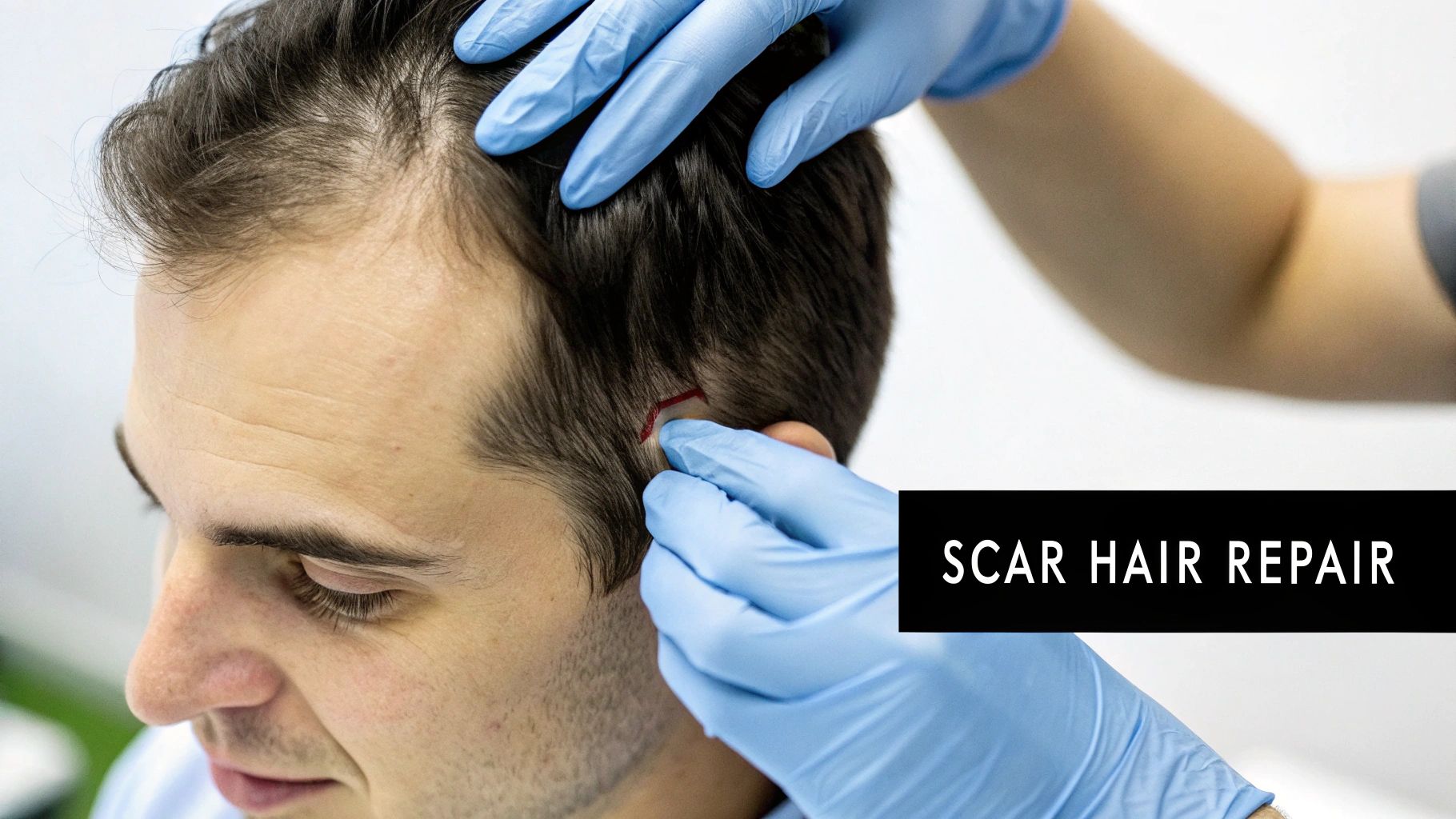
A visible scar can be a constant reminder of something you’d rather forget, whether it’s a past surgery or an accident. For many, it becomes a source of self-consciousness, something to be covered up every single day. A scar hair transplant offers a permanent way out by using your own hair to camouflage the area, blending it seamlessly into the rest of your scalp.
Think of it this way: a healthy scalp is like rich, fertile soil, full of nutrients and ready to support strong growth. Scar tissue, on the other hand, is more like compacted clay. It’s dense, less forgiving, and lacks the intricate network of blood vessels needed to nourish new life. This is the central challenge that a skilled surgeon needs to navigate.
Overcoming the Biological Hurdle
Successfully transplanting hair into a scar isn't just about placing follicles in the skin. The real art lies in ensuring those follicles get the blood supply they need to take root and flourish. This demands an incredible level of precision and a deep understanding of how scar tissue behaves differently from normal skin.
The process itself breaks down into two main steps:
- Harvesting: We start by carefully extracting healthy hair follicles from a stable donor area—usually the back or sides of your head, where hair is naturally more permanent.
- Implantation: Then, those follicles are meticulously implanted into the scar tissue one by one. The surgeon pays close attention to the angle and direction of each hair to mimic natural growth patterns and deliver a result that looks completely authentic.
Exploring the Primary Methods
For scar repair, Follicular Unit Extraction (FUE) is almost always the technique of choice. FUE involves extracting individual hair follicles, which means we avoid creating a new linear scar—something you definitely don't want when you're trying to hide an existing one. This pinpoint accuracy is what allows a surgeon to work effectively within the tough, less-vascular scar tissue.
Often, surgery is just one part of the solution. To get the absolute best aesthetic result, we sometimes combine the transplant with a non-surgical treatment. Scalp Micropigmentation (SMP) is a fantastic partner to a scar transplant. This specialised tattooing technique can create the illusion of greater density, perfectly complementing the new hair growth. Many people are now concealing scars with scalp tattoos to take their results to the next level.
A successful scar hair transplant is as much an art as it is a science. It demands a surgeon with deep expertise not only in hair restoration but also in dermatology and scar tissue physiology to maximise graft survival and achieve a seamless aesthetic outcome.
At the end of the day, this procedure is about so much more than just covering a blemish. It’s about reclaiming your appearance, boosting your self-esteem, and finally being able to move on from a past event without a daily physical reminder.
Why Transplanting Hair into Scar Tissue is a Different Ball Game
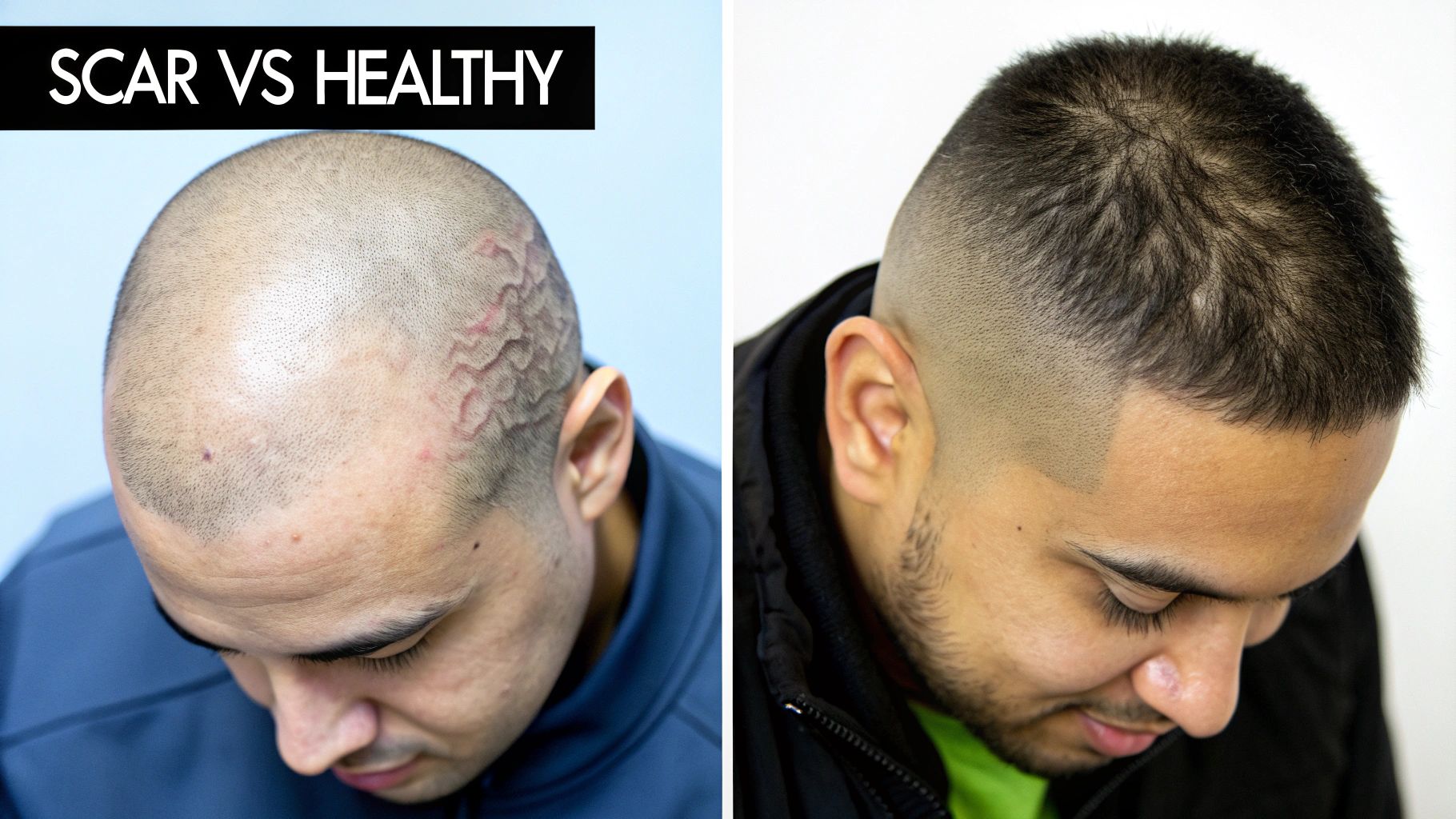
Successfully performing a scar hair transplant means working on a biological landscape that's worlds away from a healthy scalp. You can't just treat scar tissue like normal skin because, deep down, it’s playing by a completely different set of rules. This is exactly why the procedure demands a surgeon with genuine, specialised experience.
The core of the problem boils down to two things: fibrosis and reduced vascularity. When your body heals a wound, it throws down a patchwork of collagen fibres to seal the gap. But this quick repair job isn't neat and tidy. Instead of the organised, basket-weave pattern you find in healthy skin, scar tissue is a dense, jumbled, fibrous mess.
This dense, tough tissue is not only physically harder for a surgeon to work with, but the real challenge is what it's missing.
It's All About the Blood Supply
The single biggest hurdle for any scar hair transplant is the drastically reduced blood flow, or vascularity. Picture your healthy scalp as a bustling city, crisscrossed with a vast network of highways (blood vessels) that deliver oxygen and nutrients to every single hair follicle.
Scar tissue, on the other hand, is like an isolated outpost with only a couple of poorly maintained dirt roads leading to it. This lack of circulation means that newly transplanted follicles have a much tougher time connecting to the lifeline they need to survive and grow. It’s a bit like trying to plant a delicate sapling in dry, compacted soil and expecting it to flourish.
The success of a scar hair transplant hinges entirely on the health of the underlying blood supply. A surgeon's first job is to properly assess the scar's vascularity to figure out if a transplant is even viable and then plan a strategy that gives every single graft a fighting chance.
This biological reality means we can't just pack follicles into a scar as densely as we would on a healthy scalp. Trying to cram too many in would overwhelm the limited blood supply, and you’d risk most of the new grafts failing. It’s a delicate balancing act.
How the Scar Itself Shapes the Strategy
No two scars are the same. The unique character of your scar will dictate the surgical plan and, ultimately, what kind of result is possible. During a consultation, a specialist will meticulously evaluate several factors. To get a better grasp of this, understanding What Is Scarring Alopecia? provides crucial context, as it's a condition where scar tissue directly causes permanent hair loss.
Here’s what we look at:
- Scar Type: Is it a fine, linear scar from a previous FUT surgery? Or is it a wider, sunken (atrophic) scar from an old injury? Thick, raised scars (hypertrophic or keloid) are by far the most challenging due to their sheer density and poor blood flow.
- Scar Age: We can’t operate on a new scar. It needs to be fully mature—usually at least 12 months old—before we’d even consider a transplant. A younger scar is still in the process of healing and changing, making it an unstable foundation for new follicles.
- Thickness and Pliability: The thicker and tougher the scar, the harder it is to work with. In some cases, we might recommend pre-treatment therapies to help soften the tissue and improve blood flow before the actual surgery.
Reading these nuances is what makes all the difference. The surgeon has to be both a medical expert and an artist, understanding the unique story your scar tells to create a plan that works with its limitations to achieve the best possible cosmetic outcome.
Comparing FUE and FUT for Scar Restoration
When we talk about transplanting hair into scar tissue, the conversation almost always lands on two surgical methods: Follicular Unit Extraction (FUE) and Follicular Unit Transplantation (FUT). Both are staples in hair restoration, but for the delicate and challenging work of repairing scars, one has a clear advantage.
FUE is a highly detailed technique where a surgeon extracts individual hair follicles, one by one, from a healthy donor area—usually the back of the head. It’s like a miniaturist at work, carefully selecting and moving each piece. This precision leaves only tiny, dot-like marks that become virtually invisible once healed, which is a massive plus when the whole point is to hide a scar, not create a new one.
FUT, on the other hand, is often called the 'strip method' for a reason. It involves surgically removing a thin, linear strip of hair-bearing skin from the donor area. Technicians then dissect this strip under a microscope to harvest the individual follicular units for implantation. The big catch? This method always leaves a linear scar, which is often the very problem patients are trying to fix in the first place.
Why FUE Is the Go-To for Scars
For scar restoration, the meticulous nature of FUE gives it a serious edge. The micro-level approach means your surgeon can place each graft into the tough, less forgiving scar tissue without creating more trauma.
This is critical. Scar tissue has a compromised blood supply, so the less disruption, the better the chance each newly transplanted follicle has of taking root and growing.
FUE vs FUT for Scar Hair Transplants: A Comparison
To put it simply, while both techniques can place hair into a scar, their methods of harvesting that hair make a world of difference for the patient. Here’s a direct comparison of why FUE usually comes out on top for this specific job.
| Feature | Follicular Unit Extraction (FUE) | Follicular Unit Transplantation (FUT) |
|---|---|---|
| Harvesting Method | Individual follicles extracted one-by-one with a micro-punch. | A linear strip of scalp is surgically removed and dissected. |
| Donor Area Scarring | Leaves tiny, dot-like scars scattered across a wide area. | Creates a single, long linear scar at the donor site. |
| Suitability for Scars | Excellent. Minimal new scarring makes it ideal for aesthetic repair. | Less Ideal. The creation of a new linear scar can be counterproductive. |
| Placement Precision | High control over angle and density, crucial for blending. | Graft quality is high, but the donor scar is a major drawback. |
| Healing Time | Faster recovery in the donor area with less discomfort. | Longer recovery due to the incision and sutures. |
In the end, the primary goal of a scar hair transplant is to improve how an area looks without causing new cosmetic problems. FUE aligns perfectly with that goal by allowing for careful graft placement while keeping the donor area looking natural and virtually untouched.
Does FUT Still Have a Place?
While FUE is the frontrunner, FUT isn't completely ruled out. In certain situations—like needing a very large number of grafts to cover a massive scar—a surgeon might consider it. However, its major downside, that tell-tale linear scar, makes it a much less common choice for this specialised work. You can dive deeper into how different types of hair transplant scars are managed in our detailed guide.
Since 2020, Australian clinics have seen a huge increase in scar hair transplants, with over 10,000 surgeries performed by teams specialising in both FUE and FUT for scarred scalps. And while the International Society of Hair Restoration Surgery (ISHRS) correctly points out that no surgery is truly 'scarless', the incredibly minimal scarring from FUE is decisively shifting preferences. A recent trial even reported an 82% graft survival rate in scars pre-treated with lasers, boosting confidence in these modern techniques.
Ultimately, the right choice for you has to be made after a proper consultation with a specialist. They’ll be able to assess your unique scar, check your donor hair, and understand your goals to recommend the procedure that will give you the safest and best-looking result.
Using Combination Therapy for the Best Results
Getting a truly natural-looking result from a scar hair transplant often takes more than just the surgery itself. While transplanting hair is fantastic for adding real, three-dimensional texture, the end goal is always a seamless, undetectable blend. This is where a modern, multi-layered strategy really shines: combining surgical precision with an artistic, non-surgical touch.
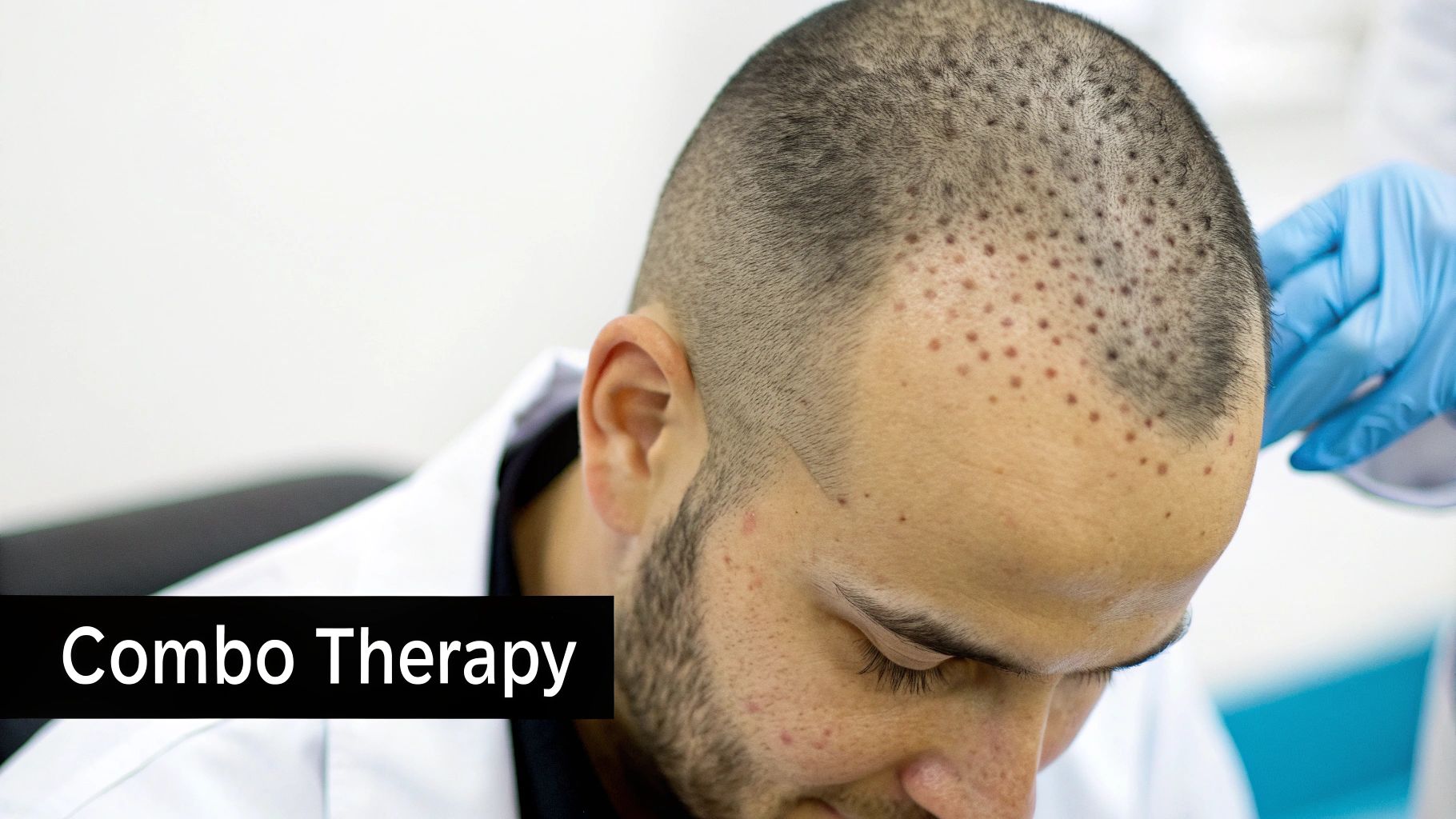
This dual approach pairs a hair transplant with Scalp Micropigmentation (SMP), which you might know as a "hair tattoo." When used together, they create the ultimate illusion of density and provide flawless camouflage, tackling the unique challenges that scar tissue throws at us.
How a Dual Approach Creates a Flawless Finish
Think of a hair transplant like planting new saplings in a thinned-out forest. It adds genuine volume and life. But even with the new trees, you might still see patches of pale ground showing through.
That’s where SMP comes in. It’s like a skilled artist adding soft shadows and depth to the forest floor, which makes the entire area look instantly fuller and more lush.
The transplant gives you the physical hair strands—something no other treatment can truly replicate. Then, once that new hair has had time to grow in, a trained SMP artist meticulously places tiny pigment deposits between the transplanted follicles. This process achieves a few critical things:
- It conceals discolouration: Scar tissue is often much lighter or pinker than the surrounding skin. SMP is brilliant at camouflaging this colour difference.
- It creates visual density: The pigment adds a subtle "shadow" effect, which drastically reduces the contrast between your hair and scalp, making your hair look much thicker.
- It perfects the blend: SMP can be used to soften the edges of the transplanted zone, making sure it merges perfectly with your existing hair for a truly natural finish.
This combination is a game-changer for people with general thinning, as it boosts the overall appearance of fullness across the entire scalp, not just within the scar itself.
By layering the real texture of transplanted hair over the subtle density created by SMP, we can achieve a level of realism that neither technique could accomplish alone. It’s about building a complete, multi-layered solution.
Optimising the Scar Tissue for Better Results
Sometimes, the scar tissue itself needs a bit of prep work to become more receptive "soil" for the new hair follicles. As part of a holistic approach, treatments like Microneedling can be used to improve the texture and blood supply of the scar. This helps to soften the dense, fibrous tissue and create a much healthier environment for the grafts to take hold and thrive.
Across Australia, the commitment to these advanced combination techniques is clear, contributing to a 90-95% patient satisfaction rate for scar hair transplants. This high level of success is driven by clinics that understand the power of integrating methods like SMP to perfect their outcomes. You can learn more about combining a hair tattoo with a hair transplant in our detailed guide. This strategy is also incredibly versatile, proving highly effective for women dealing with thinning hair and for men needing to camouflage scars in their beards.
Navigating Your Patient Journey Step by Step
Taking the leap into a scar hair transplant can feel like a big decision, but understanding the process from start to finish makes it much less intimidating. When you know what’s coming at each stage, you can focus on the incredible outcome ahead instead of worrying about the unknown.
Think of this as your roadmap—a clear guide that breaks down the entire experience, from your first chat with a specialist to the moment you see new hair pushing through.
Stage 1: The Initial Consultation
Your journey kicks off with a detailed consultation. Honestly, this is probably the most critical meeting you’ll have. It sets the foundation for your entire procedure and gives you a realistic picture of what a scar hair transplant can truly achieve for you.
During this appointment, your specialist will carefully assess your scar. They'll look at its size, where it is, how thick the tissue is, and how old it is. But most importantly, they’ll check its blood supply. This is the absolute key to determining how well new hair grafts will survive. It’s a bit like testing the soil quality before planting a garden—you need to know if the ground is fertile enough to support new life.
This is also your time to share what you’re hoping for. A great practitioner will listen intently before mapping out a personalised plan. They'll explain exactly how many grafts you'll need and what kind of density you can realistically expect.
Stage 2: Pre-Procedure Preparations
Once you and your surgeon have a solid plan, you’ll get a list of pre-operative instructions. Following these to the letter is crucial for getting the best possible result and ensuring a smooth, easy recovery.
Typically, these instructions will include things like:
- Avoiding certain medications: You’ll likely be asked to pause blood thinners, aspirin, and some supplements for about a week beforehand to keep bleeding to a minimum.
- Lifestyle tweaks: It’s a good idea to steer clear of alcohol and smoking for a few days leading up to the surgery, as both can slow down the healing process.
- Arranging for support: You'll be given a local anaesthetic, so you’ll need to organise a lift home once the procedure is done.
Stage 3: The Day of the Procedure
On the day of your transplant, you can expect a straightforward and surprisingly comfortable experience. The whole area is numbed with local anaesthesia, so while you might feel a little bit of pressure, you won’t feel any pain.
The procedure itself happens in two main parts. First, the surgeon will skilfully extract healthy hair follicles from your donor area, usually with the FUE technique. Then, they will meticulously implant these tiny grafts into the scar tissue, paying very close attention to the angle, direction, and density to make it look completely natural.
Stage 4: The Recovery and Growth Timeline
The final stage is all about healing and patience. Knowing what to expect during recovery helps you stay positive as you wait for your new hair to come in. The journey after the procedure has a few key milestones.
The first few days after surgery are the most critical for the grafts to survive. Following your aftercare instructions—like how to wash the area and when to avoid strenuous activity—gives those newly placed follicles the absolute best chance to take root and thrive.
Here’s a typical timeline of what you can expect:
- Immediate Post-Op (Days 1-10): A bit of mild swelling, redness, and scabbing is totally normal in both the donor and transplant areas. It’s just your body’s natural healing response.
- The Shedding Phase (Weeks 2-4): Don't panic if the transplanted hairs start to fall out! This is a completely normal part of the process called “shock loss.” The follicles themselves are safe and sound under the skin, just getting ready to grow new, strong hair.
- New Growth Begins (Months 3-6): This is when things get exciting. You’ll start to see the first fine hairs poking through the scar tissue.
- Visible Improvement (Months 6-12): The hair will keep growing longer and getting thicker, making a huge difference to the scar’s appearance. You’ll notice the density really starting to fill in during this time.
- Final Results (Months 12-18): Your results will continue to mature as the hair texture and density settle into their final, amazing look.
Here in Australia, the results we see from these procedures are incredibly encouraging. When scars are properly prepped, FUE success rates can reach up to 85% graft survival. Recovery is also quite manageable; most FUE patients are back to work in 2-5 days and can get back to exercise in about 3-4 weeks. This clear, predictable journey is what makes managing different types of hair transplant scarring such a rewarding and successful process for so many people.
Your Scar Hair Transplant Questions Answered
It’s only natural to have a lot of questions when you're considering a procedure like a scar hair transplant. Even after you've done your research, some specific concerns always pop up. We get it. This section is designed to give you straight, clear answers to the questions we hear most often, helping you feel confident about your next steps.
How Much Does a Scar Hair Transplant Cost in Australia?
There's no single price tag for a scar hair transplant in Australia. The final cost really comes down to the specifics of your scar—its size, location, and the level of work required to get good coverage. Most clinics will price the procedure based on the number of hair grafts needed.
As a general guide, you can expect to pay around $5.50 per graft, though this figure can shift depending on the clinic and city. For a smaller scar that might only need about 500 grafts, you could be looking at a cost of around $3,000. On the other end of the scale, for a larger, more complex area requiring 2,000 grafts or more, the investment could easily be $12,000 to over $15,000.
To give you a real-world example, a larger procedure in Perth needing 2,500 grafts might be quoted at roughly $15,000. The only way to get a firm number is to have a one-on-one consultation where a specialist can properly assess your scar and donor area. It's also worth asking about payment plans, as many reputable clinics offer them to help make the procedure more accessible.
Is a Hair Transplant on a Scar Painful?
This is easily one of the biggest worries people have, but the short answer is no, the procedure itself shouldn't be painful. Your surgeon uses a local anaesthetic to completely numb both the donor area (where the hair is taken from) and the scar tissue itself. You might feel a bit of pressure or a sensation of movement, but you won’t feel any pain during the actual implantation.
Once the anaesthetic wears off, you can expect some tenderness, mild swelling, and soreness in both the donor and recipient areas. This is completely normal. Most people describe it as a dull ache, not a sharp pain, and it’s usually very manageable. Your clinic will give you pain medication for the first few days to keep you comfortable, and the discomfort tends to fade quickly, especially with the less invasive FUE technique.
What Is the Success Rate for Hair Transplants into Scars?
Modern techniques have made transplanting into scar tissue a very reliable procedure, but the success rate can be a little lower than on a healthy, unscarred scalp. The main challenge is that scar tissue has a reduced blood supply, which is vital for new grafts to thrive. A skilled surgeon knows exactly how to navigate this.
In Australia, it's common for clinics to report graft survival rates of up to 85% in scar tissue. This success often depends on a proper assessment and, in some cases, pre-treating the scar to improve its condition. What’s even more telling is the patient satisfaction rate, which frequently tops 90%. A great result really boils down to three things:
- The surgeon’s expertise in working with delicate scar tissue.
- The condition of your scar—its age, thickness, and blood flow.
- How closely you follow the post-operative care instructions.
The journey from your first chat to seeing the final results follows a clear path.
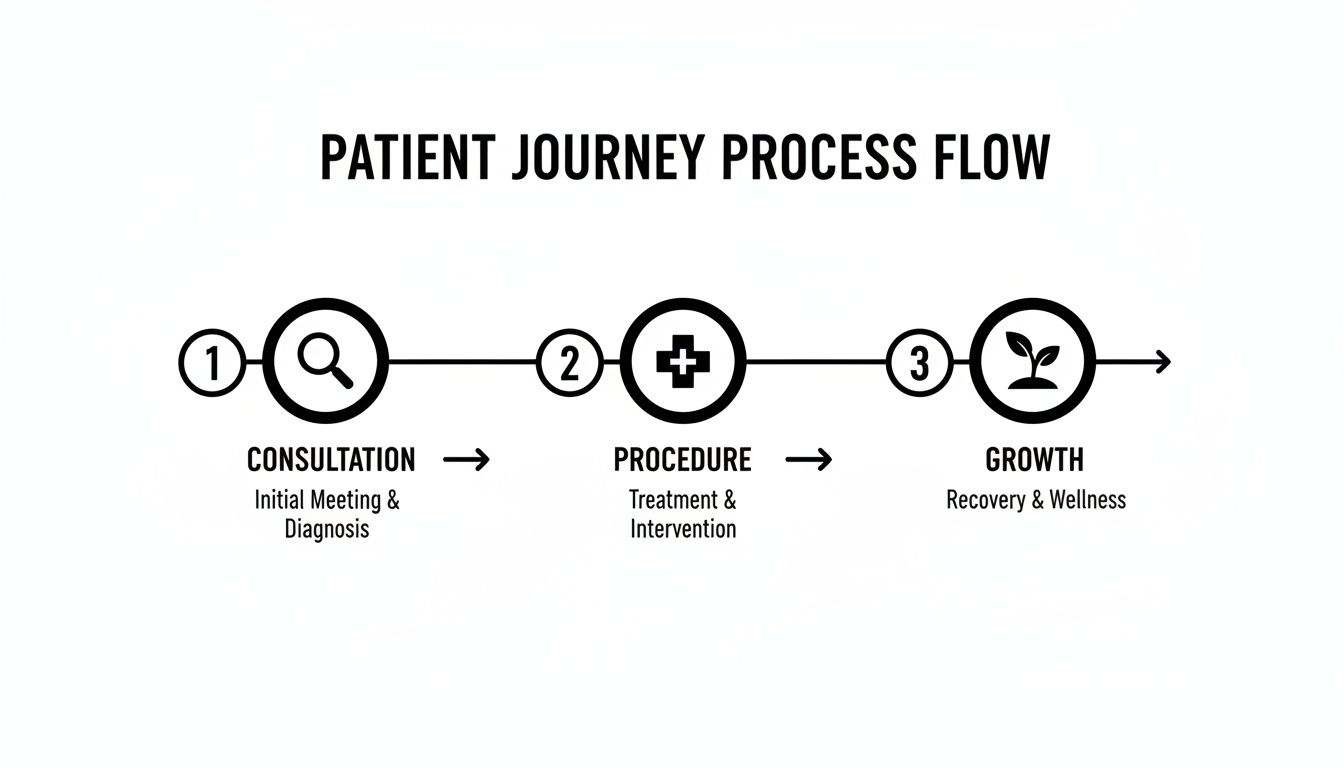
As you can see, a successful outcome is a team effort. It’s a partnership between the clinic’s skill during the procedure and your diligence during the all-important growth phase.
Am I a Good Candidate for This Procedure?
Working out if you're a good candidate is the crucial first step, and it's about more than just wanting to cover a scar. An ideal candidate will tick a few key boxes.
First off, you need to be in good general health to ensure your body can heal properly. Your scar also needs to be fully mature, which means it should be at least 12 months old. Trying to operate on a scar that’s still healing is a recipe for a poor outcome. The scar should also be relatively flat and stable, not a keloid or hypertrophic scar, as these types pose unique challenges.
The most vital factor for candidacy is having a sufficient and stable supply of healthy donor hair, usually located on the back or sides of your head. Without enough quality grafts to harvest, the procedure isn't feasible.
Finally, realistic expectations are key. A scar hair transplant can make a massive difference, but the final hair density might not be a perfect match to the surrounding, untouched scalp. This is exactly why a combined approach with Scalp Micropigmentation (SMP) is often recommended—it helps create the illusion of density for the most natural, seamless look. A proper consultation will confirm if this is the right path for you and what kind of results you can genuinely expect. You can learn more by exploring our detailed hair transplant recovery timeline to understand the full journey.