

A Guide to Hair Transplant Scarring Prevention and Care
Let's get one thing straight right from the start: any hair transplant procedure will leave a scar. There’s no getting around that. But the key thing to understand is that with today's advanced techniques, these scars can be so well-hidden they're practically invisible.
The real goal isn't to avoid scarring altogether, but to end up with scarring that no one but your barber would ever notice. How successful that is comes down to three things: the type of procedure you choose, the skill of your surgeon, and how seriously you take your aftercare.
Understanding Hair Transplant Scars
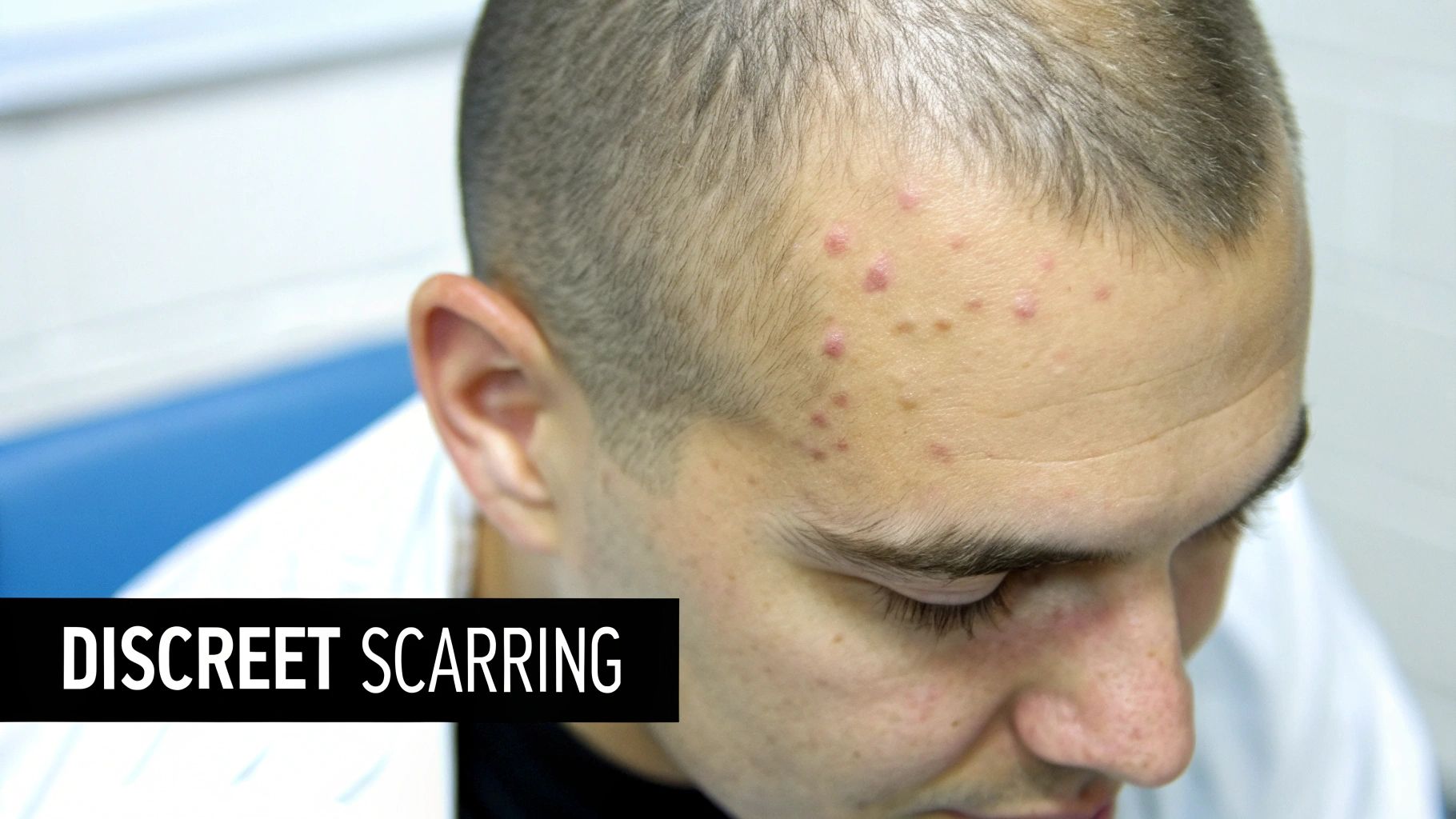
The word "scarring" is enough to make anyone second-guess a hair transplant. But what we're talking about here isn't what most people picture.
Think of it this way: old-school road repairs used to leave a big, ugly, lumpy patch of bitumen. You could spot it from a mile away. Modern roadworks, on the other hand, are designed to blend right in, making the surface look smooth and uniform again. Hair restoration has gone through the exact same evolution.
The conversation has shifted from worrying about obvious marks to creating a result you can feel great about. The focus is now on making any scarring so minimal that it doesn't limit your hairstyle or knock your confidence.
The Two Main Types of Scars
The kind of scar you'll end up with depends entirely on the surgical method used. Each technique leaves its own signature, so knowing the difference is crucial for making the right choice for you.
There are two main procedures, and they create very different types of marks:
-
Follicular Unit Transplantation (FUT): You might have heard this called the "strip method." The surgeon removes a thin strip of scalp from the back of your head (the donor area). This leaves a single, fine linear scar that’s easily hidden by the surrounding hair, as long as you don't wear it super short.
-
Follicular Unit Extraction (FUE): This is a more modern technique where individual hair follicles are removed one by one. Instead of a line, you get tiny, dot-like scars scattered over a much wider area of the scalp.
No matter which method is used, the final visibility of any scar—be it a line or a series of dots—boils down to the surgeon’s skill, your body’s natural healing ability, and how well you stick to the aftercare plan.
Ultimately, deciding on a procedure comes down to your personal goals, how you like to wear your hair, and what kind of scarring you’re more comfortable with. If you're weighing up the different options, you can find out more about how hair implants leave scars in our detailed article. This is the perfect starting point for understanding how to prevent and conceal scars to get the best possible, natural-looking result.
Comparing FUT Linear Scars and FUE Dot Scars
When you’re considering a hair transplant, one of the biggest questions is about the scarring. Let's be honest, it's a major factor. The two main techniques, FUT and FUE, leave behind very different types of scars. Think of it like a gardener taking cuttings: one method involves snipping off a whole branch, while the other is like carefully picking individual leaves. How the garden looks afterwards depends entirely on that approach.
The FUT method, often called the "strip" method, is the more traditional technique. It involves surgically removing a thin strip of scalp from the donor area—usually the back of your head. This leaves a single, linear scar.
On the other hand, the FUE technique is all about individual extractions. A specialised tool is used to punch out each hair follicle one by one. This avoids the long incision, instead leaving a scattered pattern of tiny, circular "dot" scars across a much wider area. This fundamental difference in harvesting the hair grafts directly impacts how visible the scarring will be and what hairstyles you can confidently rock down the track.
The FUT Linear Scar Explained
With an FUT procedure, the surgeon stitches the scalp back together after the donor strip is removed, which results in that fine-line scar. How noticeable it is really comes down to a few things: the surgeon's skill, how much tissue was removed, and your body's own unique way of healing.
A huge leap forward in minimising these scars is a technique called trichophytic closure. This is a genuinely clever surgical method that allows hair to grow right through the scar tissue. The surgeon meticulously trims one edge of the incision, which encourages the surrounding hair follicles to push through the scar as it heals. This provides a natural camouflage, making the FUT scar incredibly hard to spot unless you shave your head right down.
FUT is often the go-to for patients who need a massive number of grafts in one sitting. It works best if you plan on keeping your hair a bit longer at the back and sides, as this easily hides the scar line.
The FUE Polka-Dot Scar Pattern
FUE leaves behind what you could describe as a smattering of tiny, faint polka-dots. Because every follicle is removed individually, the scarring is spread out instead of being concentrated in one line. These little circular marks are typically less than a millimetre across.
The real win here is that there’s no single, obvious line to worry about. This makes FUE a fantastic choice for guys who love very short hairstyles, like a buzz cut or a fade, as the dot scars tend to just blend into the stubble. You can get a deeper understanding of how these procedures interact with other solutions by reading our guide on FUE hair transplants and scalp micropigmentation.
It’s not without its own considerations, though. If a surgeon gets overzealous and harvests too many grafts from one area, it can create a "moth-eaten" or noticeably thinned-out look. That's why choosing an experienced practitioner is non-negotiable.
Here in Australia, lifestyle often dictates the choice. Hair restoration experts I've spoken with mention that while FUT delivers a high yield of healthy follicles, the linear scar is a concern for up to 20% of patients who later look for ways to hide it. This is especially true for those of us with an active, outdoor lifestyle who prefer a short, no-fuss haircut. As a result, FUE has really grown in popularity for its barely-there dot scars and quicker healing time.
To make things clearer, let's break down the key differences between the two.
Comparing FUT and FUE Hair Transplant Scars
This table gives you a straightforward, side-by-side look at what to expect from each type of scarring, helping you weigh up the pros and cons for your own situation.
| Feature | FUT (Follicular Unit Transplantation) | FUE (Follicular Unit Extraction) |
|---|---|---|
| Scar Pattern | A single, long linear scar in the donor area. | Multiple small, round dot scars across the donor area. |
| Visibility | Easily concealed with hair longer than a #2 guard. May be visible with very short or shaved styles. | Very difficult to detect, even with short buzz cuts. Can create a thinned look if over-harvested. |
| Hairstyle Limitations | Not ideal for those who wear or plan to wear very short "fade" or shaved hairstyles. | Excellent for all hairstyles, including very short cuts, offering maximum flexibility. |
| Healing Process | Requires stitches or staples, involves a longer recovery period with more initial discomfort. | No stitches needed. Wounds heal within a week, with less discomfort and a quicker return to activities. |
Ultimately, understanding these scarring patterns is crucial. It's not just about the transplant itself, but about how you'll live with the results for years to come.
Your Scar Healing and Recovery Timeline
Knowing what to expect after your hair transplant can make all the difference. Healing doesn’t happen overnight; it’s a journey as your body works to repair both the donor area and the newly implanted grafts. Let's walk through a typical timeline so you know what’s normal and what to look out for when it comes to scarring.
Right after the procedure, you'll see some redness, a bit of swelling, and tiny scabs forming around each incision. This is all part of the body's natural response. These scabs act like little protective caps and will usually flake off by themselves within 7 to 14 days.
The First Few Months
Over the first month, the redness will gradually fade, and any tenderness should start to disappear as your scalp begins the real work of tissue repair. It’s also during this time that you might experience "shock loss"—the temporary shedding of the transplanted hairs. It can be alarming, but don't panic! It’s a completely normal phase before new, permanent hairs start to grow in their place.
By the time you reach months two and three, the scar tissue itself starts to mature. If you had an FUT procedure, the linear scar will soften and fade from pink to a much paler shade. For FUE, the tiny dot-like scars become far less obvious as the pigmentation settles down. Sticking to a gentle aftercare routine is absolutely crucial here to get the best possible result.
We cover this in more detail in our week-by-week guide to hair transplant recovery.
The visual below really helps to show the different healing journeys for FUT and FUE scarring.
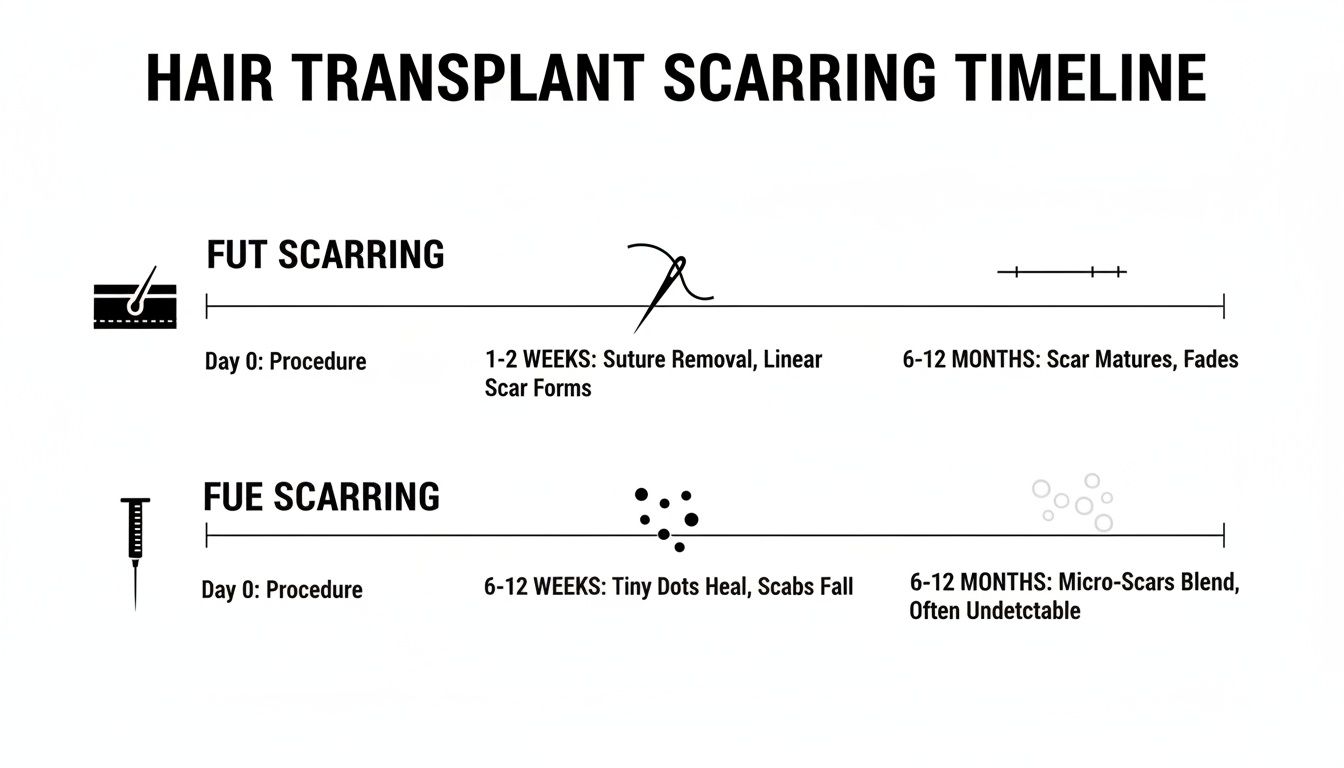
As you can see, the FUT scar settles into a single, fine line, while the FUE scars fade into small, spread-out dots that are much easier to conceal.
Long-Term Maturation and Abnormal Healing
From six months up to a year—and sometimes longer—the scar tissue continues to remodel itself. It will get flatter, softer, and blend in more closely with your natural skin tone. The final look of your scar is generally set by the 12- to 18-month mark. The biggest takeaway here is to be patient. Your body needs that time to do its thing.
Of course, while most people heal just fine, it’s good to know the signs of abnormal scarring, just in case.
- Hypertrophic Scars: These are raised, reddish scars that form but don't grow beyond the original incision line. They happen when the body gets a bit overzealous and produces too much collagen.
- Keloid Scars: Much rarer and more aggressive, keloids actually grow beyond the boundaries of the original wound. They are more common in people with a genetic predisposition, especially those with darker skin.
If you ever notice a scar becoming unusually itchy, raised, or spreading outwards well after the initial healing is done, get in touch with your surgeon straight away. Catching these issues early is the key to managing them effectively.
For those curious about the science of recovery, looking into a new frontier like peptides for healing and recovery can provide some fascinating insights into how the body repairs itself. By understanding the whole timeline, you can give your body the support it needs and get the clean, discreet result you’re after.
Here is the rewritten section, designed to sound completely human-written and natural.
Proactive Strategies to Minimise Scarring
Getting a scar that’s barely noticeable isn't just about getting lucky. It comes down to a solid partnership between a skilled surgeon and a patient who's committed to the process. While you can't change your genetics, you absolutely can take powerful steps to tip the odds in your favour, starting long before you even set foot in the clinic.
Honestly, the single most important decision you'll make is choosing your surgeon. A truly experienced specialist does more than just move hair follicles around; they understand the fine art of wound closure. They know precisely how to minimise tension on an incision, align the wound edges perfectly, and use advanced techniques like the trichophytic closure for FUT procedures. This level of expertise has a direct, massive impact on how your hair transplant scarring will ultimately look.
The Surgeon's Role in Scar Prevention
A top-tier surgeon will start by assessing your scalp laxity—basically, how loose or tight your skin is—to map out the best plan of attack. For an FUT procedure, this is critical. It ensures they can remove the donor strip without putting a heap of strain on the surrounding skin, which is a classic culprit behind those wide, stretched-out scars.
When it comes to FUE, their skill prevents over-harvesting. A careful surgeon will spread the extractions out evenly, sidestepping that "moth-eaten" appearance and protecting the health of your donor area for the long haul. A good tip? Always ask to see before-and-after photos of their patients' healed donor areas, not just the new hairline.
Your surgeon's technique lays the groundwork for a great result. A meticulous closure is all about creating a scar so fine and flat that it becomes a mere footnote to your successful hair restoration.
Your Aftercare Playbook for Minimal Scarring
Once the procedure is done, the baton is passed to you. What you do in the days and weeks after your surgery is absolutely crucial for healing well and avoiding complications that could make scarring worse.
Think of your scalp like a delicate garden that needs a bit of TLC. Here’s your playbook for getting it back to its best:
-
Gentle Cleaning is Non-Negotiable: Your clinic will give you specific instructions, but the golden rule is to be incredibly gentle. Use the shampoo they recommend and only lightly dab or pat the area dry. Absolutely no rubbing or scratching. This can dislodge the new grafts and irritate the healing tissue.
-
Avoid Sun Exposure at All Costs: UV rays are a scar's worst enemy, full stop. Sun exposure can lead to hyperpigmentation, which permanently darkens the scar tissue and makes it stand out a lot more. For the first few months, wear a loose-fitting hat whenever you head outside.
-
Introduce Healing Aids at the Right Time: Once your surgeon gives you the all-clear, you can start using treatments to support the healing. Silicone gels or sheets are proven winners; they help hydrate the scar tissue, keeping it soft and flat as it matures.
Lifestyle Choices That Fuel Good Healing
What you put into your body has a direct impact on how your skin repairs itself. Healing is hard work, and your body needs the right fuel to do it properly.
-
Nutrition and Hydration: To build new tissue, your body is crying out for protein, vitamins (especially C and A), and zinc. Focus on a balanced diet with plenty of lean proteins, fruits, and veggies. And of course, staying well-hydrated is key for healthy skin function.
-
Avoid Smoking and Excessive Alcohol: Smoking is especially bad for healing. It constricts your blood vessels, effectively starving the skin of the oxygen and nutrients it desperately needs to repair itself. Alcohol can dehydrate you and also interfere with the whole process.
By sticking to these steps, you’re creating the best possible environment for your body to heal cleanly. This hands-on approach is your best bet for ensuring any hair transplant scarring is as fine and discreet as modern medicine can make it.
How to Conceal and Correct Existing Scars
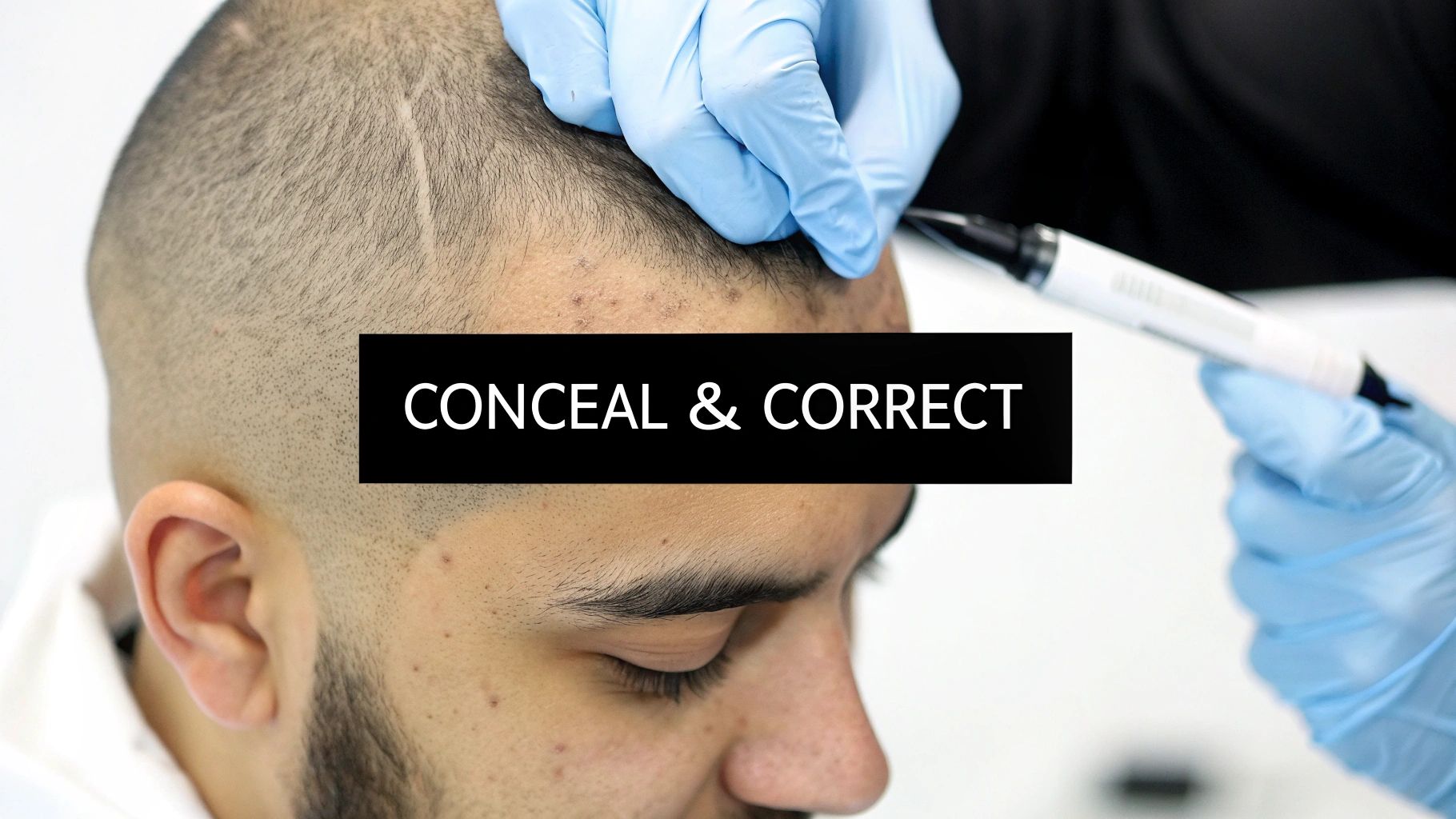
If you're dealing with a visible scar from an old hair transplant, it can feel like a constant, frustrating reminder. The good news is you're not stuck with it. Modern techniques offer fantastic ways to either hide or surgically improve old scars, helping you finally achieve the seamless look you wanted.
For most people, the goal was never just about getting hair back; it was about regaining a natural-looking head of hair without any tell-tale signs. This is especially true if you’re left with scarring from an older, less refined surgery. In fact, a huge part of the hair restoration industry here in Australia is now focused on this exact kind of remedial work.
Some clinics report that corrective procedures make up around 15% of their total work, often dealing with those classic linear scars from outdated FUT methods. This just goes to show how many people are looking for better solutions. Thankfully, whether you're after a non-surgical cover-up or a permanent surgical fix, there are some powerful options on the table.
Non-Surgical Camouflage: The Power of SMP
When it comes to non-surgically concealing hair transplant scars, one solution stands head and shoulders above the rest: Scalp Micropigmentation (SMP). You can think of it as a highly sophisticated cosmetic tattoo designed specifically to hide scar tissue on the scalp.
A skilled SMP artist uses a microneedle and specialised pigments to place thousands of tiny impressions into the skin. These dots perfectly mimic the appearance of real, individual hair follicles. When applied over scar tissue, this stippling effect breaks up the solid line or pale patch of the scar, blending it flawlessly into the surrounding hair. It’s an incredible optical illusion that creates the look of density, making the scar practically vanish.
SMP is a real game-changer because it doesn't just sit on top of the scar; it integrates it. Whether you have a long FUT scar or scattered FUE dots, SMP creates a visual texture that looks like real hair stubble, giving you the freedom to wear your hair short without a second thought.
This technique is incredibly effective and works wonders for:
- Wide FUT scars that are tough to hide with your existing hair.
- Hypopigmented scars that stand out because they’re pale or white.
- Clusters of FUE dot scars to restore an even, dense appearance.
If you want a closer look at how this all works, you can find out more about https://rightwing-health.info/blogs/news/concealing-your-scars-with-scalp-tattoos%3C/a%3E. While other temporary fixes like concealers or hair fibres exist, they’re a daily hassle and can often be messy. SMP is a lasting solution.
Surgical Revision and Repair
For those wanting to tackle the scar tissue head-on, surgical correction offers a more permanent fix. These procedures are carried out by specialist surgeons and are designed to either shrink the scar's visibility or camouflage it with new hair growth.
There are two main surgical approaches:
-
Scar Revision Surgery: It’s pretty much what it sounds like. A surgeon will carefully remove the old, wide scar tissue and then meticulously close the wound using advanced suturing techniques that minimise tension. The whole point is to swap out a prominent, ugly scar for a new one that’s incredibly fine and far less noticeable. This is often the best path for stretched FUT scars.
-
FUE Grafting into the Scar: This is a clever approach that uses hair follicles to hide the problem. A surgeon extracts individual hair follicles from a healthy donor area and strategically transplants them directly into the scar tissue. As these new hairs grow, they create a natural camouflage from within, breaking up the smooth, scarred surface. Of course, this relies on the scar having a good enough blood supply to nourish the new grafts, which a surgeon will need to assess first.
Proper healing is key to any surgical outcome, and exploring advanced wound care treatment options can make a real difference in how well a new or revised scar heals.
Ultimately, deciding between non-surgical camouflage and a surgical fix comes down to your scar, your goals, and your budget. Having a chat with both an experienced SMP artist and a hair restoration surgeon will give you a full picture of what’s possible, empowering you to finally leave that old scar in the past.
Transplanting Hair Into Burn or Trauma Scars
Trying to restore hair on scar tissue from burns, accidents, or other injuries is a whole different ball game compared to a standard hair transplant. It’s less of a cosmetic procedure and more of a reconstructive challenge, one that demands a real understanding of how damaged skin works. The biggest hurdle is that scar tissue just isn't the same as a healthy scalp.
Think about trying to grow a garden in hard, compacted clay instead of loose, fertile soil. It’s tough going. The seeds can't get the nutrients or oxygen they need because there’s hardly any blood flow. It's a similar story with hair transplant scarring from trauma; the blood supply is often compromised, which can dramatically lower the survival rate of the new hair grafts. The tissue is also thicker and far less elastic, making the simple act of placing the follicles a much trickier task for the surgeon.
Preparing the Groundwork for a Good Result
Because of these unique challenges, transplanting straight into untreated scar tissue can often lead to disappointment. The secret to a successful outcome is to prepare the "soil" before planting the "seeds". Modern reconstructive techniques focus on revitalising the scarred area first, turning it into a much more hospitable environment for new hair follicles to thrive.
This isn't just wishful thinking; it’s backed by some serious advancements. Here in Australia, where bushfire injuries sadly mean many people are dealing with burn scar alopecia, the approach has evolved significantly. In the past, graft survival rates were a bit of a lottery, but new techniques are changing that. Pre-treating the scar with things like nanofat injections or CO2 lasers can now boost graft survival rates to a much more predictable 75-90%. You can read more about these clinical findings on hair transplantation in burn scar alopecia.
So, how do these preparatory steps help?
- Improving Blood Flow: They encourage the growth of new blood vessels, which is essential for nourishing the new grafts.
- Softening Tissue: They help break down the tough, dense scar tissue, making it more pliable and ready to accept the implanted follicles.
- Enhancing Skin Quality: They improve the overall health and condition of the skin, creating a stronger foundation.
It’s a bit like renovating a house with a dodgy foundation. You wouldn’t start putting up new walls without shoring up the base first. These pre-treatments are that crucial groundwork, making sure the final result—your new hair—has the best possible chance to grow strong and last.
Setting Realistic Expectations
Even with the best techniques, working with scar tissue is a journey. It often takes patience and more than one session to build up the kind of density you might be hoping for. For many people, the best approach is to combine a transplant with other solutions to get the most natural-looking result.
For example, once a transplant has successfully established some new hair growth, you can use cosmetic techniques to create a greater illusion of fullness. Our guide on camouflage tattooing for scars dives into how methods like Scalp Micropigmentation can cleverly fill in any areas that still look a bit sparse.
The most important step? Find a surgeon who has specific, hands-on experience with these kinds of reconstructive procedures. They'll be able to properly assess your scar, recommend the right preparatory work, and give you an honest idea of what you can expect from what is, for many, a genuinely life-changing process.
Common Questions We Hear About Hair Transplant Scars
Even with all the information out there, it’s completely normal to have some lingering questions about hair transplant scars. Getting straight answers is the best way to feel confident about your decision and know what to expect.
Let's dive into some of the most common queries we get from our clients right here in Western Australia.
Will My Hair Transplant Scar Be Completely Invisible?
It's a fair question, but the honest answer is that no surgical scar is ever 100% invisible. Think of it this way: the goal isn't to make the scar vanish, but to make it so subtle that it's practically unnoticeable to the naked eye. We're talking about a result that holds up whether you're at the beach, under bright lights, or at a backyard barbeque.
With a well-executed FUE procedure, this means you'll have tiny white dots that get lost amongst your existing hair. For FUT, a top-tier surgeon will use a special technique called a trichophytic closure, which allows hair to grow directly through the scar line, hiding it brilliantly. Ultimately, the final look comes down to three things: your surgeon’s skill, how your body heals, and how well you stick to the aftercare plan.
How Long Until I Can Cover a Scar with SMP?
This is where patience really pays off. You absolutely must wait until the scar tissue has fully healed and settled before even thinking about Scalp Micropigmentation (SMP). On average, you’re looking at a timeline of 8 to 12 months.
Why the wait? Trying to apply pigment to a scar that's still pink, raised, or in the middle of healing is a recipe for a bad result. The pigment won't take evenly, and you could even damage the fragile, healing skin.
Any good SMP artist will insist on assessing the scar tissue to make sure it’s mature enough for treatment. Rushing this is a big mistake that can undermine both the hair transplant and the SMP work. It's crucial to let your body do its thing first.
Can I Get a Hair Transplant If I’m Prone to Keloid Scars?
If you or your family have a history of keloid scarring, you need to bring this up with your surgeon right away. It's critical information because it means you have a much higher risk of developing them.
For people prone to keloids, FUE is almost always the safer bet. The tiny, scattered punches are far less likely to trigger a keloid reaction than the single, long incision from a FUT procedure.
A good surgeon might also suggest doing a small "test patch" in a hidden area of your scalp. This lets them see exactly how your skin heals before they commit to the full procedure. It’s a smart, cautious approach that can save you from significant hair transplant scarring down the track.
What’s the Best Way to Fix an Old FUT Scar?
If you have an old FUT scar that you're not happy with, the good news is you have some fantastic options for dealing with it. The right choice really depends on what the scar looks like and what you're hoping to achieve.
- Scalp Micropigmentation (SMP): This is by far the most popular non-surgical fix. A skilled artist uses specialised pigments to create the illusion of tiny hair follicles, which expertly camouflages the scar and makes it blend right in.
- FUE Grafting into the Scar: This involves taking FUE grafts and transplanting them directly into the scar tissue. As these new hairs grow, they provide natural, living coverage from within the scar itself.
- Surgical Scar Revision: In this procedure, a surgeon actually removes the old, wide scar tissue and re-stitches the area using more advanced techniques to create a much finer, less obvious line.
The best first step? Chat with both a hair restoration surgeon and an SMP specialist. That way, you get the full picture of what’s possible and can decide on the best game plan for you.
At My Transformation, we specialise in using Scalp Micropigmentation to flawlessly conceal hair transplant scarring and restore your confidence. If you're ready to explore a lasting solution for your hair loss concerns, let's talk about how we can help you achieve the natural look you deserve. Learn more and book your consultation at https://rightwing-health.info/a%3E.%3C/p%3E