

Hair Transplant Surgery Recovery: Your Complete Guide to Healing
The first 48 hours after your hair transplant are without a doubt the most crucial for protecting your investment. Your main goals right now are simple: manage swelling, protect those delicate new grafts, and get plenty of rest. Sticking to your clinic's instructions to the letter during this initial window really does lay the groundwork for a fantastic result.
The First 48 Hours After Your Hair Transplant
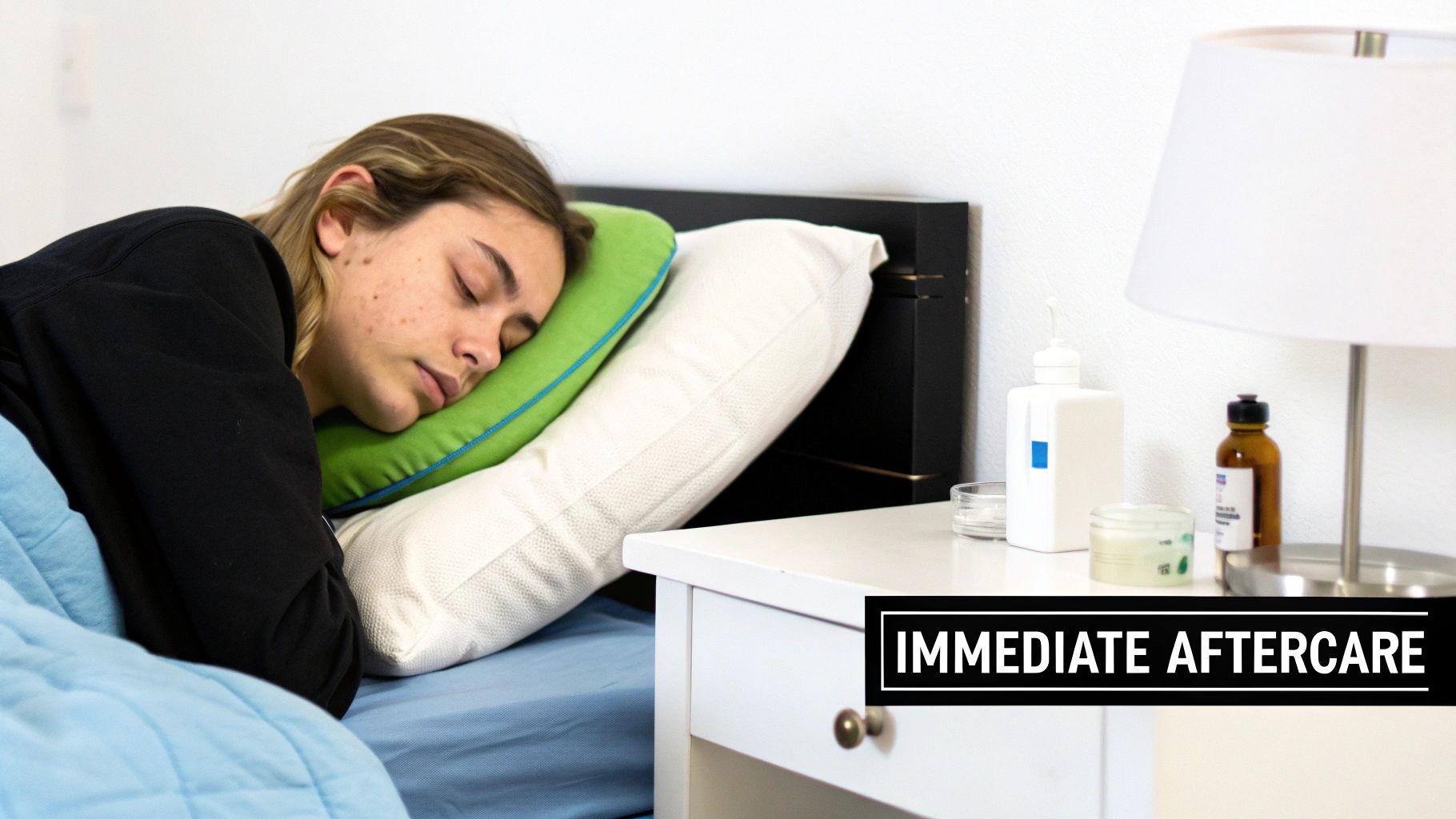
The time immediately after your procedure is make-or-break. Those newly implanted hair grafts are incredibly fragile and haven't yet anchored themselves into your scalp. I often tell my patients to think of them like tiny seeds you've just planted; they need a calm, stable environment to properly take root. Any sort of friction, pressure, or accidental bump could dislodge them, which is the last thing you want.
So, your main job is to create a safe healing zone. This means clearing your calendar, setting up a comfy spot at home, and committing to being extra gentle for a couple of days.
Mastering Your Sleeping Position
One of the biggest hurdles I see patients face is figuring out how to sleep without disturbing the recipient area. The mission is to avoid any contact between your new grafts and your pillow or sheets for the first few nights.
- Elevate Your Head: You'll want to sleep with your head and upper back propped up at about a 45-degree angle. The easiest way to do this is by stacking two or three pillows or even better, sleeping in a recliner chair if you have one. This elevation is fantastic for minimising the swelling that tends to peak around day two or three.
- Use a Travel Pillow: That U-shaped travel pillow you use for flights is about to become your best friend. It supports your neck and stops your head from rolling around, keeping the recipient area safely off any surfaces while you sleep.
- Protect Your Bedding: Grab a disposable pad or an old, dark towel and lay it over your pillows. It’s completely normal to have some light weeping or minor bleeding from both the donor and recipient areas, and this simple trick will save your good sheets from any stains.
Nailing this sleeping position is a proactive way to keep swelling down and give those grafts the secure environment they need to heal.
Your clinic will give you a post-op spray, which is usually a sterile saline solution. Follow their instructions for using it—often every hour or two while you're awake. This is vital for keeping the grafts hydrated, calming any itchiness, and preventing thick scabs from forming.
Protecting Your Grafts During the Day
While getting your sleep setup right is key, you also need to be mindful during the day. The golden rule for this period is simple but non-negotiable: do not touch, scratch, or pick at your scalp. It will probably feel a bit tender, numb, or even itchy, but you absolutely must resist the urge to touch it.
You'll notice tiny scabs forming around each graft. This is a normal and essential part of healing, as they protect the micro-incisions from infection. Just let them be; they will fall off on their own over the next week or two.
On top of that, make sure you're drinking plenty of water and taking any prescribed medication for pain or inflammation as directed. Many patients find that really understanding the FUE hair transplant process helps them appreciate why this delicate care is so important. Steer clear of any strenuous activity, which includes bending over quickly, as it can spike the blood pressure in your head and risk causing some bleeding. These first two days of careful attention are a tiny price to pay for a lifetime of great hair.
Navigating Your Week-By-Week Recovery Timeline
Understanding what happens after you leave the clinic is crucial. A hair transplant isn't an overnight fix; it's a journey with distinct phases. Knowing what to expect week by week helps you stay patient and trust the process.
Think of it as a marathon, not a sprint. This guide will walk you through the entire timeline, from the initial healing and the dreaded shedding phase right through to seeing those first exciting sprouts of new hair. Being prepared for what's normal (and what isn't) will give you the peace of mind to navigate your recovery confidently.
The First Two Weeks: Healing and Scabbing
The first 7 to 10 days are all about letting your body do its thing. You’ll notice small scabs forming around each of the newly implanted grafts. This is a good sign! These scabs are nature's tiny band-aids, protecting the delicate follicles as they settle in.
Whatever you do, don't pick at them. Doing so can accidentally pull out the fragile grafts before they've had a chance to anchor. By the end of the first week, you'll see a big reduction in redness and swelling. This is also when you can start gently washing your hair, following your surgeon's specific directions, which helps ease the scabs away naturally. Most people are comfortable enough to head back to a desk job within this first week.
A lot of patients feel anxious about how their scalp looks in these first two weeks. The redness and scabs can be confronting, but please know they are temporary and a sign that you're healing exactly as you should be.
Weeks Two to Four: The Shedding Phase
Just when you’re getting used to your new hairline, something a bit strange happens. The short, transplanted hairs will start to fall out. It’s a phenomenon we call "shock loss", and it usually kicks in between two and four weeks after the procedure. It can be alarming, but it's a completely normal—and necessary—part of the process.
This shedding happens because the follicles go into a temporary resting phase (the telogen phase) after the stress of being moved. The important part—the follicle itself—is still safe and sound beneath your skin, getting ready to grow a brand-new, healthy hair. It's simply resetting its growth cycle.
For a more granular look at these early days, check out our hair transplant healing timeline day-by-day guide.
Month Three to Six: The First Sprouts of Growth
Patience is your best friend for the first couple of months. After the shedding phase, your scalp will look pretty much as it did before the surgery. Then, right around the three-month mark, the magic starts. You’ll begin to spot the very first new hairs poking through. They'll be fine and a bit sparse at first, but it's the undeniable beginning of your new look.
From months four to six, the growth really picks up momentum. More hairs will pop up, and they’ll start to get thicker, giving you a real sense of increasing density. By the time you hit the six-month point, you’ll see a significant cosmetic improvement—a great preview of what’s to come.
Month Six to Twelve: Maturation and Final Density
The second half of the year is all about maturation. The hair that started growing earlier will continue to thicken, get longer, and improve in texture. The diameter of each hair shaft actually increases over time, which is what creates that full, dense, and natural-looking result. This is the period where you really see it all come together.
Here in Australia, the recovery from an FUE hair transplant follows a pretty predictable path. Swelling and redness are at their worst around days two to three, then the shock loss hits at weeks two to four. You'll see the first real regrowth from month four, with about 45% growth by months six to seven. The density then jumps to around 70% by months eight to nine, with the full, final result appearing at 10-12 months for over 90% of our clients.
To help you visualise this journey, here’s a table summarising the key milestones you can expect.
Hair Transplant Recovery Milestones
| Timeframe | Common Symptoms | Activity Level | Expected Growth |
|---|---|---|---|
| Weeks 1-2 | Swelling, redness, scabbing | Rest, minimal activity | No new growth |
| Weeks 2-4 | Shedding of transplanted hair | Return to light exercise | No new growth (shock loss) |
| Months 3-4 | Itching, some pimples | Resume normal exercise | Fine, new hairs start to appear |
| Months 6-9 | Increasing density and thickness | Full activity | Significant thickening (45-70% density) |
| Months 10-12 | Hair matures in texture | Full activity | Final results (90%+ density) |
By the time you reach the 12-month mark, what you see in the mirror is your final result. Your new hair will be long enough to cut and style however you like, blending in perfectly with your existing hair for a look that is completely, naturally yours.
Navigating Swelling, Pain, and Scabbing After Your Procedure
Once you're through the first 48 hours, your recovery journey shifts gears. This next phase is all about careful management to protect your investment and pave the way for fantastic results. We’ll focus on the three big things every patient deals with: swelling, a bit of discomfort, and the inevitable scabbing.
Getting on top of these things early doesn't just make you feel more comfortable; it creates the perfect healing environment for those new grafts to settle in and thrive. Let's walk through exactly what you need to do for each.
Managing Swelling and Discomfort
Swelling is just your body's way of responding to the procedure, so don't be alarmed when it shows up. It’s completely normal for it to peak around day three or four. You'll likely notice some puffiness around your forehead, and it can even drift down towards your eyes. The good news is, you can definitely help it along.
Continuing to sleep with your head propped up at a 45-degree angle is still your best strategy. Gravity is your friend here, helping to draw fluid away from your scalp. If the swelling is bothering you, a gentle cold compress can be a game-changer.
- Apply it to your forehead only: Never, ever put a cold compress or ice pack directly on the new grafts. They're far too delicate at this stage.
- Keep it short and sweet: Apply the compress for 10-15 minutes at a time, taking regular breaks. This will help reduce the inflammation without causing any harm.
As for pain, it’s typically very mild and easily handled with the medication your clinic provided. The trick is to stay ahead of it. Take your painkillers on the schedule you were given, rather than waiting for the discomfort to kick in. Most people find they only need them for the first couple of days.
Dealing with Scabs and Washing Your Hair
You’ll soon see tiny scabs forming around each implanted graft. This is a great sign! It means your body is healing properly. These little scabs are like tiny bodyguards, protecting the new follicles underneath. Your job is to help them soften and fall off on their own time—no picking or scratching, as this could pull a graft right out.
That saline spray you were given is your most valuable tool right now. Misting your scalp regularly keeps the grafts hydrated, calms any itchiness, and is crucial for stopping the scabs from getting too hard and crusty.
When your clinic gives you the green light to wash your hair (usually after a few days), the technique is everything. This is a world away from your usual shampoo routine.
- Use Lukewarm Water: Hot water can make inflammation worse, so keep the temperature gentle and lukewarm.
- Lather Up First: Mix a small amount of your special shampoo with water in a cup to work up a lather. Gently pour this solution over your head instead of rubbing the shampoo in directly.
- No Scrubbing: Just let the soapy water sit for a minute or two before rinsing. Rinse by pouring cups of lukewarm water over your scalp, always using very low pressure.
- Pat, Don't Rub: You can gently pat the donor area dry with a clean, soft towel, but let the recipient area air-dry completely.
This gentle method gets your scalp clean without disturbing the grafts. As you continue this routine, the scabs will soften and start to flake away naturally, usually within 7 to 14 days. It's also normal to have questions about any marks left behind. Understanding how to minimise hair transplant scarring can provide peace of mind as you heal.
This timeline gives you a great visual of the hair growth stages you can expect after your surgery.
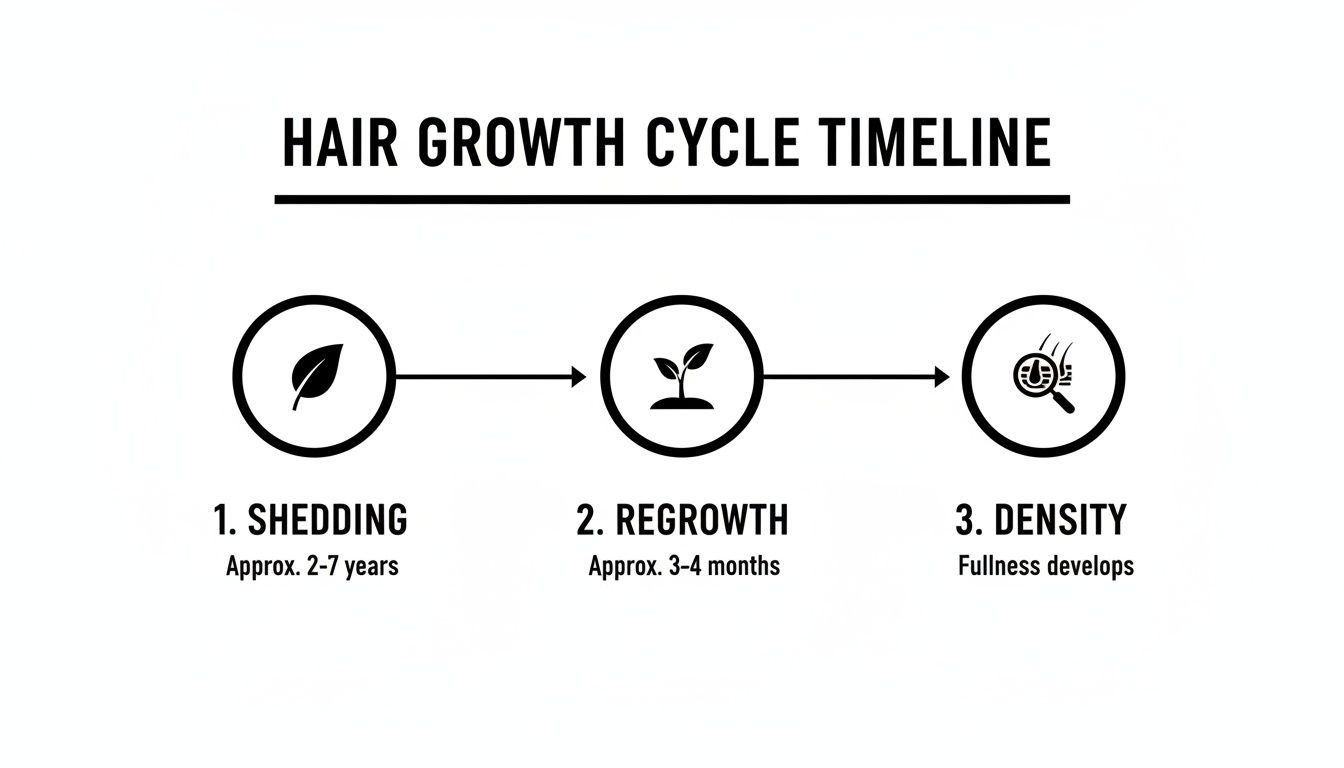
As the graphic shows, the shedding phase is a temporary but necessary part of the process. It's the scalp hitting the reset button before your new, permanent hair begins to grow in and build density.
Lifestyle Adjustments That Support Hair Growth
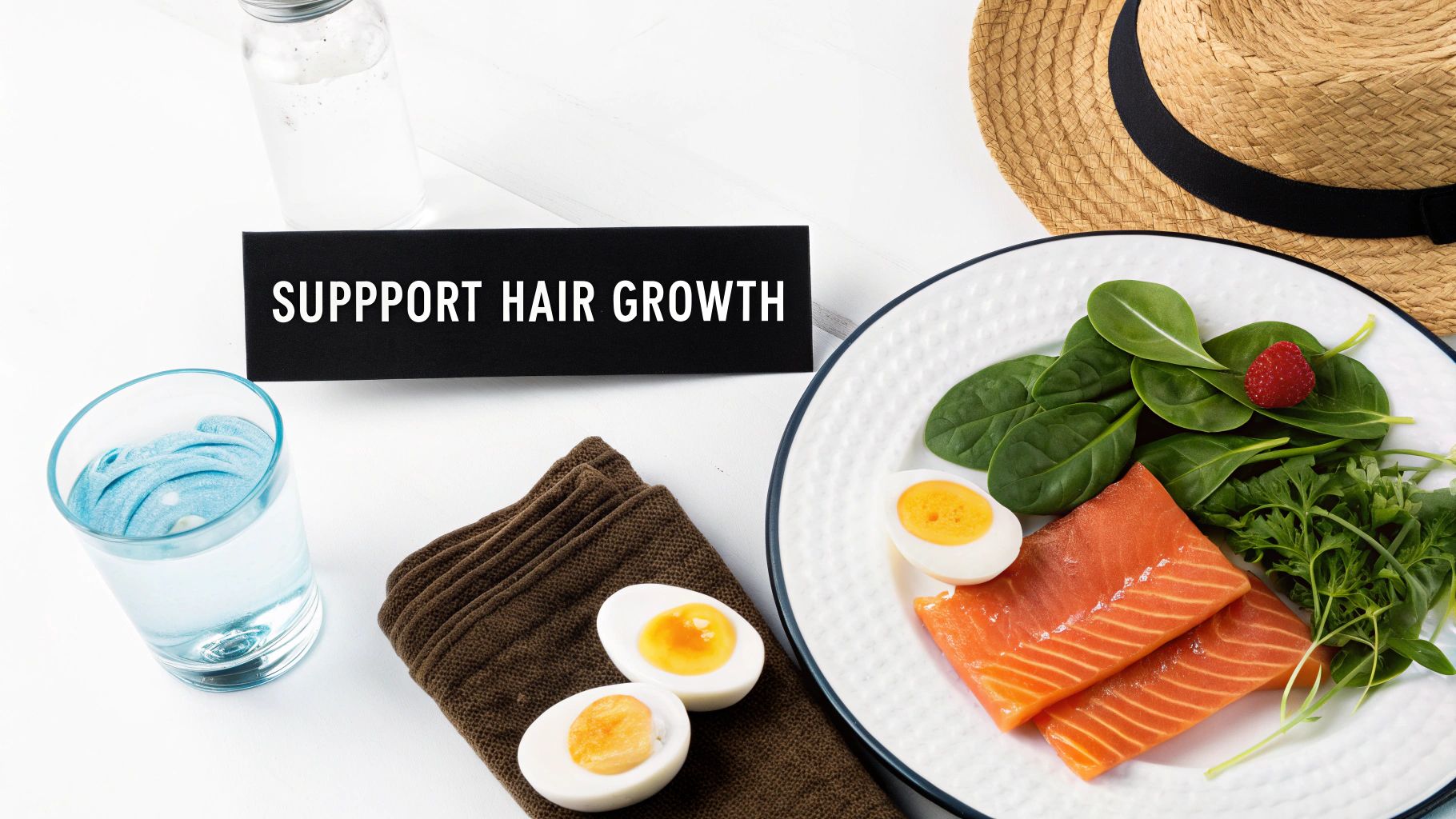
Your long-term results depend just as much on what you do after the procedure as on the surgery itself. Making a few smart lifestyle tweaks creates the perfect internal environment for your new follicles to heal, take root, and thrive.
Think of your body as the soil for your newly planted grafts. By enriching that soil with good nutrition, proper rest, and avoiding a few key things, you give your new hair the best possible chance to flourish.
Fuelling Your Follicles with the Right Nutrition
Your body is in healing mode, and that process demands a lot of energy and very specific nutrients. Each hair follicle is like a tiny factory, and to produce strong, healthy hair, it needs a steady supply of building blocks. A nutrient-rich diet is one of the most powerful things you can do to support your recovery.
Here’s what to focus on:
- Protein: Hair is mostly protein, so lean meats, fish, eggs, and legumes are absolutely essential.
- Iron: This mineral is crucial for getting oxygen to your follicles. You'll find it in spinach, lentils, and red meat.
- Vitamins C and E: These are antioxidants that help protect your cells from stress. Think citrus fruits, berries, and nuts.
- Zinc: A lack of zinc can sometimes lead to shedding, so make sure you’re eating things like seeds, whole grains, and oysters.
To really give your follicles a boost, it’s worth exploring the best supplements for hair growth which can complement your diet. A balanced plate paired with the right supplements can be a powerful combination for getting the best results.
Easing Back into Physical Activity
Getting your body moving again is fantastic for circulation, but timing is everything. If you push yourself too hard, too soon, you can raise your blood pressure and put those delicate new grafts at risk. It’s absolutely critical to ease back into exercise gradually.
Your clinic will give you a specific timeline, but a good rule of thumb is to avoid any strenuous activity for at least two weeks. This means no heavy weightlifting, running, intense cardio—basically, anything that makes you sweat a lot or strain yourself.
Start with some light walking in the first week. It’s great for promoting blood flow without overdoing it. After about 14 days, you can slowly reintroduce lower-impact exercises like cycling or a light jog. The most important thing is to listen to your body and pull back if you feel any discomfort.
Habits to Avoid During Healing
Some habits can really get in the way of your recovery and even affect your final result. For the first few weeks, you absolutely need to put these on hold.
Smoking is a big one. It constricts your blood vessels, which chokes off the supply of oxygen and nutrients your healing scalp desperately needs. Drinking too much alcohol can also be a problem, as it dehydrates you and can thin your blood, interfering with the healing process.
Fortunately, the recovery downtime in Australia is surprisingly short. Most patients are back to their normal routines within a week. Australian-specific timelines often show a return to non-physical jobs in just 2-5 days, and a return to sports can be safe after 10 days, especially with the no-stitch FUE technique. This minimal disruption makes it that much easier to focus on these crucial lifestyle adjustments for a few weeks.
How SMP Can Enhance Your Transplant Results
Let's be honest, the waiting game after a hair transplant can be tough. You've made the investment, gone through the procedure, and now you have to be patient as the new follicles slowly wake up and start their growth cycle. But what if you could get an immediate visual boost while you wait?
That’s exactly where Scalp Micropigmentation (SMP) shines. It’s the perfect partner for your hair transplant.
Think of SMP as a highly advanced form of cosmetic tattooing, but it’s a world away from a standard tattoo. Using incredibly fine micro-needles and specialised pigments, an artist places tiny dots on the scalp that perfectly mimic individual hair follicles. The result is a subtle shadow that immediately creates the look of a denser, fuller head of hair.
It’s an incredibly effective technique for tackling common concerns during the recovery phase, giving you a cosmetic fix while your final transplant results mature over the next year.
Bridging the Gap to Your Final Results
One of the biggest wins with SMP is the visual density it adds. Even after a fantastic transplant, you might still feel you want a bit more fullness, especially if your hair is naturally fine or you were dealing with significant hair loss to begin with.
An SMP artist will meticulously place thousands of these tiny pigmented dots between your existing hairs and the newly transplanted ones. This layering technique is a game-changer, dramatically reducing the colour contrast between your scalp and your hair, which makes any thinness far less obvious. For many of my clients, it's the finishing touch that elevates their result from great to absolutely amazing.
Here’s a common scenario: a patient is six months post-op and loves his new hairline, but the crown area is still coming in and looks a little sparse under bright lights. By adding SMP to the crown, we can instantly camouflage the scalp. This gives him the confidence of a full look while the last 30-40% of his transplanted hair finishes growing and thickening up.
Scalp micropigmentation isn't just for the recipient area. It’s also brilliant for camouflaging scars in the donor area, especially the linear scar from an older FUT procedure, making it practically invisible.
Finding the Right Time for SMP
Timing is everything when you're combining SMP with a hair transplant. You absolutely must give your scalp enough time to heal completely from the surgery before starting any micropigmentation. If you rush it, you could risk damaging your new grafts and compromising the quality of the SMP.
Most experienced clinics and SMP artists will advise waiting at least six to eight months after your hair transplant. This waiting period is non-negotiable and ensures a few critical things have happened:
- Complete Healing: Your scalp is fully recovered. All the swelling, redness, and sensitivity from the surgery have completely subsided.
- Graft Security: The newly transplanted follicles are securely anchored and no longer fragile or at risk from the SMP process.
- Visible Growth: There's enough new hair growth for the SMP artist to clearly see the final pattern, angle, and density. This is crucial for blending the pigment seamlessly.
Waiting gives the artist a stable canvas to work on, guaranteeing the pigment is deposited at the right depth for a natural, long-lasting look. To dig a little deeper, check out our guide on combining scalp micropigmentation with a hair transplant. A bit of strategic patience here really pays off, delivering a flawless result where you can't tell where the real hair ends and the SMP begins.
Common Questions About Hair Transplant Recovery
Going through a hair transplant is a big step, and it’s completely normal to have a million questions pop up during recovery. Even with the best preparation, you’ll find yourself wondering about little things as your scalp heals and you wait for those new hairs to grow.
This is your go-to guide for those nagging questions. We'll cut through the noise and give you clear, straight answers based on years of experience, so you can feel confident and relaxed about the whole process.
When Will My Scalp Look Normal Again?
This is probably the number one question on everyone’s mind. You just want to know when you can step out without feeling like everyone is staring.
The good news is, the most obvious signs of surgery don’t stick around for long. The initial redness and swelling calm down quite a bit by the end of the first week. Those tiny scabs you see around each graft? They’ll gently flake off within 7 to 14 days, especially if you’re sticking to the gentle washing routine we give you.
By the two-week mark, most people find their scalp looks settled enough that a casual observer wouldn't notice anything. You might still have a bit of faint pinkness lingering for a few more weeks, particularly if you have fair skin, but that's totally normal. Your scalp has been through a delicate procedure, so a little patience is key.
Is Itching a Bad Sign?
An itchy scalp is one of the most common—and annoying—parts of recovery. It can make you worry, but trust me, it’s almost always a great sign that things are healing just as they should.
Think about it: thousands of tiny incisions are mending, and new follicles are getting ready to grow. All that biological activity can definitely trigger an itchy feeling.
The main culprits are:
- Healing: As your skin and nerve endings repair themselves, itching is a natural side effect.
- Dryness: Your scalp can get quite dry after the procedure, which is a classic cause of itchiness.
- Scabs: When the scabs start to form and then loosen, they can irritate the surrounding skin.
The golden rule here is do not scratch. It’s tempting, I know, but scratching can dislodge your precious new grafts or, worse, lead to an infection. Your best friend here is the sterile saline spray your clinic provides. A quick spritz can soothe the area instantly. Gentle, careful washing also works wonders by clearing away dry skin and loose scabs.
What if I Accidentally Bump My Head?
It’s the moment of panic every patient dreads. You turn a corner too fast or forget about that low kitchen cabinet—and thump. First off, take a deep breath.
In the very first few days, the grafts are incredibly delicate, and a hard knock could be a problem. But once you get past that initial 7 to 10 day window, the grafts have started to anchor themselves by establishing a blood supply. They become surprisingly secure.
A light bump after this point is highly unlikely to cause any real damage. If you do knock your head, check for any bleeding from a graft site. If you see any, or if you’re just feeling anxious, the best thing to do is contact your clinic. Sending them a quick photo can often provide immediate peace of mind.
Remember, the grafts are tougher than you think, especially after that first critical week. A minor incident is rarely a cause for major concern, but checking in with your clinic is always the smartest move.
Can I Wear a Hat After My Transplant?
Absolutely, but timing and fit are everything. For the first 7 to 10 days, it’s best to let your scalp breathe and avoid any headwear that could cause friction on the new grafts.
After that initial period, you can start wearing a loose-fitting hat. Think of a baseball cap worn on a looser setting or a soft, roomy beanie. The goal is to avoid anything that compresses or rubs against the recipient area. Make sure it's a clean hat, too—you don't want to risk any infections.
A hat is actually a great idea for protecting your sensitive scalp from the sun, which is vital during recovery. Just steer clear of tight hats or hard hats for at least a few weeks, or whatever your surgeon recommends.
Are the Results Actually Permanent?
Yes, the transplanted hair is here to stay. The hairs are taken from your donor area (the back and sides of your head), a spot that's genetically programmed to resist the DHT hormone responsible for typical balding. This means the hair we move will keep growing for the rest of your life.
What’s important to understand, though, is that your original, non-transplanted hair might continue to thin over time. This is why many surgeons recommend treatments like Finasteride or Minoxidil—to hold on to the hair you already have and keep everything looking natural and full for the long haul.
For some, enhancing the look of density is also a long-term goal. This is where you might consider how combining a hair tattoo with a hair transplant can create an even fuller appearance.
Here in Australia, we see fantastic outcomes. Success rates for modern FUE techniques boast a 95-97% graft survival rate, and patient satisfaction is consistently high at 90-95%. In terms of the timeline, by the six-month mark, over 80% of patients notice significant thickening, with the final look locked in around 10-12 months.
At My Transformation, we are dedicated to providing not just exceptional results but also the support and guidance you need throughout your entire hair restoration journey. If you're ready to explore how Scalp Micropigmentation can be the perfect solution for your hair loss, we invite you to get in touch. Let's work together to restore your confidence. Visit us at https://rightwing-health.info/a%3E.%3C/p%3E