

Hair After Hair Transplant A Complete Recovery Guide
So, you've just had your hair transplant. What happens now? The first couple of weeks are less about seeing new hair and more about your scalp's recovery. It’s a critical time where your body is working hard to welcome and secure those newly placed follicles.
What to Expect Immediately After Your Hair Transplant
Right after the procedure, don't be alarmed by what you see in the mirror. Your scalp will be red, a bit swollen, and covered in tiny scabs around each implanted graft. This isn't a sign of something wrong; it's the complete opposite. It's the sign of your body's natural healing process kicking into gear.
Think of your scalp like a freshly planted garden. The soil (your scalp) has been disturbed to plant new seeds (the hair grafts). It needs a little time to settle down before you see any new growth.
Here’s a quick rundown of what’s completely normal in those first few days:
- Redness and Swelling: Expect your scalp to be pink and puffy. Sometimes, the swelling can even drift down to your forehead and around your eyes for 2-4 days. It's just your body's inflammatory response, and it's temporary.
- Tiny Scabs: Little crusts will form over each graft. These are like tiny protective helmets for the follicles underneath. Whatever you do, don't pick them! They need to fall off naturally.
- Some Discomfort: Both the donor area and the newly implanted area might feel a bit tender, tight, or itchy. This usually calms down within the first week.
The First 14 Days After Your Hair Transplant
Knowing what's coming day by day can really help manage expectations and reduce any anxiety. This initial period is all about healing. Your main job is to follow your aftercare instructions to the letter to give those grafts the best possible chance of survival. Proper scalp care is essential, and even after you've healed, maintaining scalp health is key. For ongoing care, it's worth learning about the benefits of using a quality bald head moisturiser, as a hydrated scalp is a healthy scalp.
Remember, the first two weeks are not about how your hair looks. It’s all about creating the perfect healing environment. Patience here is your best friend—it sets the stage for the fantastic results to come.
To give you a clearer picture, here's a quick reference guide for what to expect during that crucial two-week healing window.
| Timeframe | What Your Scalp Looks Like | Key Aftercare Focus |
|---|---|---|
| Days 1-3 | Obvious redness and some swelling, with tiny scabs clearly visible at each graft site. | Rest is your top priority. Stay hydrated, and sleep with your head elevated to help with swelling. |
| Days 4-7 | The swelling will start to go down noticeably. Scabs will harden, and you'll likely feel some itchiness. | Gentle washing, exactly as your clinic instructed. This helps to carefully clean the area. |
| Days 8-14 | Scabs will start to flake off on their own as you wash your hair, revealing clean skin underneath. | Resist the urge to scratch! Keep your scalp out of direct sunlight to prevent any damage. |
Once those scabs are gone and the redness has faded, you've successfully navigated the most delicate phase of your recovery. Now, the real journey of hair growth begins.
Navigating The Shock Loss Phase
Just when you’re getting past the initial healing, something unexpected often happens. You might look in the mirror one day and see the tiny, transplanted hairs starting to fall out. This usually kicks in sometime between the second and eighth week, and it’s a phenomenon known as shock loss.
Seeing hair fall out after you’ve just paid to have it put in can be pretty confronting, I get it. But believe it or not, this is a completely normal—and even positive—part of the journey.
Think about it like moving a mature tree. When you uproot it and plant it in a new spot, it often drops its leaves. It’s not dying; it’s just conserving energy to focus on establishing strong roots in its new home. Your hair follicles are doing the exact same thing. The minor trauma of being relocated causes the old hair shaft to be jettisoned, but the most important part—the follicle itself—is safe and sound under your skin, getting ready for what's next.
This shedding is a clear signal that the follicles are entering a brief resting phase. They're settling in, connecting to a new blood supply, and preparing to kick off a brand-new growth cycle. It's the reset they need before they start producing the strong, permanent hair you’ve been waiting for.
Why Shock Loss Is A Good Sign
It sounds completely backwards, but this shedding phase is actually the bridge to new growth. It means the transplanted follicles survived the move and are now syncing up with your scalp's natural rhythm.
"Shock loss is the scalp's way of hitting the 'restart' button. The follicle isn't gone; it's just gearing up to produce a stronger, healthier hair shaft that will last a lifetime."
Essentially, the old hair has to make way for the new. Understanding this helps you see it for what it is: not a setback, but a necessary step towards the final result. It’s a sign of anticipation, not concern.
What Is The Timeline For Shedding?
While everyone’s body responds a little differently, the timeline for shock loss is fairly predictable.
- Weeks 2-8: This is the prime window for shedding to begin. For some, it's a gradual process; for others, it can feel more sudden.
- Existing Hair: Don't be surprised if some of your original, non-transplanted hair near the new grafts also thins out. This is just a temporary reaction to the stress on the scalp and it will grow back right alongside the new hairs.
It's so important to remember this is just a temporary stage. Once the follicles have had their rest, you'll start to see the first hints of new growth, usually around the three-month mark. This shedding phase is simply clearing the path for the real results to come through.
If you want to get into the nitty-gritty of why this happens, you can learn more about the hair growth cycle in our detailed guide. For now, just know that a bit of patience during this phase goes a long way.
Your Complete Hair Growth Timeline
So, you’ve made it through the initial healing and weathered the dreaded “shock loss” phase. Now, the real magic starts to happen. This is where your patience is rewarded as those newly transplanted follicles wake up and get down to business, growing new, permanent hair. It’s not an overnight miracle, but a gradual process where every month brings you a step closer to the look you’ve been waiting for.
I often tell my clients to think of it like planting a garden. You prepare the soil and plant the seeds, but for a while, it looks like nothing is happening. Beneath the surface, though, roots are taking hold, and eventually, the first tiny sprouts push through. Your hair regrowth follows a very similar, predictable path.
This timeline gives you a great visual of those first critical stages, from the day of the procedure, through the shedding period, and into the very first signs of new life.
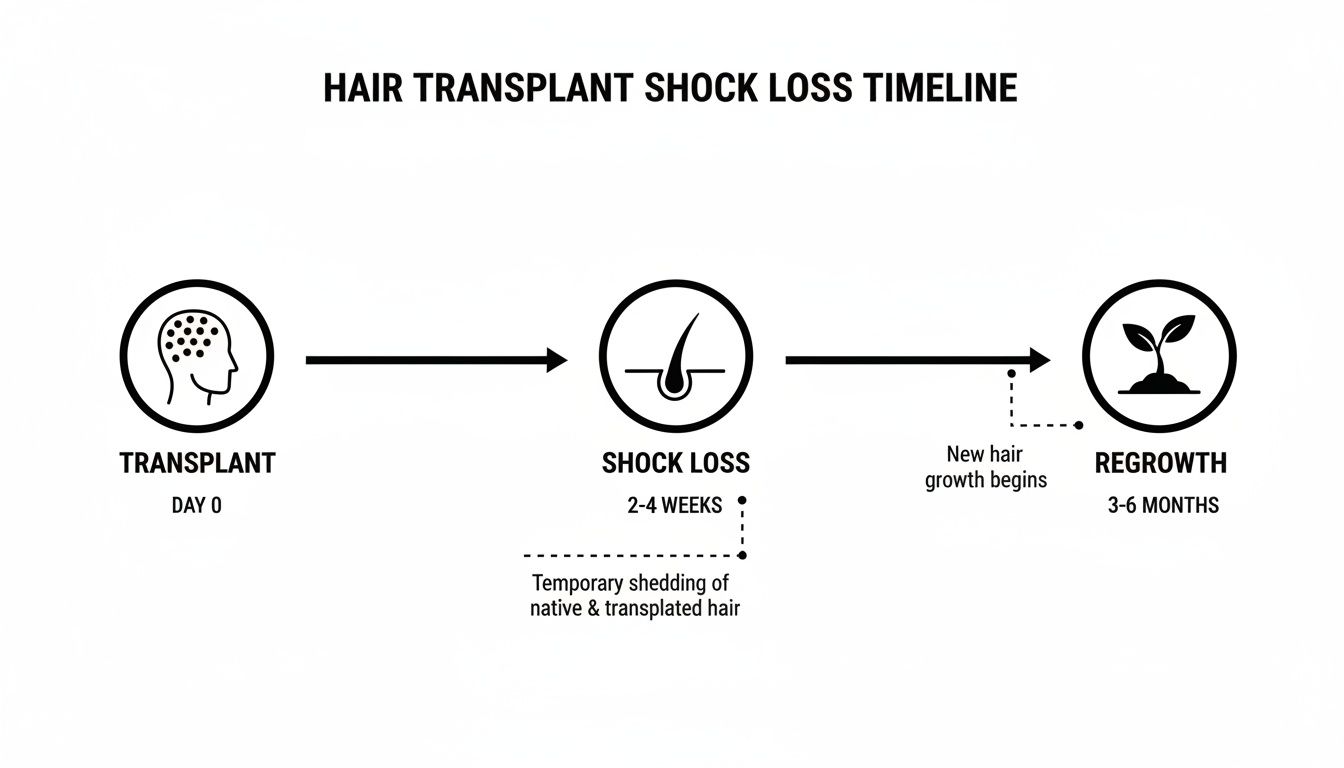
As you can see, the shedding phase is just a temporary, but essential, bridge to the exciting regrowth that comes next.
The First Sprouts: Months 3 to 4
Right around the three-month mark is when you’ll start seeing the first concrete evidence of success. You’ll notice fine, almost translucent hairs beginning to pop up. We call these "vellus hairs", and they might look a bit thin and wispy at first.
Don’t worry about their initial delicate appearance. This is actually a fantastic sign! It means the transplanted follicles have successfully settled in and kicked into a new growth cycle. Over the next few months, these little guys will mature, becoming thicker, darker, and longer. Our detailed hair transplant healing timeline dives deeper into this exciting stage.
Gaining Momentum: Months 5 to 9
This is the period where things really start to get exciting. Your hair growth picks up serious speed, and the new hairs begin to make a real difference to your overall density. The hair shafts themselves thicken, which provides much better coverage and makes the treated areas look noticeably fuller.
By the six-month mark, most people hit what we consider the halfway point, enjoying about 50% of their final result. By month nine, you're building on that progress with even more density and length, finally getting to a point where you can start styling your new hair with confidence.
Your patience truly pays off during these months. The day-to-day changes can feel subtle, but when you compare photos from one month to the next, the improvement is undeniable and incredibly motivating.
This is also a fantastic time to support the process. Exploring complementary treatments like Red Light Therapy for Hair Growth can be a great way to give your follicles an extra boost.
The Final Result: Months 12 to 18
While month nine feels like a huge milestone, the best is still on its way. Between 12 and 18 months post-op, your hair finally reaches full maturity. Each hair shaft will have thickened to its maximum diameter, and all the viable follicles will be in a productive growth phase. This is what creates that final, natural-looking density and texture.
This incredible transformation is backed by solid science. Here in Australia, modern hair transplants have an amazing 90-95% graft survival rate. This means the overwhelming majority of follicles we move take hold and grow strong, permanent hair. This high success rate comes down to using healthy donor hairs from the back and sides of the head—hairs that are naturally resistant to DHT, the hormone that causes male pattern baldness.
Essential Aftercare For The Best Results
Getting the best possible result from your hair transplant doesn’t stop when you walk out of the clinic. What you do in the days and weeks that follow is just as critical as the procedure itself. Think of your aftercare routine as the final piece of the puzzle—it protects your investment and helps those new hair follicles flourish.
Your newly transplanted grafts are incredibly delicate, like tiny seeds just planted in a garden. They need the right conditions to take root and grow strong. Your job is to create a gentle, clean, and protected environment for them, especially during those crucial first few weeks.
Gentle Washing Is Non-Negotiable
Washing your hair for the first time can feel a bit daunting. It’s completely normal to be worried about knocking the new grafts out, but proper, gentle washing is key to keeping the area clean and preventing scabs from forming.
Your clinic will give you a specific set of instructions, but the general idea is always the same:
- No Direct Water Pressure: For the first week or so, don't let the shower spray hit your scalp directly. A much better way is to use a cup to gently pour lukewarm water over your head.
- Dabbing, Not Rubbing: When you apply the special shampoo, use your fingertips to dab it on very gently. Whatever you do, don't rub or scrub the area where the new hairs are.
- Air Dry Is Best: The simplest approach is to let your hair air dry. If you must, you can lightly pat the surrounding, non-transplanted areas with a soft towel, but avoid hairdryers unless it’s on the absolute coolest, slowest setting.
Sun Protection And Activity Guidelines
Here in Australia, the sun is no joke, and for a healing scalp, it's a real threat. Your skin will be extremely sensitive to UV rays after the procedure, which can easily damage the delicate new skin and harm the follicles underneath.
For the first month, you absolutely must avoid direct sun on your scalp. A loose-fitting hat will be your best mate whenever you go outside. It's a simple step, but it makes a huge difference to your final outcome.
Getting back to the gym or your usual fitness routine also needs to be a gradual process. Sweating too much can raise the risk of infection, and any strenuous activity can increase blood pressure, which might cause bleeding from the graft sites. Most surgeons will tell you to avoid any heavy exercise for at least two weeks. A gentle walk is usually fine after a few days, but always check with your clinic before you start anything. Proper aftercare also goes a long way in minimising any visible marks, which you can read more about in our guide to hair transplant scarring.
Finally, don't forget about what you're putting into your body. Eating well and staying hydrated gives your body the fuel it needs to heal properly and grow healthy, strong hair. These simple, practical steps put you in the driver's seat of your recovery, helping you get the fantastic results you're after.
How SMP Can Enhance Your Transplant Results
So, you’ve had your hair transplant, which is a fantastic step for restoring your hairline and getting that coverage back. But what if you’re after that next-level illusion of density? This is where Scalp Micropigmentation (SMP) shines, acting as the perfect partner to your transplanted hair. It’s not a replacement, but more of a finishing touch that makes everything look that much fuller.
Think of it this way: your hair transplant plants the trees in the forest, giving you real, tangible texture and volume. SMP is like adding shadows on the forest floor, getting rid of any stark contrast between your scalp and your hair. That simple trick makes the whole forest look incredibly dense and healthy.
This combination is also a brilliant solution for anyone with limitations in their donor area. If you don't quite have enough grafts to get the thickness you’re dreaming of, SMP can cleverly fill in those visual gaps. It creates a look of complete fullness that a transplant on its own might struggle to achieve.
Creating The Ultimate Illusion Of Fullness
The real magic of SMP is how it makes your scalp less visible. A skilled technician applies thousands of tiny, layered dots of specialised pigment in and around your existing and transplanted hair. These dots look just like natural hair follicles, which has the effect of darkening the scalp.
This creates a powerful visual boost for a few key reasons:
- Reduces Scalp Glare: That shiny scalp look? It’s caused by light reflecting off the skin, which is what makes thinning so obvious. SMP minimises the colour contrast between your skin and hair, putting a stop to that glare.
- Adds Visual Density: The treatment essentially creates a permanent shadow under your hair. This provides a backdrop that makes every single strand, both native and transplanted, look thicker and more substantial.
- Conceals Scarring: If you have any scars from FUE or FUT procedures in your donor area, SMP is an incredibly effective camouflage tool. It blends the scar tissue seamlessly into the surrounding hair.
By strategically adding pigment, SMP doesn't just sit alongside your new hair; it amplifies it. It’s often the difference between a good result and a truly phenomenal one, giving you a powerful sense of fullness that can be a huge confidence booster.
For many people, this is the final piece of the hair restoration puzzle. The transplant gives you the real hair and structure, and SMP perfects the underlying density. To dive deeper into how these two treatments work in tandem, check out our guide on using scalp micropigmentation with a hair transplant. It’s all about working smarter to get the most natural and dense look possible.
What Can You Realistically Expect From Your New Hair?
Getting your head around what a hair transplant can actually deliver is the first, and most important, step in the whole journey. This isn't about magic; it's about a clever and artistic blend of medical science and aesthetics, aimed at creating a significant, natural-looking improvement.
Think of it less as getting a whole new head of hair and more like a masterful relocation project. The surgeon's skill is absolutely crucial here. They aren't just plugging in follicles; they're meticulously designing a new hairline, placing each graft at just the right angle and direction to make sure it all blends perfectly with your native hair.
The Factors That Shape Your Final Look
Your individual result comes down to a few key things. The extent of your hair loss and the quality of your donor hair—that's the hair taken from the back and sides of your head—are the biggest players. Naturally, a thicker donor area gives the surgeon more to work with, but even with a limited number of grafts, a skilled practitioner can create a brilliant illusion of fullness.
The real aim is a believable enhancement, not trying to wind back the clock to the hairline you had as a teenager. A truly successful transplant is one that looks so natural, nobody even guesses you've had it done.
Here in Australia, patient satisfaction is incredibly high, and that's because the focus is squarely on getting results that are both believable and long-lasting. For instance, Australian hair transplant success rates are right up there, hovering between 85-95%. Some of the top clinics even report up to a 97% graft survival rate, often by using highly specialised tools for precise placement. This dedication to quality and technique is what really makes achieving that natural density possible. You can learn more about the factors driving these high success rates in Australia.
Ultimately, making sure your expectations line up with what the procedure can realistically do is the single most important step towards being genuinely happy with your final result.
Got a Few More Questions About Your Hair Transplant Recovery?
It’s completely normal to have some lingering questions as you navigate the recovery process. Getting your head around the long-term reality of your new hair is a huge part of feeling confident in your decision. Let's tackle some of the most common queries we hear.
First up, the big one: is this for keeps? Absolutely. The hair follicles we transplant are harvested from the back and sides of your head—areas that are genetically hard-wired to resist balding. That means they’ll keep growing for life, just as they would have in their original spot. You can cut it, wash it, and style it just like the rest of your hair.
When Can I Start Styling My New Hair?
Hold your horses for just a little while. Your scalp needs time to heal properly, so you’ll want to wait about a month before reaching for any styling products like gels or waxes.
When it comes to anything more intense, like using heat styling tools or getting a fancy haircut, it's wise to wait at least three to six months. This gives those new hairs plenty of time to get firmly established and strong.
Another thing people often wonder about is the success rate and whether it's truly worth the investment. Here in Australia, the procedures are incredibly effective, with a success rate of 90-95% of the transplanted grafts successfully taking root and growing. When you pair that success with the permanence of the result, it really puts the cost into perspective compared to temporary fixes. You can find more detailed hair transplant statistics and the science behind them if you're curious.
The most important thing to remember is this: once your new hair is fully grown in, which usually takes about 12 to 18 months, it’s yours for good. There's no special maintenance needed beyond just taking care of it like you would any healthy head of hair.
At the end of the day, a hair transplant isn't just about getting your hair back; it's about restoring confidence. Knowing what to expect lets you sit back and enjoy the journey to fantastic, natural-looking results.
Ready to take the next step and explore how Scalp Micropigmentation can perfect your look? At My Transformation, Michael is dedicated to helping you find the ideal solution for your hair loss concerns. Book your consultation today!