

Top Guide: training required to become a professional hair tattoo artist
Discover what it takes to launch your career as a professional hair tattoo (SMP) artist in just days. You’ll get a clear breakdown of course lengths, investment figures and essential certifications before you sign up.
Overview Of SMP Training Requirements
Here’s a quick glance at the key elements:
- Course Duration That Fits Busy Lives
- Budget Advice For Your Investment
- Must-Have Pre-Course Certificates
- Supervised Practice Hours To Build Confidence
Scalp micropigmentation training in Australia stands out for its accessibility. Rather than spending years in medical or tattoo apprenticeships, most providers pack core techniques, hygiene protocols, client handling and equipment setup into an intensive 3–5 days. Expect to invest around $6,500 AUD, with options for online or in-class delivery. Certification isn’t optional—it’s your ticket to credibility. Learn more about these requirements from The Aussie Way.
“A focused SMP module fast-tracks your skill set and ensures you meet industry standards,” says industry veteran Sarah White.
Training Summary Table
Below is a concise summary of what each training package typically covers:
| Training Aspect | Details |
|---|---|
| Duration | 3–5 days |
| Cost | $6,500 AUD |
| Prerequisites | Infection control certificate |
| Hands-on Practice | 20+ hours supervised |
| Delivery | Online or in-class |
This snapshot helps you compare offerings at a glance and pick the path that suits your schedule and budget.
Planning Your SMP Course
Get ahead with these practical tips:
- Allocate funds for both course fees and professional kit
- Check your state’s health regulations and licensing requirements
- Book live-model practice sessions early to refine your technique
Additional pointers:
- Factor in travel and accommodation for in-person workshops
- Budget for ongoing supplies and replacement needles
Read also: our guide on scalp micropigmentation training to choose the right path.
Use this overview to plan your SMP certification journey with confidence and clarity.
Prerequisites For SMP Training
Before you start practising scalp micropigmentation, get your legal and professional foundations in place. Each Australian state has its own cosmetic tattoo rules, and SMP often falls outside formal licensing. Even so, investing in thorough training keeps clients safe and builds your credibility. For more on cosmetic tattoo pathways, check out Tanya Beauty Care.
Begin by ticking off these essentials:
- Confirm your workspace meets local health and safety codes.
- Earn an Infection control or bloodborne pathogens certificate.
- Refresh your understanding of pigment theory across different skin types.
- Plan a realistic budget covering course fees, gear and travel.
Legal Essentials
Getting clear on regulations up front means fewer surprises later. In Western Australia, councils often inspect studios; in Victoria, no SMP licence is required. Keeping accurate records of your compliance steps will keep your training timeline on track.
| State | Licensing | Council Inspections | Training Recommended |
|---|---|---|---|
| NSW | No | Yes | Hands-on course with mentor |
| VIC | No | No | Infection control certification |
| WA | No | Yes | Pigment theory and practice modules |
| QLD | No | Partial | Client consultation workshops |
“Starting with clear legal guidelines lets you focus on mastering techniques faster,” says a Perth graduate.
Health Certifications
No SMP journey is complete without robust infection control training. You’ll also need a first aid certificate to manage any client reactions. Emily, training in Tasmania, credits her bloodborne pathogens course with giving her studio the professional edge.
Next up are hands-on modules, each overseen by an experienced tutor:
- Skin preparation to reduce risks and maximise pigment retention
- Pigment theory: colour matching and dilution ratios
- Client consultation skills for setting realistic expectations
Document Preparation
Paperwork isn’t glamorous, but it’s non-negotiable. Make sure you have:
- Government-issued ID (driver’s licence or passport)
- Public liability insurance tailored to cosmetic services
- Proof of completed pre-course units
- A compliant studio address and, if needed, a Working With Children Check
You might find our guide to buying tattoo machines in Australia useful.
Set aside $1,000 AUD for emergency supplies and last-minute kit upgrades. This buffer smooths out any unexpected purchases.
Graduate Success Examples
Sarah in Melbourne assembled her documents two months early and secured a compliant studio before demand spiked. She aced her Infection control certification and built a demo portfolio by practising on friends.
Over in Perth, Jamal discovered on his first teen client call that he needed a Working With Children Check. A swift online application had him compliant within 24 hours.
These stories show how proactive prep lets you dive straight into honing your SMP skills.
Building A Reference Portfolio
A standout portfolio is your calling card. Photograph each practice session under consistent lighting and add concise captions:
- Close-ups highlighting individual hairline strokes
- Before-and-after sequences that showcase progression
- Notes on pigment formulas and needle configurations
With these prerequisites sorted, you’ll enter your SMP training confident, compliant and ready to excel.
Choosing The Right SMP Course
When you’re exploring scalp micropigmentation training down under, a few key factors jump out: quality tuition, hands-on practice and your budget. To give you a clear picture, here’s what usually changes from one program to the next:
- Duration: 3–5 days across in-person or hybrid formats.
- Hands-On Hours: anywhere between 15 and 25+ so you can master every stroke.
- Investment: courses typically range from $5,000 to $7,500 AUD, depending on inclusions.
- Extras: look for mentorship, post-course support and the range of needles, pigments and setup tools.
Putting these points side by side helps you spot the best fit for your learning style.
Comparison Of Top SMP Courses
Below is a snapshot of Australia’s leading SMP providers. You’ll see how each stacks up on time commitment, cost and kit inclusions.
| Provider | Duration | Cost AUD | Hands-On Hours | Kit Included |
|---|---|---|---|---|
| SMP Academy | 5 days | $6,500 | 20 | Full |
| Hair Ink | 3 days | $5,000 | 15 | Starter Only |
| The Aussie Way | 4 days | $7,200 | 25 | Complete Setup |
| Barber SMP | 2 days | $6,000 | 18 | Essentials |
This comparison makes it simple to weigh up hands-on hours against the gear you’ll walk away with.
That said, mentorship can be the secret ingredient in how quickly you gain confidence behind the needle.
Instructor Quality And Support
A seasoned trainer can turn complex techniques into second nature. Here’s what to look for:
- Real-Life Case Studies: trainers who share their own client before-and-afters accelerate your learning curve.
- Live Demonstrations: watching needle depth and pigment layering in action helps you avoid guesswork.
- Ongoing Q&A Sessions: having a direct line to your tutor means troubleshooting in real time.
Ultimately, regular feedback loops are what refine your stroke precision and colour consistency.
Tips For Aligning Goals
Your ideal course should suit your priorities—whether that’s getting certified fast or digging deep into pigment theory.
- Tight Schedule? Opt for an intensive bootcamp with condensed modules.
- Theory-Focused? Choose a program with extra sessions on colour matching and scalp anatomy.
- Long-Term Support? Search for providers offering lifetime mentor access or refresher days.
Balancing these elements ensures the training truly serves your professional ambitions.
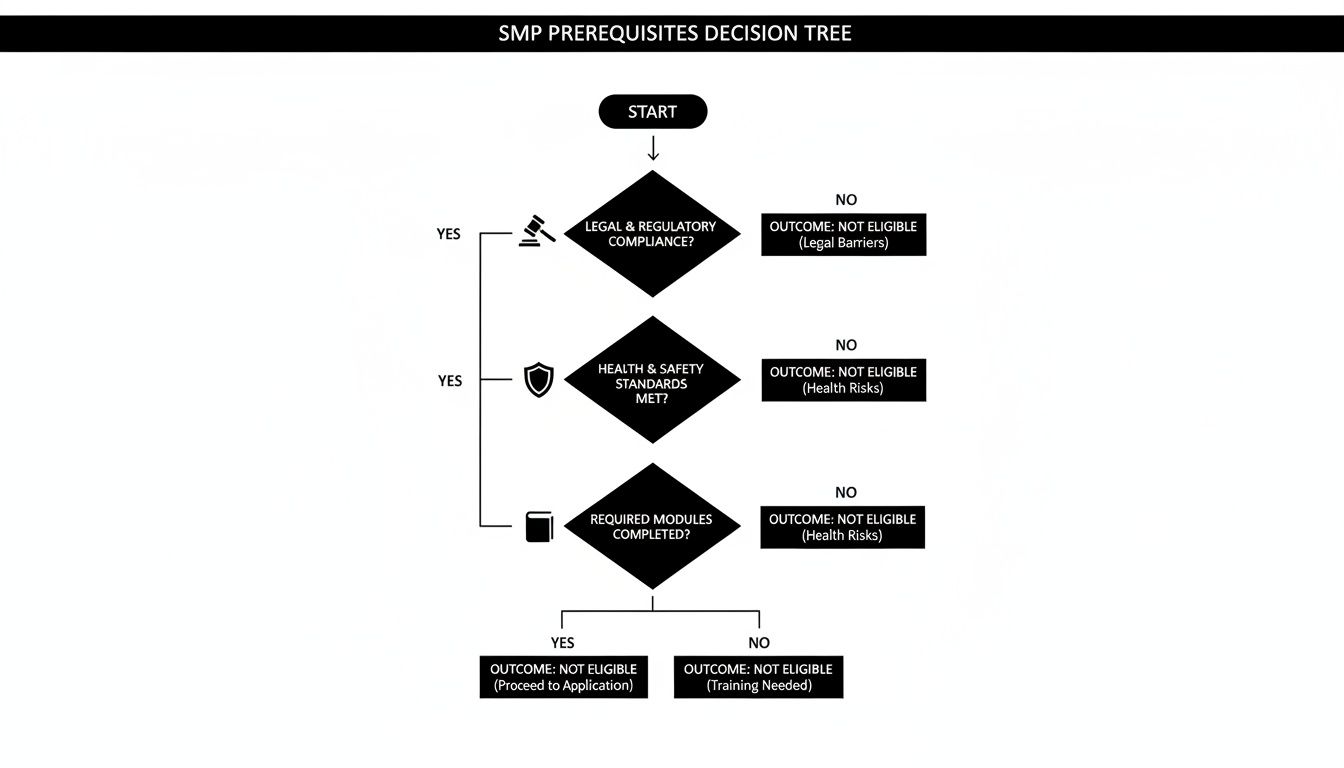
Infographic On Training Prerequisites
Every accredited SMP program rests on a few non-negotiables: legal clearances, health certificates and core skill modules. This decision tree lays it all out:
Final Decision Checklist
To narrow down your options, run through this quick list:
- Align your available days with course length.
- Confirm at least 20 supervised practice hours.
- Make sure kits include both pigments and needles.
- Smaller class sizes often mean more one-on-one support.
For barbers adding SMP to their services, dive into the https://rightwing-health.info/blogs/news/smp-training-barber-smp%3C/a%3E guide—packed with industry-specific advice.
Booking sooner rather than later is wise; these courses fill up fast. Happy training!
Essential SMP Skills And Techniques
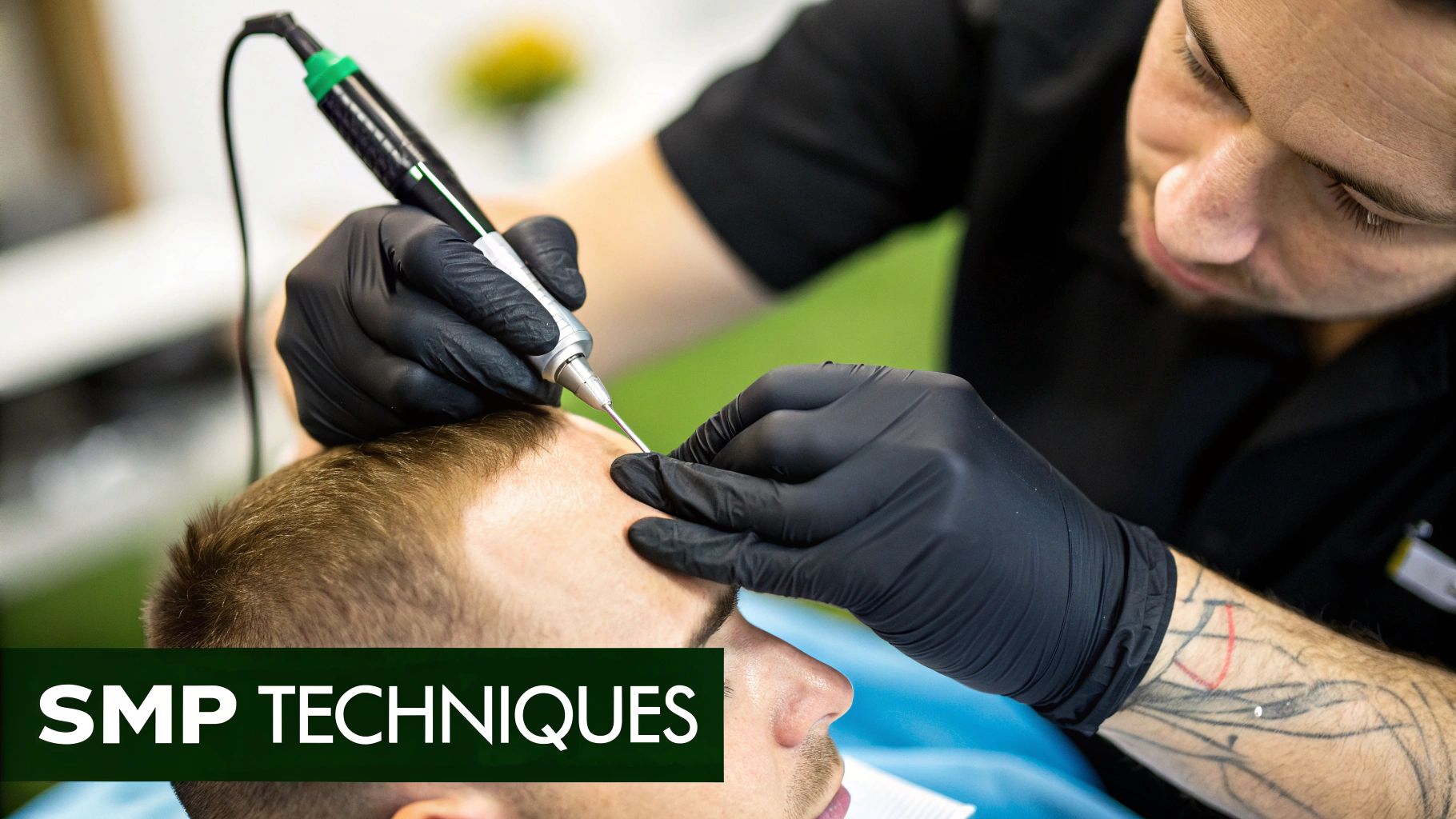
Becoming proficient in scalp micropigmentation is about more than just mastering the device. After countless hours of hands-on practice, you’ll quickly notice how subtle changes in dot size or angle transform a patchy result into something uncanny-ly real.
On top of that, understanding how each element ties together—from pattern mapping to aftercare—will set you apart in this craft. Here’s a rundown of the core competencies you’ll develop on your journey to professional SMP artist status:
- Pattern Mapping: Analyse natural hair direction and density before every session.
- Pigment Blending: Mix tones to suit a range of skin undertones.
- Machine Calibration: Fine-tune speed and depth based on scalp type.
- Hygiene Protocols: Adhere to stringent sanitation steps to avoid cross-contamination.
Natural Follicle Pattern Techniques
When you treat the scalp like a canvas, every dot matters. Mapping placement in advance—almost like stencilling—helps you maintain uniformity across the hairline, temples and crown.
Early on, I’d sketch directly onto practice skins to visualise fade transitions. For instance, easing off dot density around the temples creates that sought-after soft fade. To nail this technique:
- Light pressure along the hairline prevents harsh outlines.
- Needles angled between 45° and 90° mimic natural hair growth.
- Assess dot contrast under daylight and studio lighting for consistency.
Photographing each session has saved me from repeating the same missteps. Over time, you’ll refine your stencil maps until they feel second nature.
Optimising Pigment Blending
Mastering blends is like mixing the perfect shade of paint. A 50% dilution of black often gives the illusion of soft stubble in transition zones.
I always run a quick patch test on synthetic skin to check tone and saturation. Jot down each formula alongside client notes so you can recreate it next time.
“Pigment accuracy transforms a good SMP into a great one,” senior artist Jenna Miles reminds us.
Once your mix feels spot-on, adjust your machine settings to match the pigment’s viscosity. It’s this level of detail that elevates your work from solid to standout.
Machine Settings And Workflow Tips
A good baseline is a 1mm needle depth with moderate voltage—enough to place pigment securely without overworking the skin. From there, small tweaks make all the difference.
Seasoned artists I’ve worked with often:
- Use Hygiene Checklists to keep station setup flawless.
- Employ Workflow Templates for logging client specs and pigment recipes.
- Implement Session Timing hacks, breaking the day into design, application and aftercare segments.
By organising your time this way, you’ll minimise fatigue and maintain focus. Before you know it, your before-and-after gallery will speak for itself.
Explore advanced hair-stroke methods in our specialised guide for thread-by-thread scalp micropigmentation.
Refining Your SMP Workflow
Every client brings their own hair loss pattern and comfort level. Blocking out realistic time slots prevents overruns and keeps bookings running smoothly.
A bullet-proof session plan usually includes:
- Pre-Session Checklist: Sterilise needles, prepare pigments and review the design.
- Aftercare Instructions: Guide clients on healing, washing and sun protection.
- Outcome Surveys: Gather feedback to sharpen your approach next time.
Reviewing cases with a mentor or peer helps you spot blind spots faster. Apply these steps consistently in practice sessions, and you’ll soon deliver natural, lasting SMP results every time.
Key takeaway: Document your process, seek feedback and iterate relentlessly.
Your dedication to hands-on refinement is what ultimately shapes you into a true SMP professional. Keep experimenting, stay curious and watch your artistry flourish.
Setting Up Your SMP Business
Once your certification is complete, the real work begins. You’ll need clear goals and a solid financial plan to create a lasting SMP studio.
Deciding between a permanent address and a mobile setup comes down to your startup budget and the clientele you want to serve.
Before committing to any lease, check local zoning rules and health regulations. That simple step could save you from unexpected delays or fines.
-
Lease Negotiations & Council Approvals
Align your contract with council zoning provisions and public health standards to avoid disruptions. -
Equipment Investment
Choose tattoo machines and pigments tested for consistency—whether you’re in a studio chair or working on location. -
Insurance & Liability
A robust public liability and professional indemnity policy protects you if complications arise. -
Pricing Research
Review SMP rates in your area and factor in your experience. Aim for fees that reflect both market demand and your skill level.
Crafting Service Packages
Turning one-off clients into loyal advocates starts with well-structured offerings.
Think of your service tiers as a journey—from a simple hairline touch-up to a full-density transformation.
-
Basic Package
A concise consultation, hairline or scar mapping and pigment application. -
Premium Package
Full scalp coverage, intricate shading techniques and a follow-up retouch. -
Maintenance Plan
Annual or six-monthly refreshers that keep results looking sharp.
Here’s how typical earnings stack up in Australia:
| Service Type | Earnings Range |
|---|---|
| Scar Concealment | $400–$800 |
| Light Hair Loss | $800–$1,250 |
| Advanced SMP Cases | $2,500+ |
Most newcomers performing just 12 treatments each month can reach roughly $47,600 a year. Seasoned SMP artists typically bring in $60,000–$120,000 annually. Read the full insights on Australian Beauty School.
Building clear packages with transparent pricing boosts client trust and referral potential.
Building Client Referrals
Follow-up is your secret weapon. A friendly check-in two days after treatment shows you care and prompts valuable feedback.
-
Referral Discounts
Give clients a 10% credit on their next session for each new customer they refer. -
Salon & Clinic Partnerships
Forge alliances with barbers and dermatologists to widen your referral network. -
Social Proof Campaigns
Post genuine before-and-after shots on Instagram, tagging clients (with permission) to highlight real outcomes. -
Masterclass Upsells
Host hands-on workshops for loyal clients—an engaging way to demonstrate SMP basics and spark word-of-mouth.
Check out our guide on Finding the Best Scalp Micropigmentation Clinic Near You for tips on building industry connections with local salons.
Consistent follow-up and genuine care lead to a steady pipeline of SMP bookings.
Keeping your equipment fresh and attending advanced masterclasses will help you stay ahead of trends. Track revenue by service in a simple spreadsheet, and consider a CRM for seamless appointment management.
Common Mistakes And Tips For Success
It’s surprising how many SMP trainees rush into a full session without doing a simple patch test first. Inevitably, pigment retention becomes unpredictable and you end up backtracking for extra touch-ups. That not only eats into your schedule but chips away at client confidence.
Similarly, aftercare often gets sidelined. I’ve seen clients skip moisturiser or forget sunscreen entirely—and the result is premature fading. A quick chat about home routines can save you hours of corrections down the track.
- Check needle depth and machine speed for every area: dial between 0.8mm and 1.2mm depending on the scalp zone.
- Do a tiny test dot in an inconspicuous spot to confirm pigment hold.
- Send a brief post-session survey to gather honest feedback and fine-tune your technique.
Here’s a real scenario: Laura, based in Perth, struggled with patchy density until she tweaked her voltage by just 0.2V on her machine. That small adjustment eveninged out her results almost immediately.
On the flip side, mixing your pigments too dark is a trap I see often. Over-intense blends lead to harsh outlines and, worse, client complaints when the look appears too heavy.
Top Equipment Pitfalls
Clients with sensitive scalps will thank you for slowing the needle speed and reducing the number of passes. Less irritation means less bleeding and a calmer healing phase.
Veteran SMP artist Jenna Miles stresses that overworking the same area can create scar tissue—something you definitely want to avoid.
- Calibrate your machine before each appointment: check voltage and needle alignment carefully.
- Swap out needles after 2–3 uses so they stay razor-sharp.
- Follow strict sanitisation protocols after every client to uphold hygiene standards.
Cash flow hiccups often come from unpredictable bookings. A simple remedy is to block out regular maintenance slots for touch-ups and secure a non-refundable deposit at the time of booking.
Balancing Business And Craft
It’s a juggling act: delivering consistent quality while filling your calendar. Mark in Fremantle allocates 2.5 hours per session, which has made all the difference in staying punctual and relaxed.
Consistent quality and transparent deposits created a reliable monthly income for Mark.
Don’t underestimate the power of before-and-after photos and authentic testimonials. Sharing genuine success stories on social channels keeps your pipeline full and showcases your expertise.
- Schedule monthly peer reviews to spot any technique drift early.
- Track revenue by service type to identify your most profitable offerings.
- Offer mini refresher sessions at discounted rates to encourage return visits.
- Analyse session times weekly to uncover efficiency gains.
FAQ
Curious about what it takes to train as a professional hair tattoo artist in Australia? You’re in the right place. Below, we unpack the essentials—from prerequisites through to practical tips that came from our own graduates.
First up: prerequisites. Every serious SMP artist needs a solid grounding in infection control and a clear grasp of pigment behaviour under the skin. Most reputable providers bundle these theory components into their core syllabus.
Here’s how most training programs break down:
- In-person intensives featuring hands-on practice over 3–5 days
- Online modules with live demos and interactive Q&A sessions
- A complete kit—tools, pigments and needles—for around $6,500 AUD
- 20+ hours of supervised practice to hone your technique
Legal questions often crop up. In Australia, there isn’t a mandatory licence for SMP training, but choosing an approved course does two things: it ticks the compliance box and it gives clients confidence in your skills.
Take Sarah, a Perth graduate who added evening live-model sessions to her timetable. That simple tweak doubled her client bookings within a few months.
Common Questions
How quickly can you recoup your investment?
With about 12 treatments a month, many artists reach roughly $60,000 AUD in revenue after their first year.
“Hands-on modules fast-track skills and boost confidence,” shares an industry trainer who’s mentored over 150 SMP artists.
Picking the right course can feel overwhelming. Consider:
- Course duration and how it aligns with your schedule
- Mentorship formats—are there one-on-one check-ins?
- Kit inclusions, especially pigment range and needle configurations
Ready to lock in dates and dive in? Enrol now.
Ready to start your SMP journey?
Book your training today with My Transformation at https://rightwing-health.info/a%3E%3C/p%3E