

smp training barber + smp: Elevate Your Barber Skills
If you're a barber looking to expand your services, SMP training isn't just another skill—it's a natural and seriously profitable career move. It takes the artistry you already have with hairlines and client relationships and channels it into a permanent hair loss solution, transforming your craft into a service that genuinely changes lives.
Why Barbers Make Perfect SMP Artists
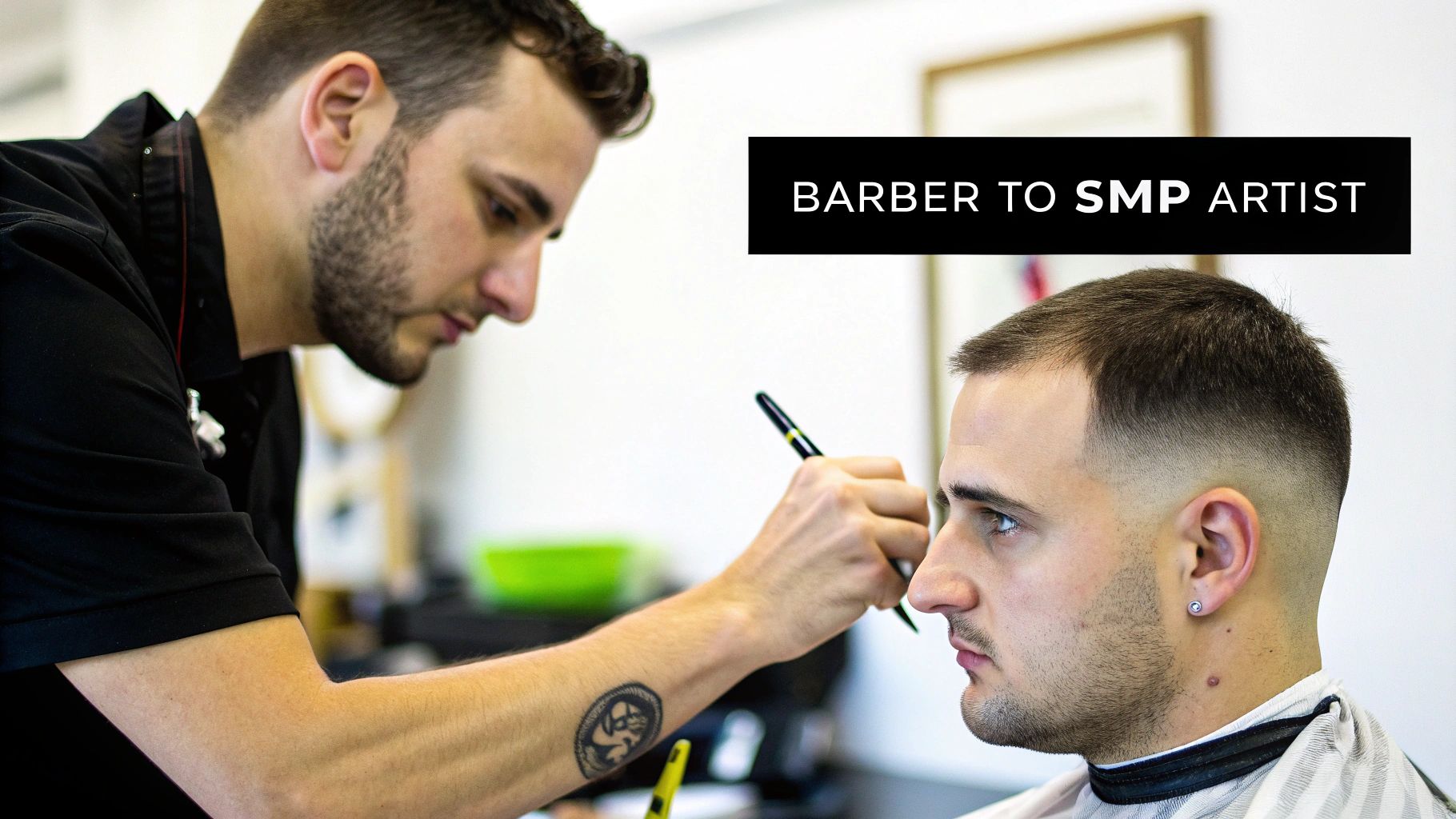
Think about the skill you put into every single fade and line-up. Now, imagine applying that same precision to a lasting, confidence-restoring solution for hair loss. That’s the door Scalp Micropigmentation (SMP) opens. It’s not just an add-on service; it’s a direct evolution of the skills you’ve already mastered.
As a barber, you’re more than just a hair cutter—you’re a trusted advisor. Your clients already turn to you for everything from grooming tips to quiet conversations about their thinning hair. This established trust is your single greatest asset when it comes to offering a high-value service like SMP.
Leveraging Your Existing Skill Set
The good news is, your daily grind has already prepared you for the technical and creative demands of SMP. Unlike people coming from totally different industries, you walk in with a real, hands-on understanding of what makes a hairline look authentic and sharp.
Let's break down the core skills you use every day:
- Hairline Artistry: You’ve got a trained eye for crafting natural, crisp hairlines that work with a client's face shape, age, and personal style. This is hands-down the most critical artistic component of a great SMP treatment.
- Understanding Facial Symmetry: You instinctively know how to balance a look, making sure a haircut or beard trim complements a client's features. The exact same principle applies to designing a scalp treatment that looks completely real.
- Client Consultation and Trust: Your regulars already trust your opinion. That existing relationship makes it so much easier to talk about a sensitive subject like hair loss and propose a solution that actually works.
- Precision and Dexterity: That steady hand you need for detailed clipper-over-comb work or a clean razor line? It’s the same muscle memory you’ll use to handle an SMP machine with incredible accuracy.
When you add SMP to your toolkit, you aren't starting from square one. You're building on a solid foundation of expertise that puts you way ahead of anyone new to the game.
The Business Opportunity in Your Barbershop
Bringing SMP into your shop is a massive business opportunity. Instead of sending clients with thinning hair somewhere else, you can become the one-stop solution. This doesn't just open up a huge new revenue stream; it cements your barbershop's reputation as the go-to place for men's grooming.
And while SMP is all about the scalp, the principles of using pigment for density can be applied elsewhere. For instance, the same techniques can be adapted to create fuller-looking beards. You can dive deeper into that in our guide to becoming a tattoo beard man. This guide will walk you through the whole process, showing you exactly how to turn your artistic talent into a premium service that clients are actively looking for.
So, What Exactly is Scalp Micropigmentation?
Alright, let's break down what Scalp Micropigmentation (SMP) really is. Forget about hair transplants or snake oil remedies. Think of it as a highly sophisticated cosmetic tattoo, but designed specifically for the scalp. It's an art form that solves a very real problem for a lot of guys.
At its heart, SMP is all about using microneedles to place thousands of tiny dots of pigment into the skin. An experienced artist carefully deposits these dots into the upper layer of the scalp, with each one perfectly replicating a single, natural hair follicle.
The result? An incredibly realistic illusion of a full head of hair. It's not about drawing on hair; it’s about layering these tiny impressions to create depth and the look of a short, buzzed haircut. This meticulous detail is what makes professional SMP a world away from a standard tattoo.
What Kind of Problems Can You Solve with SMP?
This is where it gets interesting for you as a barber. SMP is incredibly versatile, meaning you can offer a genuine solution for a whole range of hair loss issues your clients walk in with. It’s not a cookie-cutter service; it's a completely custom treatment.
Here are a few common scenarios where SMP is a game-changer:
- Fixing Receding Hairlines: You can build a sharp, clean, and natural-looking hairline for guys who want that fresh buzz-cut style.
- Creating Density in Thinning Hair: For clients with thinning on top, SMP fills in the gaps. It reduces that noticeable contrast between the scalp and their existing hair, making everything look much thicker and fuller.
- Hiding Scars: It's brilliant for camouflaging scars from old hair transplant surgeries (both FUT and FUE) or other injuries to the head.
- A Solution for Alopecia: For men and women dealing with alopecia, SMP can provide a complete and consistent look, restoring a full hairline and coverage.
This flexibility makes SMP a perfect service to add to your barbershop. You're already the expert they trust with their look, and now you can offer a real solution for their hair loss. You can dive deeper with our detailed guide on what scalp micropigmentation is and see the results for yourself.
Why Are Clients Choosing SMP?
Your clients are looking for answers that are straightforward, reliable, and last. SMP delivers on all fronts, and that's why its popularity is booming. It has some serious advantages over options like hair transplant surgery, medications, or those messy topical fibres.
For a start, the results are instant. A client walks out after their final session with a brand-new look. That's a massive confidence boost right there. Unlike a transplant, there’s no agonising wait to see if the new follicles will even survive.
SMP provides a guaranteed outcome. The artist, working with the client, has total control over the finished look—from the shape of the hairline to the final density. That kind of predictability is a huge deal for anyone fed up with the guesswork of other treatments.
On top of that, it's incredibly low-maintenance. Once the treatment has healed, it requires pretty much zero daily effort. It just fits perfectly into that easy, no-fuss lifestyle many guys want. The look is locked in 24/7, whether they're at the gym, in the pool, or just rolling out of bed.
This demand for reliable cosmetic services is backed by solid numbers. In Australia, the hairdressing and barbering sector is a huge part of the beauty industry, which is tipped to be worth around AUD 7.5 billion in 2025. The market has been growing at a strong clip, about 5.9% each year between 2020 and 2025, which shows people are ready to invest in quality services. This growth creates the perfect opportunity for skilled barbers to introduce a high-value service like SMP, tapping directly into what clients are asking for.
How to Choose the Right SMP Training Program
Deciding where to learn Scalp Micropigmentation is easily the most important choice you’ll make on this journey. This isn’t like learning a new fade technique over a weekend. SMP is a specialised cosmetic procedure that demands incredible precision, a sharp artistic eye, and a non-negotiable understanding of health and safety.
The training program you choose is the foundation you’ll build your entire SMP career on. Get it right, and you're set for success.
The market is flooded with options, from intense, hands-on workshops to super-flexible online courses. Each has its pros and cons, and the best fit for you really boils down to your learning style, your current schedule behind the chair, and how quickly you want to start offering this service.
Let’s break down the two main paths so you can make a smart investment in your future.
Comparing In-Person and Online SMP Training
To help you see the differences at a glance, here’s a straightforward comparison between the two main training formats.
| Feature | In-Person Training | Online Training |
|---|---|---|
| Learning Style | Ideal for hands-on learners who thrive with direct, real-time feedback. | Perfect for self-motivated individuals who need flexibility to learn at their own pace. |
| Practical Experience | Excellent. You'll work on live models under the direct supervision of an expert. | Relies on synthetic practice skins, with feedback often provided via video submissions. |
| Cost | Generally higher due to facility overheads, travel, and accommodation. | More affordable as it eliminates travel and facility costs. |
| Time Commitment | Requires taking dedicated time off work, often several consecutive days. | Highly flexible; you can fit lessons around your existing client and personal schedule. |
| Instructor Access | Immediate and direct. You can ask questions and get physical guidance on the spot. | Access is usually through email, Q&A sessions, or community forums; less immediate. |
| Networking | Great opportunities to connect with your instructor and fellow students face-to-face. | Networking happens through online communities, forums, or dedicated social media groups. |
Ultimately, neither option is inherently "better" — it's about what aligns with your personal circumstances and how you learn most effectively.
In-Person Workshops: The Hands-On Approach
For a lot of barbers, there's just no substitute for learning in person. This style of training is all about direct mentorship and real-world practice. You’ll be in the room with an experienced instructor who can literally guide your hand, correct your depth and angle in the moment, and answer questions as they pop into your head.
The single biggest advantage here is working on live models. Theory is crucial, but it's another thing entirely to feel how the needle interacts with real skin, manage a client's comfort, and watch the results come to life right in front of you. That experience is priceless.
The catch, of course, is that in-person training demands a serious commitment. It usually means stepping away from your barbershop—and your income—for several days. You’ll also need to budget for travel and a place to stay if the course isn't local.
Online Courses: The Flexible Alternative
Online SMP training for barbers has exploded in popularity, and for good reason. It offers a level of flexibility that in-person workshops simply can't match. You can learn from anywhere, squeezing in modules between client appointments or after hours.
These courses are almost always more affordable because they don't have the overheads of a physical training academy. The best online programs use high-quality, detailed video tutorials, comprehensive manuals, and plenty of practice on synthetic skins to build your foundational skills from the ground up.
The trade-off? You lose that immediate, over-the-shoulder feedback. To succeed with online training, you have to be disciplined and self-motivated. It’s absolutely vital to choose a program that offers strong support after you’ve finished the modules, like video critiques of your work or live Q&A sessions with instructors. Before jumping in, it's a good idea to think about whether you should train in Scalp Micropigmentation to make sure you're ready for the commitment.
Key Questions to Ask Any Training Provider
Whether you're leaning towards an in-person workshop or an online course, you need to do your homework on the provider. Treat this like an investigation, because your money and your professional reputation are on the line.
Here’s a checklist of must-ask questions:
- Who’s the Instructor? Find out who is actually teaching the course. Look for a seasoned artist with a massive portfolio of top-tier work and, just as importantly, actual teaching experience.
- What’s in the Curriculum? Does it cover everything from colour theory and skin anatomy to advanced hairline design and marketing your new service? A great program teaches you how to run the business, not just perform the procedure.
- How Much Hands-On Practice? For in-person courses, ask point-blank: "How many live models will I personally work on?" For online courses, ask what practical assignments are required and what kind of feedback you'll get.
- What Happens After I'm Certified? The learning doesn't stop when the course ends. The best trainers offer ongoing support, whether it's access to a private community, mentorship calls, or a direct line for advice when you're stuck on a tricky client.
- Can I See Your Graduates' Work? Ask for proof. Testimonials are great, but a gallery of successful student results speaks volumes about the quality of the training.
Investing in top-shelf training from day one is the smartest financial decision you can make. It helps you avoid costly mistakes down the road, builds immediate trust with clients, and sets you on a path for long-term profit and a stellar reputation in the SMP industry.
This decision tree can help you visualise where SMP fits into the hair restoration landscape for your clients.
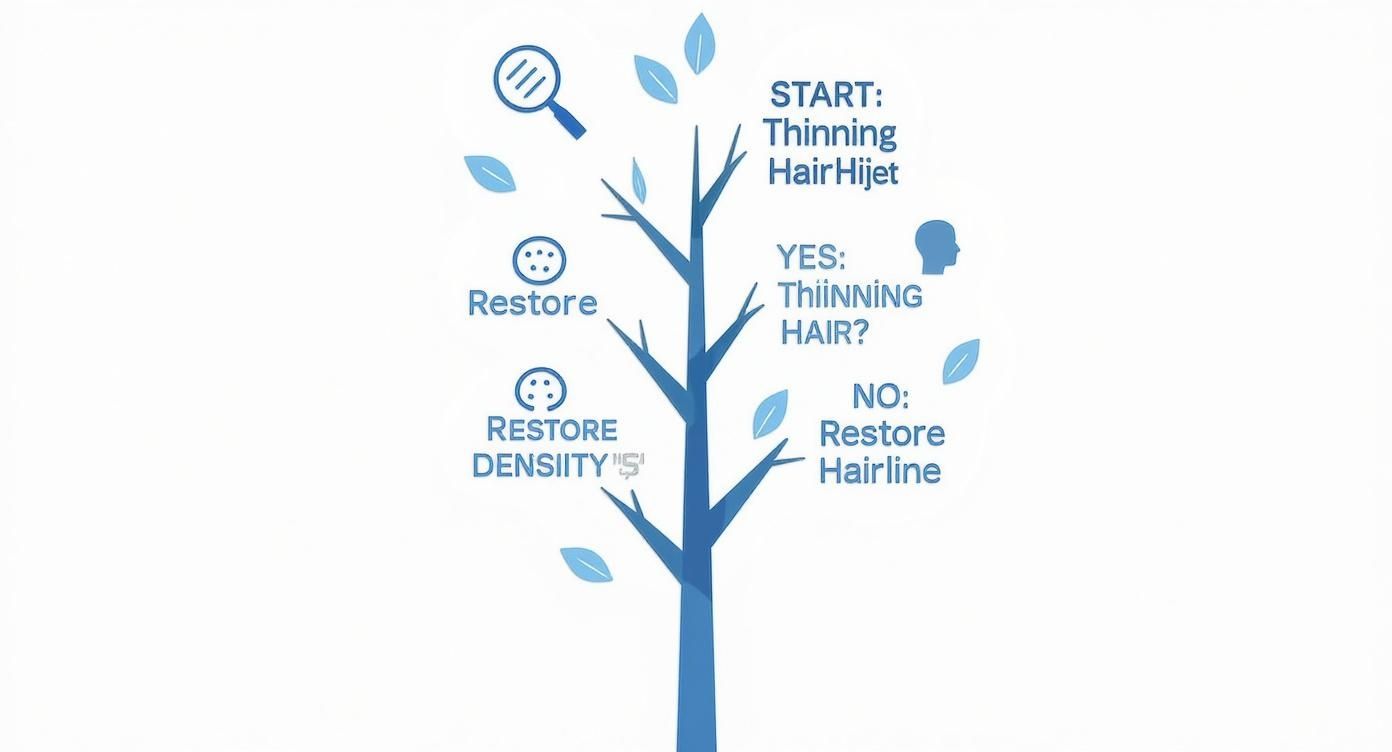
As you can see, SMP is an incredibly versatile solution, perfect for everything from adding density to thinning hair to completely rebuilding a sharp, clean hairline.
Building Your Professional SMP Toolkit
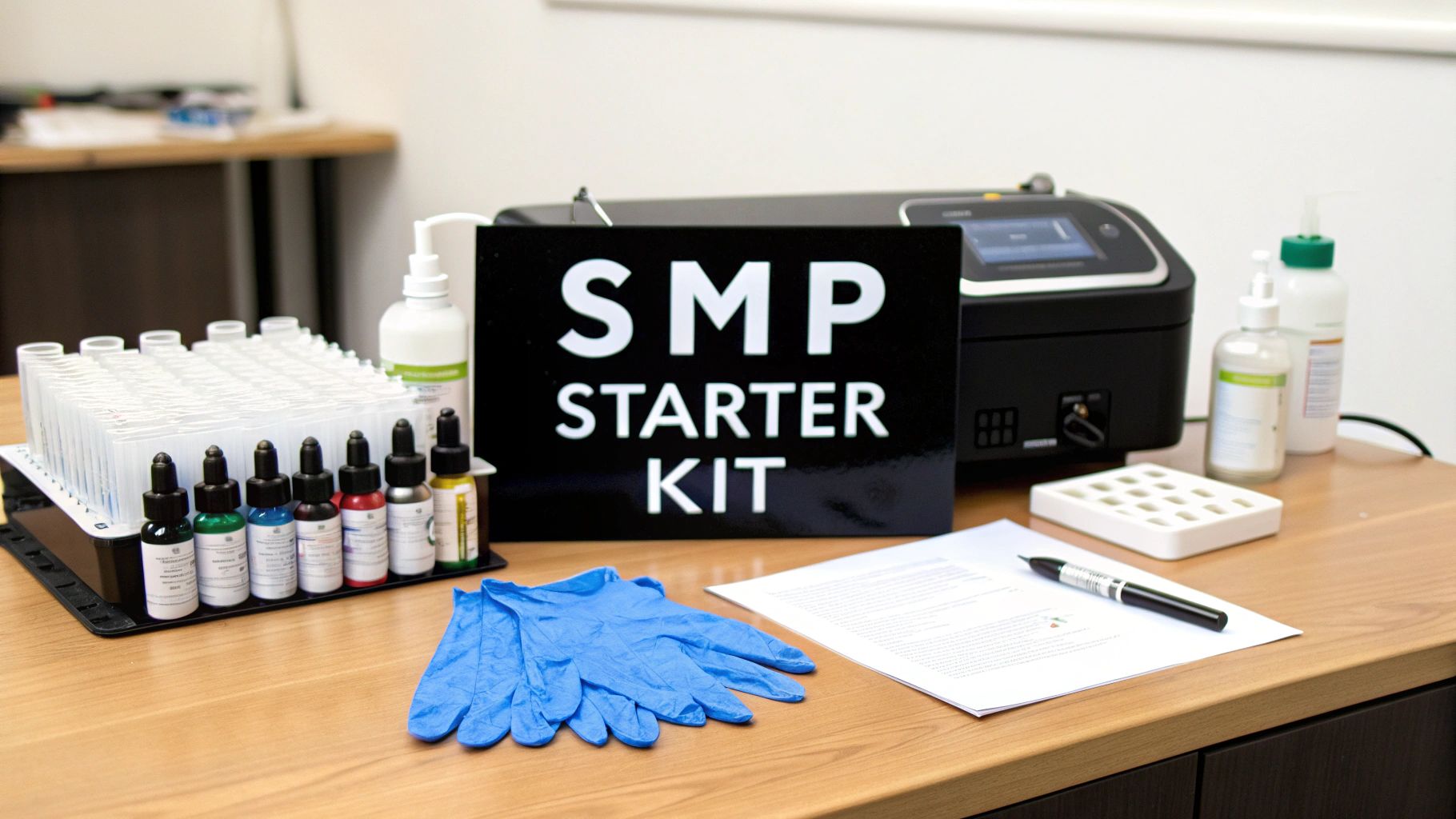
You wouldn't use just any clippers or shears at your station, right? You've picked each tool for a reason. Building your SMP toolkit demands that same level of care and precision. This isn't about grabbing standard tattoo gear; it's about curating a specialised set of instruments built for the unique canvas of the human scalp. Getting to know your tools inside and out is a cornerstone of any decent SMP training for barbers.
The right gear is the difference between crisp, hyper-realistic results and a blotchy, faded mess that could ruin your reputation. Think of your SMP machine and needles as an extension of your own hand—they're what translate your skill into a life-changing result for your client.
The Core Equipment You Need
The heart of your setup is the SMP machine. At first glance, it might look like a regular tattoo machine, but it’s specifically engineered for the delicate, precise work of scalp micropigmentation. These machines give you pinpoint control over needle depth, which is crucial for creating those tiny follicle impressions without them blurring or spreading under the skin.
Next up, your needles. This is definitely not a one-size-fits-all situation. You'll need a range of needle configurations in your arsenal. We’re talking everything from fine, single-point needles for creating those soft, detailed hairlines, to multi-point needles (like a 3-Round Liner) for efficiently building density over larger areas of the scalp. A huge part of the craft is knowing exactly which needle to grab for which part of the job.
And then there's the pigment. This is non-negotiable. You absolutely must use high-quality, carbon-based pigments made specifically for SMP. These are designed to heal true, settling into a natural charcoal-grey tone that perfectly mimics a real, shaven hair follicle. Use standard tattoo inks, and you risk the colour turning blue or green over time—a disaster you and your client want no part of.
Essential Hygiene and Safety Supplies
Your barbershop is already a clean environment, but SMP takes hygiene to a whole new level. Since the procedure involves breaking the skin, maintaining a sterile workspace is absolutely critical to prevent any risk of infection and keep your clients safe.
Here's what your daily setup will involve:
- Medical-Grade Gloves: Nitrile gloves are the standard for every single procedure.
- Disposable Needle Cartridges: Needles are strictly single-use. You’ll open a fresh one in front of the client and dispose of it in a sharps container immediately after the session.
- Barrier Film and Covers: Everything gets wrapped. Your machine, power supply, and cords must be covered in disposable barrier film to eliminate cross-contamination.
- Hospital-Grade Disinfectants: You'll need properly certified cleaning agents to sterilise your station and any non-disposable equipment between every appointment.
Think of your SMP station like a surgical theatre. Every surface must be clean, every disposable item must be fresh, and every protocol must be followed without exception. This commitment to safety builds immense trust with your clients.
A Sample Starter Kit and Estimated Costs
Getting started does require an upfront investment, but it's one that pays for itself surprisingly quickly. A good starter kit from a reputable supplier will set you up with everything you need for your first handful of clients. If you’re hunting for quality equipment, you can find a great selection when you [buy tattoo machines in Australia](https://rightwing-health.info/blogs/news/buy-tattoo-machines-australia%3C/a%3E%29.%3C/p%3E
- SMP Machine & Power Supply: $500 - $1,500
- Assorted Needle Cartridges (Box of 20): $50 - $100
- SMP Pigment Set (Multiple Shades): $200 - $400
- Practice Skins & Drawing Tools: $100 - $200
- Hygiene Supplies (Gloves, barriers, etc.): $100 - $150
All up, your initial investment for a complete professional kit will likely land somewhere between $950 and $2,350. It might sound like a lot, but keep in mind that the fee for just one full SMP procedure is often more than this entire amount. For a skilled artist, the return on investment is incredibly fast.
Pricing Your SMP Services and Maximising Profit
Alright, you've done the hard work and completed your SMP training for barbers. Now comes the exciting part: turning that new skill into a serious money-maker for your shop. Getting your pricing right is everything. This isn't about plucking a number from thin air; it's about setting a clear, value-based structure that reflects the incredible, life-changing results you're delivering.
The industry standard for pricing SMP is tied to the Norwood Scale—the system that classifies the different stages of male pattern baldness. This creates a really straightforward, tiered pricing model that clients can immediately understand. A bloke at a Norwood 2 or 3 (just a bit of hairline recession) is going to pay a lot less than someone at a Norwood 6 or 7 (significant hair loss across the scalp).
This approach keeps your pricing fair and connects it directly to the amount of work, time, and pigment each client needs.
Setting Your Price Structure
A solid price list should cover every possible client scenario, from small touch-ups to full-scalp transformations. By creating clear packages, you make the initial consultation a breeze and set clear expectations right from the get-go.
Here are a few examples of how you could structure your services:
- Scar Camouflage: This is usually a smaller, more focused job. You'll want to price it on a case-by-case basis, depending on the scar's size and complexity. Prices often land between $500 and $1,500.
- Density Fill: Perfect for clients with thinning hair who just want to create the illusion of more thickness. This is typically priced by the area (like the crown or mid-scalp) and you can expect to charge anywhere from $1,500 to $3,000.
- Full Scalp Treatment (Norwood 5-7): This is your top-tier service, almost always needing 3-4 sessions to get it perfect. A comprehensive treatment like this will generally be in the $3,000 to $5,000+ range.
It's a really smart move to bundle your prices to include all the required sessions. Most full treatments need at least three visits to build up the perfect density and shade. For a closer look at how to structure your costs, check out our detailed guide on scalp micropigmentation prices.
Calculating Your Return on Investment
Let's talk numbers—the ROI. The initial cost for your SMP kit and training might feel like a big step, but the return is incredibly quick. Because this is such a high-value service, you make back your investment much faster than you would with standard cuts and shaves.
Think of it this way: the revenue from just one or two full scalp treatments can often pay for your entire initial investment in training and equipment. Everything after that is pure profit.
Let's walk through a simple, realistic scenario. Say your total startup cost for training and gear is $7,000.
- You book your first client for a Norwood 5 treatment and charge $4,000.
- Your second client needs a density fill for their crown, and you charge $2,000.
- Your third client wants to hide a hair transplant scar, and you charge $1,000.
Just like that, after only three clients, you’ve brought in $7,000 and completely covered your startup costs. Every single client you see from that point on is directly adding to your shop's bottom line. This rapid ROI makes adding SMP one of the most profitable decisions a barber can make.
The barbering industry here in Australia is in great shape. As of August 2025, there are about 66,800 employed barbers and hairdressers pulling in a median weekly earning of AUD 1,121. With positive job growth expected, adding a high-ticket service like SMP puts you in a prime position to smash those average earnings. You can read more about the Australian barbering industry on the Jobs and Skills Australia website.
Marketing Your New SMP Services to Clients
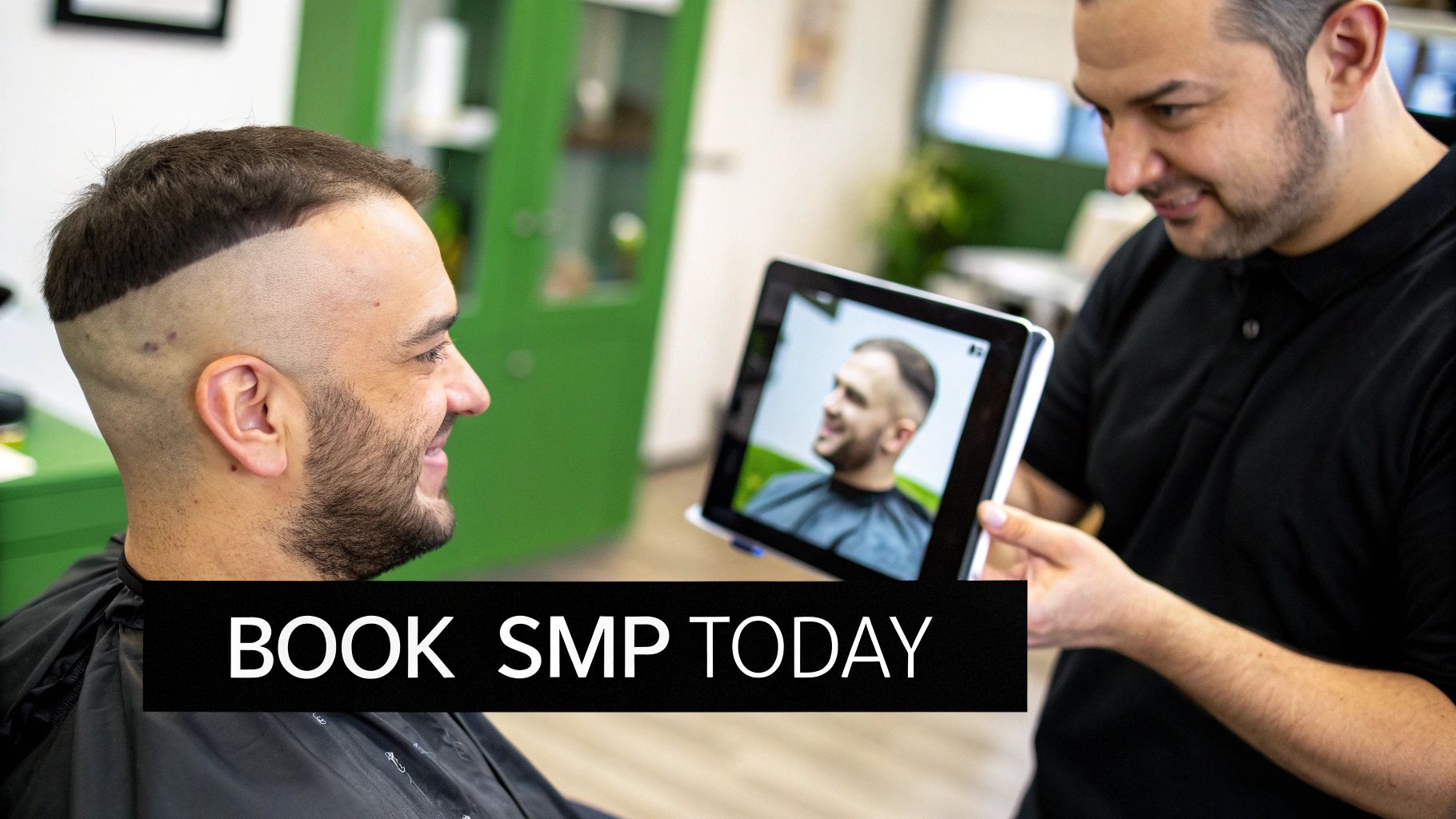
Finishing your SMP training is a huge milestone, but now the real work begins: getting clients through the door. The brilliant thing is, your first and best pool of potential clients is already sitting in your chair every single day. You don't need a massive marketing budget, just a smart strategy that builds on the trust you already have.
The secret is to shift your mindset from being just a barber to also being a hair loss consultant. It all starts with low-key, education-based marketing that takes the mystery out of SMP and positions it as a practical solution for your existing clientele. You have a massive advantage because the conversation can start naturally during a regular haircut.
Starting the Conversation In-Shop
Your barbershop is your number one marketing tool. It's where your clients are relaxed, comfortable, and already thinking about their appearance. By adding a few simple things to your space, you can plant the seed about SMP without ever sounding like you're doing a hard sell.
These small changes can make a world of difference:
- Build a Pro Portfolio: Get a high-quality lookbook printed or load up a dedicated tablet. Fill it with impressive before-and-after photos of your work (your training models are perfect to start with) and leave it on a coffee table or at your station where people will see it.
- Use Tasteful Signage: A professionally designed flyer or a small, classy sign at your reception desk mentioning "Hair Density Solutions" or "Hairline Restoration" is often enough to get people curious.
- Educate While You Cut: When a client brings up their thinning hair, you now have a genuine solution to offer. You can casually say, "You know, a lot of my clients are looking into Scalp Micropigmentation for that. It’s a fantastic way to restore the look of density." That simple sentence opens the door to a real, helpful chat.
Your goal isn't to sell; it's to educate. When a client sees SMP as a credible solution offered by someone they already trust, the service practically sells itself.
Taking Your SMP Services Digital
Once you’ve got your in-shop approach dialled in, it’s time to bring in new clients from online. Your digital marketing should feel just like your in-person style: authentic, visual, and all about the incredible results. Social media platforms like Instagram are tailor-made for showing off the kind of visual transformation SMP delivers.
Kick things off by focusing on these core digital strategies:
- Show Off Your Work on Instagram: Before-and-afters are your strongest asset, period. Post high-quality photos and videos that show the whole journey, from the initial consultation to the final, healed result. Don't forget to use local hashtags like #SMPPerth or #SydneyHairTattoo to attract local eyes.
- Update Your Website & Booking System: Add a dedicated "Scalp Micropigmentation" page to your website. Make sure it has a detailed FAQ section, clear pricing info, and a really obvious call-to-action button to book a free consultation.
- Lean into Local SEO: Get your Google Business Profile updated immediately to list SMP as a service. Gently encourage your happy SMP clients to leave a review mentioning their experience—this will give you a massive boost when people in your area search for "SMP near me."
To really get ahead, you'll want to implement some proven social media marketing strategies to get your content right, engage with your audience, and build a solid brand. By combining powerful in-shop conversations with a smart online game plan, you’ll create a steady stream of high-value SMP clients for your business.
Common Questions About SMP Training for Barbers
Thinking about adding Scalp Micropigmentation to your services? It’s a big step, and if you’re like most barbers, you’ve probably got a bunch of practical questions swirling around. You’re used to the clear-cut world of barbering, so it’s only natural to want the full story before you invest your hard-earned time and money.
Let’s break down some of the most common things barbers ask when looking into SMP training.
First up, regulation. This is a big one. In Australia, SMP is a form of cosmetic tattooing, which means it’s regulated by state and territory health departments. This isn't like just getting a new set of clippers; you’ll need to tick specific boxes for hygiene, safety, and licensing. This usually involves getting a skin penetration licence and making sure your workspace is up to health code. Any decent training course will walk you through exactly what your local laws require.
Then there’s insurance. Your standard barbershop liability policy almost certainly won't cover a cosmetic procedure like SMP. You'll need to get a separate, specialised insurance policy for cosmetic tattooing. Think of it as your safety net—it protects you, your shop, and your clients. This is absolutely non-negotiable before you even think about taking on your first client.
Navigating Client Expectations and Skill Transition
A lot of barbers ask how the SMP consultation differs from a regular haircut chat. While the basics of listening and understanding what the client wants are the same, the stakes are obviously higher with a permanent procedure. A huge part of SMP training for barbers is learning how to manage those expectations properly.
You'll get skilled at conducting in-depth consultations, making sure clients fully grasp the process, the healing, and what the results will look like years down the track. It’s about more than just drawing a line; it’s about discussing hairline design, how the pigment might fade over time, and why multiple sessions are needed to build that perfect, natural-looking density.
You might be surprised how naturally the transition from clippers to an SMP machine feels. Your steady hand, your grasp of angles, and your trained eye for symmetry give you a massive head start. The main new skills you'll pick up are mastering needle depth, choosing the right pigment, and creating that layered, dot-by-dot effect that mimics real hair follicles.
Finally, the question I hear all the time: "How do I get my first clients?" Simple. Look at the guys already in your chair. Your current customer base is an absolute goldmine. For barbers getting started in SMP, learning some proven small business marketing tips is key to turning those initial conversations into bookings. Good training won’t just hand you a needle; it will give you the business and marketing know-how to make sure your new service is a success right from the get-go.
At My Transformation, we are dedicated to providing the highest quality SMP services and training to help you succeed. Visit our website to learn more about our courses and how you can start your journey today.