

Your Guide to Fixing a Botched Hair Transplant
When you invest your time, money, and hope into a hair transplant, the last thing you expect is to be left with a result that looks worse than before. A botched hair transplant isn't just a minor disappointment; it's a procedure that leaves you with an unnatural appearance, obvious scarring, or hair that just doesn't grow properly. It’s the kind of outcome that happens when inexperienced hands or outdated techniques are at play, falling far short of what you were promised.
What a Botched Hair Transplant Really Looks Like
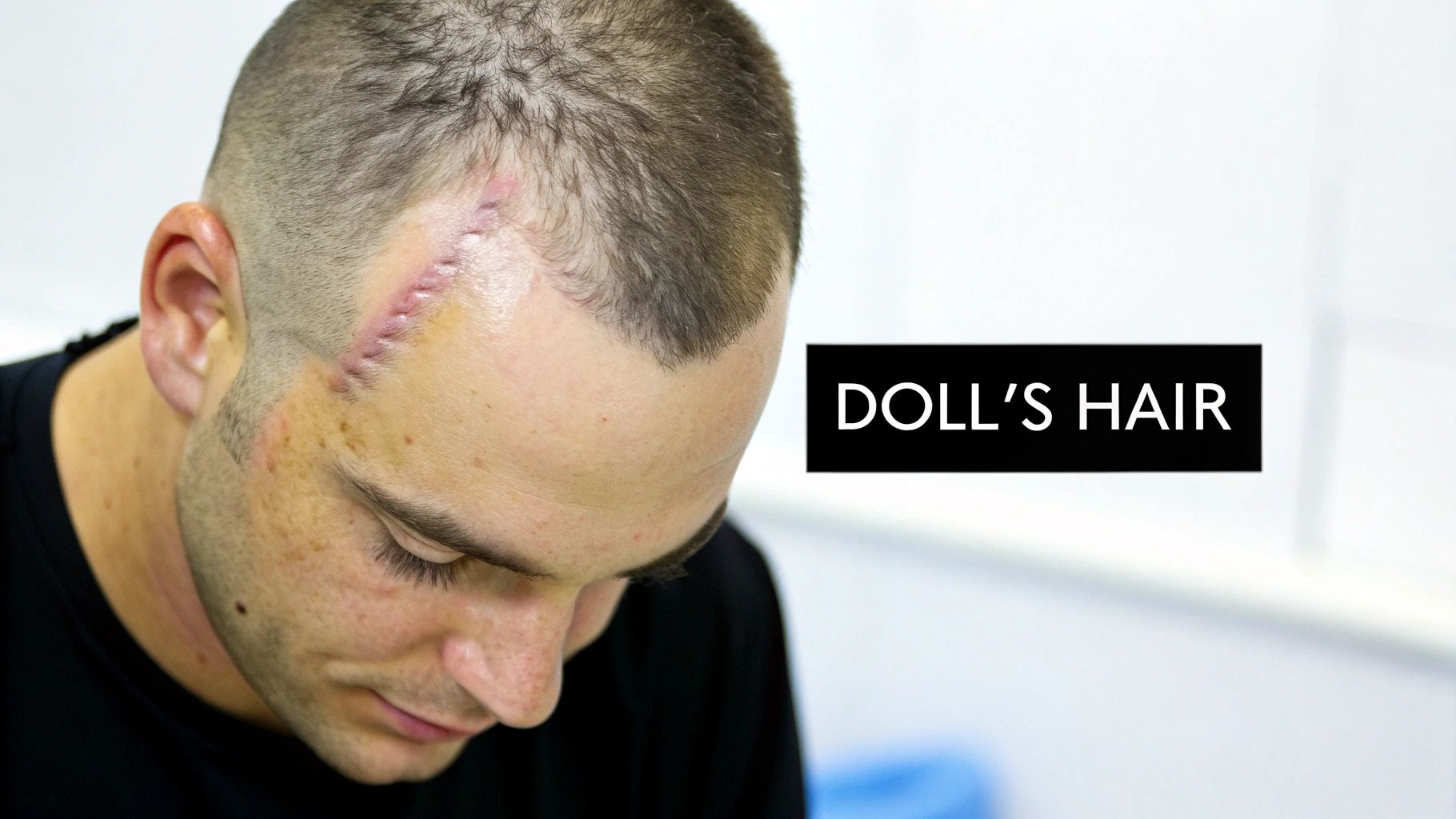
Realising your hair transplant hasn't worked out is a gut-wrenching experience. If you're reading this, chances are you're worried about your own results and trying to figure out if what you're seeing is normal. It's completely valid to feel that way.
A good way to think about it is to compare it to art. A skilled artist creates a masterpiece where every brushstroke is deliberate, blending seamlessly to create a natural, cohesive picture. A botched transplant, on the other hand, is like a paint-by-numbers job gone wrong—the colours are in the wrong place, the lines are harsh, and it just looks… off.
Let's break down the most common red flags. Knowing what to look for will help you objectively assess your situation and confirm whether your concerns are justified. This is the first, most crucial step toward finding a real solution.
Unnatural and Pluggy Hairlines
This is often the most obvious sign of a bad transplant. The hairline frames your face, so when it’s wrong, it’s impossible to miss. Back in the early days of hair restoration, surgeons used large "plugs" of hair follicles, creating that infamous "doll's hair" look. While technology has improved, a poorly trained surgeon can easily replicate these mistakes.
A natural hairline should be soft and slightly imperfect, using delicate, single-hair grafts right at the front to mimic how hair actually grows. Here’s what to watch out for:
- A Perfectly Straight Line: Nature never draws in straight lines. A ruler-straight hairline screams artificial and is a dead giveaway of poor artistry.
- "Plugs" or "Corn Rows": This happens when grafts with multiple hairs are crammed into the frontline. Instead of a soft, feathered look, you get distinct clumps.
- Incorrect Hair Direction: The surgeon didn't pay attention to the natural angle and flow of your hair, causing transplanted hairs to stick straight out instead of lying flat.
Poor Density and Patchy Growth
Another massive problem is when the hair just doesn't look full enough. You've waited the full 12-18 months for the final result, only to see that the transplanted area is still sparse and you can easily see the scalp through it. This usually means not enough grafts were used, or worse, a large number of the transplanted follicles didn't survive the journey.
In a successful procedure, you can expect a graft survival rate of 90-95%. When that rate plummets, it's often due to the surgical team mishandling the grafts or poor post-operative instructions. This is what leads to that patchy, uneven look.
It’s an incredibly frustrating situation. You've gone through the whole process, paid the price, and are left with coverage that makes the transplant obvious to everyone.
Visible and Excessive Scarring
While all hair transplant procedures leave some scarring, it should be minimal and well-hidden. Obvious, unsightly scarring is a classic sign of a botched job.
With the FUT (or "strip") method, a rushed or poorly skilled surgeon can leave you with a wide, raised scar across the back of your head that's impossible to hide without long hair.
With FUE procedures, the risk comes from over-harvesting the donor area. When a surgeon takes too many follicles from one spot, they can create a "moth-eaten" look—a pattern of tiny white dot scars that becomes very noticeable with a short haircut. Knowing the difference between normal healing and excessive damage is key. You can find out more about how to deal with a hair transplant scar in our detailed guide. A good surgeon protects your donor area, because it's a finite resource.
Understanding Why Hair Transplants Fail
When a hair transplant doesn't turn out right, it's natural to wonder if you did something wrong during recovery. But let's be clear: the result is almost always sealed the day of the procedure, determined entirely by the skill of the clinic and surgeon you chose.
Knowing why it failed isn’t about assigning blame. It's about understanding the link between what you're seeing in the mirror and the technical mistakes that happened during the surgery. This knowledge is your power when you start looking for a solution.
Think of a surgeon like a master landscaper designing a high-end garden. They don't just randomly plant trees. They consider the soil, the sunlight, and how each plant will grow and interact with the others over years to create a seamless, natural look. A cheap or inexperienced operator, on the other hand, just shoves plants in the ground and hopes for the best. The difference in the final result is stark, and it's the same with hair transplantation.
The Critical Role of Surgeon Experience
Honestly, the single biggest factor behind a successful transplant is the person holding the tools. A great surgeon is part technician, part artist. They have the technical skill to handle delicate grafts, but also the artistic eye to create a hairline that isn't a dead-straight line, placing each follicle at just the right angle to mimic natural growth.
The problem is, the industry has a dark side. We’ve seen a huge rise in "black market" clinics, often overseas, that offer unbelievably low prices. In these places, it’s common for poorly trained technicians—not qualified surgeons—to do most of the work. They treat your finite donor hair like it's an unlimited resource, which can lead to disaster.
The fallout from this inexperience is serious. A real surgeon knows how to minimise trauma to both the scalp and the grafts, which is key to their survival. An unqualified technician can easily damage follicles during extraction or implantation, leading directly to the patchy, thin results you might be seeing now.
Technical Errors That Lead to Failure
Putting aside general inexperience, most botched jobs come down to a few specific technical blunders. These are the mistakes made in the operating room that become visible problems months later.
-
Improper Graft Handling: Hair follicles are incredibly fragile living tissues. Once they're taken from your scalp, they need to be stored in a specific solution at the right temperature. If they're left out too long, handled too roughly, or allowed to dry out, they die before they're even put back in.
-
Incorrect Implantation Depth: This is a classic rookie mistake. If a graft is placed too deep, you can end up with pimples, cysts, and a bumpy, cobblestone-like texture on your scalp. If it’s too shallow, it won’t connect to the blood supply and will fail to grow.
-
Over-Harvesting the Donor Area: A good surgeon treats your donor hair like gold because it's a limited resource. Over-harvesting means taking too many grafts from one spot on the back or sides of your head. This leaves a patchy, "moth-eaten" look that can be incredibly difficult, if not impossible, to fix later.
In Australia, the success of a hair transplant hinges on the surgeon and their technique. Top practitioners consistently see graft survival rates between 90-95%. However, with cut-rate clinics or black market operations, it's not uncommon for rejection rates to skyrocket past 30%. A massive red flag is a survival rate below 85%, which almost always points to serious issues with technique or post-op care. With the right team, you can find out how hair transplant results can last forever.
Poor Planning and Flawed Artistry
Finally, a hair transplant isn't just a medical procedure; it's a long-term strategic plan. A clinic that doesn't properly assess your hair loss pattern or consider where it's headed in the future is setting you up for failure.
They might give you a sharp, low hairline that looks okay for a year or two. But as your natural hair continues to recede behind it, you'll be left with an isolated island of transplanted hair—a dead giveaway of a bad transplant. This lack of foresight proves they were focused on a quick payday, not a natural result that would stand the test of time.
Your Action Plan After a Bad Hair Transplant
Realising your hair transplant hasn't delivered the results you were promised is a gut-wrenching moment. It’s completely normal to feel a mix of frustration, disappointment, and even panic. But the absolute worst thing you can do right now is rush into another decision.
Before you do anything else, just pause and take a breath. This isn't about finding a quick fix; it's about methodically and patiently creating a smart plan to get things back on track. Let's walk through the steps that will turn that frustration into a proactive strategy, putting you back in control of your journey.
Step 1: Wait and Observe
I know this is the hardest part, but the most critical first step is to simply wait. A hair transplant is a marathon, not a sprint, and the final look you're hoping for won't be truly visible for a full 12 to 18 months. What seems patchy, thin, or just plain wrong at the six-month mark could very well be a work in progress.
During this period, the transplanted follicles are still settling in, and new hairs are just kicking off their growth cycle. Judging the outcome too soon is like critiquing a garden a week after you’ve planted the seeds. You have to give your scalp the time it needs to heal and for those new hairs to mature. To get a better sense of what's normal, it helps to review a detailed hair transplant recovery timeline to understand each stage of the process.
Step 2: Document Everything Meticulously
While you're playing the waiting game, get serious about record-keeping. This documentation will be your most powerful tool if you decide to get a second opinion or explore corrective work later on. A vague feeling of unhappiness is one thing; clear, dated evidence is something no one can argue with.
Here’s what you should be tracking:
- Consistent Photos: Take clear, well-lit photos of your scalp every month. Make sure you capture the same angles each time—front, top, both sides, and the back. Consistent lighting is key to showing the real story.
- Written Notes: Keep a simple journal. Jot down your observations about specific areas of concern, like lingering redness, hairs growing at weird angles, or spots that look unusually thin.
- Original Paperwork: Dig out every document related to your original procedure. This includes consultation notes, consent forms, invoices, and any post-op care instructions you were given.
Step 3: Request Your Medical Records
Once you've passed that 12-month mark and are still unhappy with what you see, it's time to arm yourself with more information. Contact the clinic that performed the surgery and formally request a complete copy of your records. These are your medical files, and you have a right to them.
These records should detail the exact number of grafts used, the technique (FUT or FUE), and a "map" showing where those grafts were placed. This isn't just for your own peace of mind—it's absolutely essential for a new specialist to understand what was done and, just as importantly, what donor hair you have left to work with.
Step 4: Seek an Honest Second Opinion
With your photo log and surgical records in hand, it's time for the most important step: getting a second opinion from a reputable, experienced specialist. You are not looking for another sales pitch here. You need an honest, unbiased assessment from an expert who has a proven track record in botched hair transplant repairs.
Be very cautious of anyone who immediately tries to sell you on another surgery. A true professional will start by examining the health of your scalp, carefully evaluating your remaining donor area, and discussing all the options on the table, including non-surgical ones. Their priority should be a realistic, long-term solution, not a quick sale that could make a bad situation even worse.
Comparing Your Options for Corrective Treatment
Realising your hair transplant hasn't gone to plan is a tough pill to swallow, but it’s definitely not the end of the line. The focus now has to shift from what went wrong to how to make it right. Thankfully, there are several solid ways to either fix or conceal a poor result, and each has its own pros, cons, and best-case scenarios.
Getting your head around these different paths is the first step toward feeling back in control. The three main avenues are another hair transplant (a revision), Scalp Micropigmentation (SMP), or using cosmetic camouflage techniques. Let's break them down to see what might be the best fit for you.
Before jumping into any decision, it's critical to follow a calm, methodical process. This flowchart lays out the immediate steps you should be taking.
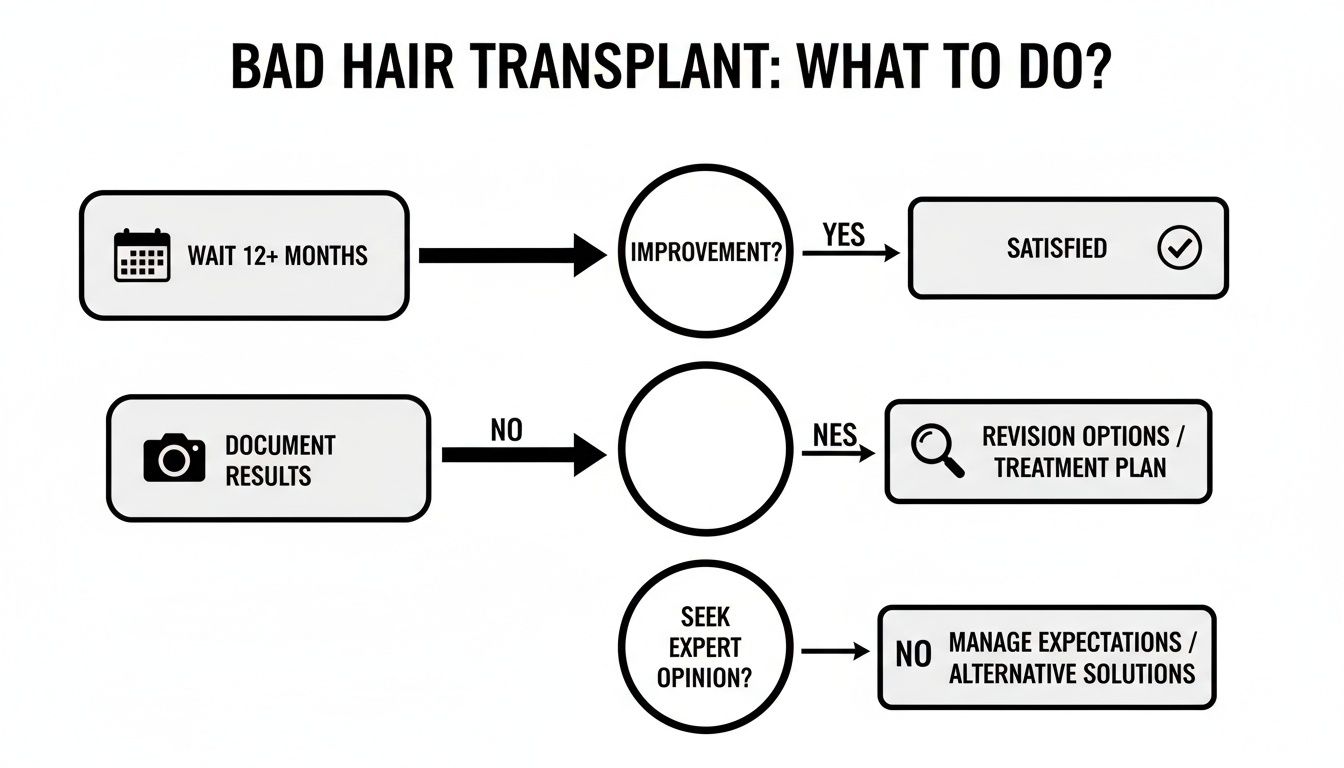
As you can see, the key is patience. You need to wait for the final result to reveal itself before you document everything and get a genuine expert opinion.
Revision Hair Transplant Surgery
For many, the first thought is to simply try again with another surgery. A revision transplant is designed to correct the mistakes of the first procedure. This might involve using finer grafts to soften a harsh, pluggy hairline, strategically adding density to patchy spots, or trying to hide scarring.
But this route comes with some big warnings. A second surgery is entirely dependent on having enough healthy donor hair left, and your original procedure might have already exhausted or damaged that precious supply. It's another expensive and invasive surgery with a long recovery, and there’s absolutely no guarantee that round two will be any more successful.
Crucial Consideration: A revision is only a viable option if it's done by an elite surgeon who genuinely specialises in repair work. Rushing into another surgery with the wrong person can make things much worse, leaving you with even less donor hair and more visible scarring.
Scalp Micropigmentation (SMP)
Scalp Micropigmentation has completely changed the game for fixing bad hair transplants. It’s a non-surgical technique where a skilled practitioner uses specialised pigments to place thousands of tiny dots on the scalp, perfectly mimicking the appearance of individual hair follicles.
Think of it as a highly advanced form of cosmetic tattooing, creating a permanent 3D illusion of hair. An experienced SMP artist can tackle several problems at once:
- Create the Illusion of Density: By tattooing tiny "follicles" in between the sparse transplanted hairs, SMP makes the entire area look dramatically thicker and fuller.
- Camouflage Scars: SMP is brilliant at hiding scars. It can blend away the long linear scars from an FUT procedure or the hundreds of tiny dot scars from FUE, making them virtually disappear.
- Redesign Unnatural Hairlines: A practitioner with an artistic eye can completely redraw a harsh, doll-like hairline, giving you a much softer and more natural-looking frame for your face.
SMP is often the perfect solution when your donor hair is limited because it doesn't use any of it. It gives you a guaranteed result almost immediately, without the pain, recovery, or risks of more surgery. To see how it measures up against other treatments, you can check out our detailed guide on how SMP compares to other hair restoration methods.
Camouflage Techniques
This category covers the quick, temporary fixes like hair fibres, scalp sprays, and special concealers. These products work by sticking to your existing hair to make each strand look thicker, or by colouring your scalp to reduce the noticeable contrast between your skin and hair.
While these products can give you a decent short-term confidence boost for minor issues, they are not a permanent fix. They need to be applied every day, can look messy or fake if you don't get it just right, and risk running or smudging in the rain or during a workout. They’re a temporary patch, not a solution to the real underlying problems.
Making the right choice means weighing up what each option can realistically deliver. This table provides a quick, side-by-side look at the three main approaches to help you compare.
Corrective Options for a Botched Hair Transplant
| Feature | Revision Transplant | Scalp Micropigmentation (SMP) | Camouflage Techniques |
|---|---|---|---|
| Primary Goal | Physically add new hair grafts to correct density, scarring, or hairlines. | Create the illusion of density and conceal scars by tattooing thousands of micro-dots resembling hair follicles. | Temporarily conceal thin areas and reduce scalp visibility with topical products like fibres or sprays. |
| Invasiveness | Highly Invasive. A full surgical procedure requiring anaesthesia and significant recovery time. | Non-Invasive. A cosmetic tattooing procedure with minimal discomfort and no downtime. | Non-Invasive. A topical product that is applied and washed out daily. |
| Permanence | Permanent, but success is not guaranteed and depends heavily on donor hair availability and surgeon skill. | Long-Lasting. Typically lasts 4-6 years before a minor touch-up is needed to maintain vibrancy. | Temporary. Must be reapplied daily and can be affected by sweat, rain, or swimming. |
| Best For | Patients with minor issues, sufficient healthy donor hair remaining, and access to a top-tier revision surgeon. | Scar concealment, adding density to thin results, fixing unnatural hairlines, and for those with limited donor hair. | Hiding minor thinness as a short-term solution while considering more permanent options. |
| Main Drawback | High cost, significant risk of failure, further depletion of limited donor hair, and long recovery period. | Requires a highly skilled artist for natural results; a poor application can look artificial. | Can look unnatural, requires daily effort, and is not a "get up and go" solution. |
Each path has its place, but for many dealing with the fallout from a poor transplant, SMP offers the most reliable and versatile solution without risking further damage.
The biggest challenge in Australia is cutting through the noise. Many clinics make grand promises like "95% success rates" but offer zero credible evidence. Shockingly, some studies suggest that as many as 90% of patients who get a bad result don't even know it's a poor job—they just assume that's the best that could be done. Of those who have a low-quality procedure, only a tiny 6% ever seek corrective work, meaning countless Aussies are likely living with a botched hair transplant without realising it.
When you start looking for answers, getting a professional, unbiased opinion is invaluable. Consulting with a reputable aesthetics clinic allows you to explore potential corrective options and build a realistic plan that truly fits your situation and what you hope to achieve.
How SMP Solves Botched Transplant Issues
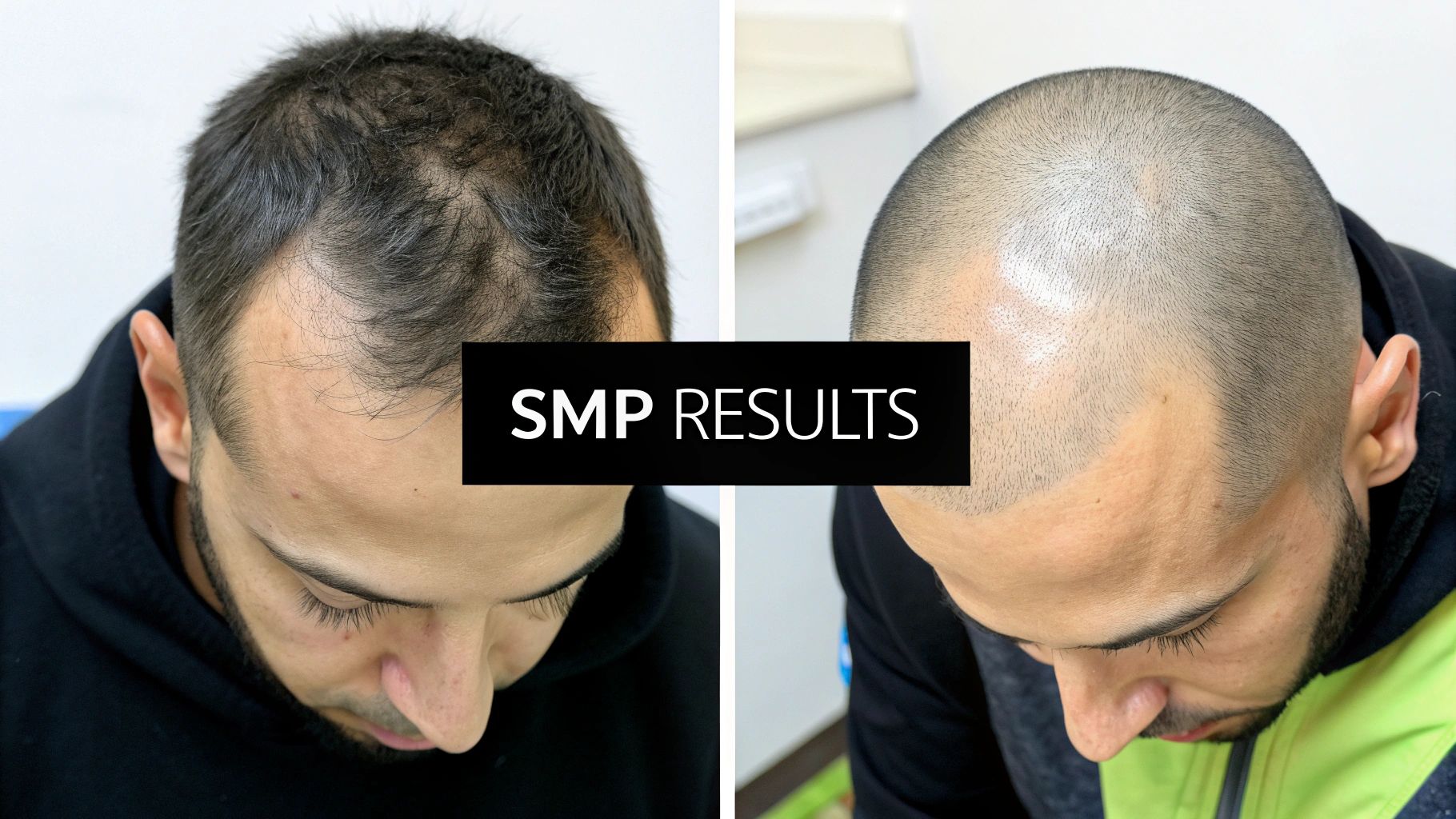
Going through the emotional and financial wringer of a failed hair transplant is tough. The last thing you want is to consider another invasive procedure. This is precisely where Scalp Micropigmentation (SMP) comes in as a powerful and, most importantly, reliable alternative. It’s not another surgery; it’s a non-invasive art form that directly tackles the most common tell-tale signs of a botched hair transplant.
Think of a skilled SMP practitioner as an illusionist for your scalp. Using highly specialised pigments and micro-needles, they place thousands of tiny impressions that perfectly mimic the appearance of individual hair follicles. The real magic is in its versatility – an artist can use this technique to precisely target and fix the specific issues you're dealing with.
Across Australia, more and more people are becoming aware of the risks that come with hair transplants. Infection is a huge one. When a clinic doesn't stick to strict sterile conditions, an infection can wipe out the new grafts and destroy the final result. The high costs and emotional toll of these failures are pushing people toward safer options like SMP, which delivers guaranteed results without any of the surgical risks.
Adding Density to Thin Results
One of the most disappointing outcomes of a bad transplant is poor density. You go through the whole process, wait over a year for the final result, and are left with sparse, see-through coverage that just looks thin and unnatural. A second surgery is always a gamble, and it completely depends on you having enough healthy donor hair left – which often isn't the case.
This is a problem SMP solves brilliantly. A practitioner can meticulously layer thousands of pigmented “follicles” between your existing transplanted and native hairs.
This isn’t just about colouring in the scalp. It’s about creating a sophisticated 3D illusion of depth and fullness. By carefully building up layers of these tiny dots, an artist dramatically reduces the contrast between your hair and scalp, making the whole area look significantly thicker. That thin, patchy look is gone for good.
Best of all, this is all done without interfering with a single one of your healthy hair follicles, preserving what’s left of your precious donor area.
Masterfully Concealing Transplant Scars
Visible scarring is the ultimate giveaway of a hair transplant, especially one that didn't go to plan. Whether it’s the long, linear scar from an FUT procedure or the patchy, "moth-eaten" look from an over-harvested FUE donor area, these marks are a constant, confidence-sapping reminder.
SMP is, without a doubt, the most effective way to camouflage these scars. The technique involves carefully depositing pigment into the scar tissue and the surrounding scalp to blend its colour and break up its noticeable texture.
- For FUT Scars: The artist works to blend the scar line into the hair around it, making that pale strip virtually vanish, especially when you wear your hair short.
- For FUE Scars: Each of those little white dots is filled in with pigment matched to your hair colour, effectively erasing that spotty pattern left by the punch tool.
The result is a seamless look that restores a natural, even appearance to the back and sides of your head. We dive much deeper into this in our guide on concealing scars with scalp tattoos.
Redesigning an Unnatural Hairline
Nothing screams botched hair transplant more than a bad hairline. It might be harsh and pluggy, or just unnaturally straight and blocky. It's often the first thing people see, and it can be almost impossible to hide. Trying to fix it with another surgery is loaded with risk and can easily make things look even worse.
With SMP, you get to take back control and completely redesign your hairline. A skilled artist can frame your face with a new hairline that looks soft, natural, and perfectly suited to you.
Here’s how it’s done:
- Softening the Edge: Subtle, scattered impressions are added just in front of that hard transplant line to break it up and create a gentle transition.
- Creating a Natural Shape: A new hairline is designed to be age-appropriate and complement your facial structure, not look like it was drawn on with a ruler.
- Adding a Feathered Look: Using lighter pigments and a more delicate touch, the artist mimics the finer, softer hairs that grow naturally at the very front of a hairline.
Ultimately, SMP offers a dependable way forward. It gives you guaranteed, immediate results that hide the past and deliver the clean, natural look you were hoping for in the first place.
Frequently Asked Questions About Transplant Repair
When you're faced with a hair transplant that didn't go to plan, you’re bound to have a million questions running through your mind. The way forward can feel unclear, but getting straight answers is the first step to getting things back on track.
Let's cut through the noise and tackle some of the most common concerns people have when looking for a fix.
How Long Should I Wait Before Fixing a Bad Hair Transplant?
This is a tough one, because your first instinct is to fix it now. But in this case, patience is absolutely crucial. You really need to wait a full 12 to 18 months before you can see the final, settled result of a hair transplant. Things can look patchy or uneven at the six or nine-month mark, and that can still be part of the normal healing and growth cycle.
That doesn't mean you have to wait in the dark, though. If you're seeing obvious problems like a shockingly unnatural hairline or serious scarring after a year, it's time to talk to a revision specialist. You could even get a preliminary opinion around the 9 to 12-month mark to start mapping out a plan. Just know that most surgeons won't touch a corrective procedure until the scalp has completely healed and the full results are in.
Can SMP Completely Hide My Hair Transplant Scars?
Yes, absolutely. Scalp Micropigmentation (SMP) is a game-changer for hiding transplant scars. It works brilliantly on both the long, thin scars from FUT surgery and the little white dot scars that FUE procedures can leave behind.
A skilled SMP artist meticulously adds pigment that matches your hair colour and skin tone, making the scars blend right in. Here’s how it works:
- For FUT Scars: The artist uses tiny dots of pigment to break up the solid line of the scar, making it fade into the surrounding hair.
- For FUE Scars: Those tiny, pale spots are carefully filled in, which gets rid of that "moth-eaten" look that happens when too much donor hair is taken.
The end result? You can wear your hair as short as you like without worrying about the scars showing. Many people find it useful to understand how you can combine a hair tattoo with a hair transplant to get the best of both worlds.
Will a Revision Transplant Use All My Remaining Donor Hair?
This is a huge concern, and for good reason. Your donor area is a limited resource, and a bad transplant may have already depleted it significantly. A second surgery means taking even more hair from that same area.
A good surgeon will be brutally honest about what's left in your donor area. If it’s too thin or damaged, another transplant might not be an option. Pushing ahead anyway could leave you with a weak result and noticeable thinning at the back and sides of your head—making things worse.
This is exactly why non-surgical fixes like SMP are so often the best solution for a botched hair transplant. SMP creates the look of density and covers up flaws without touching a single precious hair follicle.
What Are My Next Steps If I Live in Western Australia?
If you're in Western Australia and unhappy with your transplant, your first move should be to book a consultation with a specialist in corrective work. You need a straight, no-nonsense assessment from someone who lives and breathes this stuff.
An expert can take a proper look at your situation and walk you through how options like Scalp Micropigmentation can fix your specific issues, whether it's hiding scars, rebuilding a hairline, or just adding the look of fullness. Getting that professional advice gives you a clear roadmap and helps you finally move past this frustrating experience.
At My Transformation, Michael is an expert in helping people in your exact situation. We provide an honest assessment of your results and explain how Scalp Micropigmentation can address your specific concerns. Contact us for a confidential chat to explore your options and see how we've helped others in Perth and across WA.