

Scalp Micro Pigmentation Your Guide to a Fuller Hairline
Ever heard of a hair tattoo? That's the simplest way to think about Scalp Micro Pigmentation, or SMP. It’s a sophisticated cosmetic procedure that uses tiny, layered dots of pigment on the scalp to create the look of real hair follicles.
The result is a clever illusion—one that gives you the appearance of a fuller, denser head of hair. It’s a fantastic way to camouflage thinning patches, rebuild a receding hairline, or even cover the entire scalp for a sharp, buzz-cut look.
Understanding Scalp Micro Pigmentation
SMP offers a lasting fix for hair loss by expertly disguising areas where hair is thin or gone altogether. But don't mistake it for a regular tattoo. This is a highly specialised art form.
A trained SMP artist uses precision equipment to place thousands of tiny pigment dots into the upper layer of your scalp's skin. These dots mimic the look of individual hair follicles, either creating the impression of a closely shaved head or adding visual density underneath longer, thinning hair.
The key differences are in the tools and techniques. SMP uses unique pigments formulated to resist colour change over time, and the needles are far finer than those used in a typical tattoo parlour. The goal isn't to draw lines but to build up layers of dots, creating a subtle shadow that redefines your hairline and restores the look of a full head of hair.
The Art and Science Behind SMP
The real magic of SMP is in the details. A great result is completely undetectable, and that comes down to the practitioner’s skill. They need to account for your skin tone, the exact shade of your natural hair, and the kind of hairline that will suit your face. It's a perfect blend of technical precision and artistic vision.
Here’s what goes into creating that natural finish:
- Layering: The process is almost always spread across a few sessions. This allows the artist to gradually build up the density, which is crucial for achieving a realistic, three-dimensional effect.
- Pigment Matching: Your practitioner will expertly mix pigment shades to get a perfect match for your existing hair and skin tone. This ensures the treated areas blend in seamlessly.
- Follicle Replication: Each dot is placed with care to copy the slightly random, irregular pattern of natural hair growth. This is what helps avoid an artificial, "stamped-on" look.
A Growing Solution in Australia
SMP has really taken off here in Australia. In the bigger cities, you can expect scalp micropigmentation costs to range from about $2,000 to $3,400 AUD. That price reflects the incredible skill required to create the crisp, clean dot work that stands up to the Aussie sun and lifestyle.
According to industry experts on SMP pricing in Australia, this makes it a brilliant method for building natural-looking density that truly lasts.
The SMP Procedure From Consultation to Completion
Thinking about scalp micropigmentation? It’s important to understand that this isn't a one-shot deal. The process is a carefully planned journey, broken down into a few key stages to deliver a result that looks completely natural. It’s more like an artist layering paint to create depth and realism than a simple, single treatment.
The whole experience unfolds methodically, starting with your first chat and ending with a final perfecting session, all designed to make sure the pigment, the application, and the final look are exactly what you want.
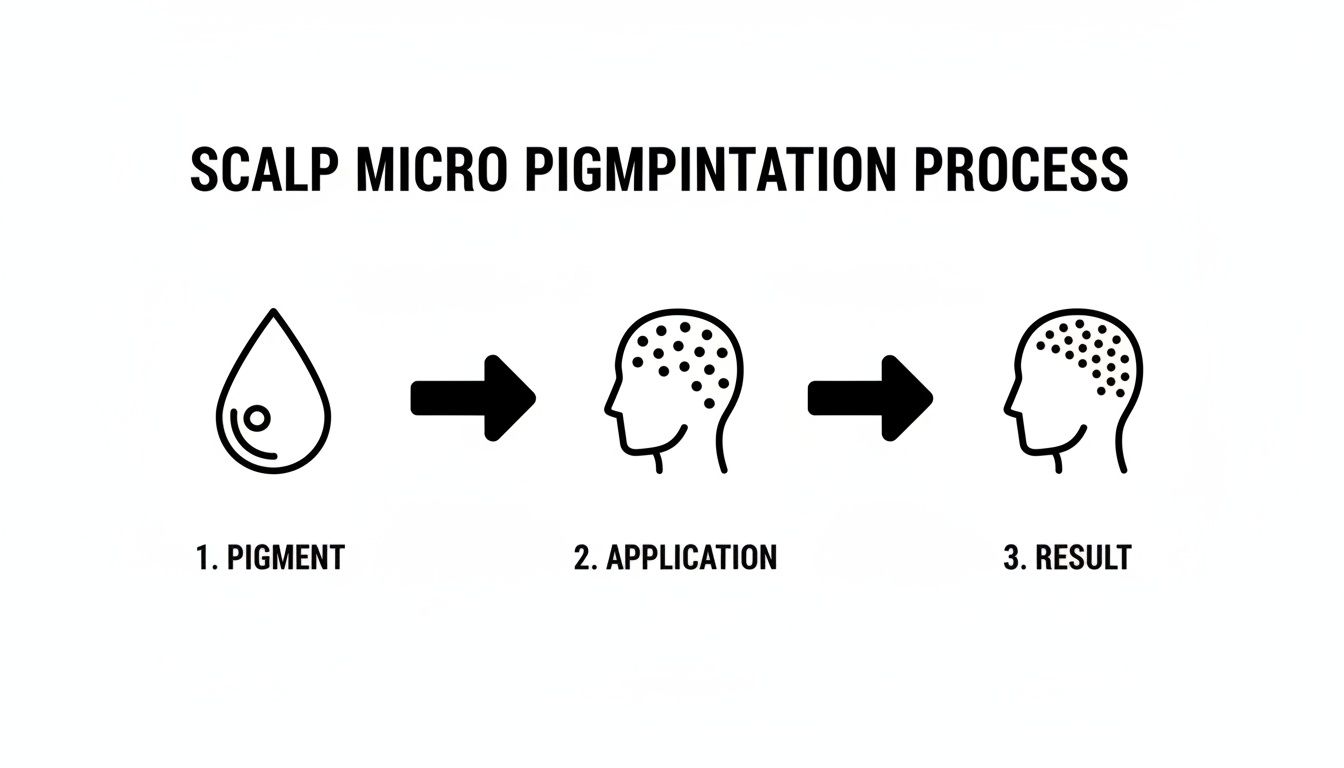
As you can see, the core idea is simple: select the right pigment, apply it with meticulous precision, and build up a natural-looking result. Each of these steps is vital for creating a believable and long-lasting solution to hair loss.
Your Initial Consultation
Your journey always starts with a detailed consultation. Honestly, this is probably the most critical meeting you'll have, as it lays the groundwork for everything that follows. Think of it as a strategy session where you and your practitioner get on the same page about the vision for your new look.
In this meeting, we'll talk about your hair loss history, what you're hoping to achieve, and any questions you have. Your artist will have a good look at your skin type, hair colour, and even your facial structure to figure out the best approach for you. This is where we design your future hairline together—whether you're after something sharp and defined or a softer, more natural look that’s age-appropriate.
This initial design phase is where art truly meets science. A great practitioner maps out a hairline that not only looks fantastic now but will continue to suit you for years to come, ensuring the final result is timeless.
Based on our chat, your practitioner will draw up a personalised treatment plan. This will cover the likely number of sessions, the specific pigment shades we'll use, and the total cost.
The Multi-Session Approach
One thing to know about SMP is that it’s not a one-and-done procedure. To get that truly realistic, three-dimensional look, we have to build up the density in careful layers. That's why the treatment is typically spread across 2 to 4 sessions, with each one lasting a couple of hours.
It's a bit like the artistic technique of stippling. One layer of dots looks flat and unconvincing, but when you add more layers, you start to create shadow, texture, and a genuine illusion of depth. SMP works in exactly the same way.
- Session 1: The Foundation. The first session is all about laying the groundwork. Your artist will map out your new hairline and apply the initial layer of pigment impressions. This creates the basic shape and a light covering. Your scalp will probably be a little red afterwards, which is totally normal.
- Session 2: Building Density. This is where the magic really starts to happen, usually about a week after the first session. The artist adds more pigment dots in between the ones from session one, which dramatically increases the sense of density and gives you a much fuller look.
- Session 3: The Perfecting Touch. The third (and sometimes fourth) session is for all the fine-tuning. Here, the practitioner will perfect the blend with any existing hair, fill any spots that need a little more density, and make final tweaks to the hairline to make sure it looks flawless from every angle.
This layered approach is absolutely essential. It allows for a gradual, controlled build-up and gives your skin the time it needs to heal between appointments, which is crucial for how well the pigment holds and the final quality of the work.
To get a better idea of what to expect as your scalp recovers, our day-by-day scalp micropigmentation healing timeline is a great resource. Each session gets you one step closer to that final, confidence-boosting result, ensuring the transformation is both impressive and incredibly natural.
Is SMP the Right Hair Loss Solution for You?
Choosing a hair loss treatment is a big decision, and it’s deeply personal. Scalp micro pigmentation is an incredibly versatile option, but whether it’s the right one for you really boils down to your specific situation, your lifestyle, and what you want to achieve. It’s about more than just covering thinning areas; it’s about finding a solution that feels like a natural part of you.
SMP really comes into its own for a wide range of people, offering a fresh start and a huge confidence boost. Whether you're after a subtle touch-up or a complete style change, figuring out where SMP excels is the first step to making a smart choice.
Ideal Candidates for a Buzz Cut Look
Men with significant hair loss, like advanced male pattern baldness, are often the perfect candidates for SMP. If you’re already comfortable with a shaved head or rock a 'buzz cut', this treatment can masterfully restore your hairline, giving you the look of a full head of hair that's been purposely shorn close.
Instead of that classic horseshoe pattern, SMP gives you a strong, sharp frame for your face. It's a fantastic choice if you want a clean, low-maintenance style without worrying about daily concealers or the rollercoaster of other treatments.
It’s also a great fit for guys with receding hairlines or thinning crowns. A skilled scalp micro pigmentation artist can meticulously rebuild what you've lost, crafting a hairline that looks completely natural—whether you prefer something soft and subtle or crisp and defined. The result is a seamless blend into your existing hair for a totally refreshed look.
Adding Density for Thinning Hair
But SMP isn’t just for the buzz cut crowd. It’s also a brilliant solution for men and women with longer hair who are struggling with diffuse thinning all over. In these cases, the aim isn't to mimic a shaved head, but simply to minimise the stark contrast between your hair and the scalp shining through.
By carefully placing pigment between the existing hair strands, the artist creates a subtle shadowing effect on the scalp. This instantly makes your hair look thicker and denser, covering up those thinning patches and letting you style your hair with confidence again.
For women especially, SMP can be life-changing. It’s incredibly effective at hiding a widening part line or thinning at the crown, giving a powerful boost to density without getting in the way of your existing hair.
Concealing Scars and Alopecia
Beyond the usual hair loss patterns, SMP is a powerful tool for camouflage and correction. Many people have noticeable scars from old hair transplant procedures (both FUT and FUE), injuries, or surgeries. These scars can be a constant, unwelcome reminder.
SMP is fantastic for hiding scar tissue. A good practitioner can carefully deposit pigment into and around the scar, blending it with the surrounding scalp until it becomes practically invisible. For anyone who’s been through previous hair restoration treatments, this can be the final, liberating step.
Even better, scalp micro pigmentation offers a real solution for people dealing with different forms of alopecia. Whether it's the patchy hair loss of alopecia areata or the complete loss from alopecia totalis, SMP can restore the appearance of a full head of hair. It provides a look of consistency and control that the condition itself so often robs you of.
A Closer Look at Who SMP Helps
To help you see exactly where you might fit in, here’s a breakdown of common hair loss conditions and how SMP provides a custom-fit solution for each.
Scalp Micro Pigmentation Candidate Suitability
| Hair Loss Condition | Who It Affects | How SMP Provides a Solution |
|---|---|---|
| Male Pattern Baldness | Men with receding hairlines, thinning crowns, or significant balding (Norwood Scale 3-7). | Creates the illusion of a full head of hair with a defined, natural-looking hairline, perfect for a 'buzz cut' style. |
| Female Pattern Hair Loss | Women experiencing diffuse thinning, often noticeable at the part line or crown. | Adds a 'shadow' to the scalp, reducing the contrast with the hair and making it appear instantly thicker and fuller. |
| Alopecia Areata/Totalis | Individuals with patchy or complete hair loss on the scalp due to autoimmune conditions. | Restores the appearance of a full hairline and density across the entire scalp, offering a consistent and reliable look. |
| Thinning Hair (General) | Men and women with low-density hair who want a fuller appearance without shaving it. | Fills in sparse areas, creating an underlying shade that camouflages the scalp and boosts the visual volume of existing hair. |
| Hair Transplant Scars | Patients with linear (FUT) or dotted (FUE) scars from previous surgical procedures. | Expertly camouflages the scar tissue by depositing pigment that matches the surrounding hair follicles, making scars far less visible. |
Ultimately, the impact goes far beyond just looks. It’s about reclaiming your confidence and freeing yourself from the mental energy that hair loss consumes. By ditching the daily routine of applying fibres, stressing about hair systems, or feeling self-conscious, SMP gives you the freedom to just live your life. It’s a straightforward, lasting solution that lets you focus on what really matters.
How SMP Stacks Up Against Other Hair Loss Treatments
Trying to figure out the best way to tackle hair loss can feel like you're staring at a dozen different road maps. You've got everything from daily-use products to full-blown surgery, and each one comes with its own set of pros, cons, and costs. It's important to understand where scalp micropigmentation fits in, so you can make a choice that genuinely works for your lifestyle, budget, and what you want to see in the mirror.
Think of SMP as being in its own unique category. It doesn't promise to regrow hair, but it does something else—it expertly restores the look of a full head of hair. The results are guaranteed, immediate, and permanent, which is a massive point of difference from surgical procedures and temporary cosmetic fixes.
SMP Versus Hair Transplants
The most common face-off is SMP vs. hair transplant surgery (like FUE or FUT). Both are designed to solve hair loss, but they get there in completely different ways. A hair transplant is a major surgical procedure where active hair follicles are physically moved from a dense area (usually the back of your head) to the thinning spots.
Scalp micropigmentation, on the other hand, is completely non-surgical. It's a cosmetic treatment that uses specialised pigments to create the illusion of thousands of tiny hair follicles. There are no incisions, no need for donor hair, and practically zero recovery time.
Here's a good way to think about it: a hair transplant is like a major home renovation. You're knocking down walls—it's structural, invasive, takes a long time to heal, and you're never quite sure how the final result will turn out. SMP is like hiring a master artist to paint a permanent, flawless mural that instantly transforms the space.
Let's break down the key differences:
- Invasiveness and Downtime: Hair transplants are surgery, plain and simple. You're looking at anaesthesia, incisions, and a recovery that can drag on for weeks. The final results won't even be visible for up to a year. With SMP, you might have a bit of redness for a day or two, but there's no real downtime to speak of.
- Guaranteed Results: The success of a hair transplant hinges on how many of the transplanted follicles survive, and that’s never 100% guaranteed. SMP results are predictable and immediate. What you see in the mirror after your final session is exactly what you get.
- Cost: Transplants are a huge financial commitment, often running into the tens of thousands of dollars. SMP is a much more affordable one-time investment for a permanent result.
- Scarring: The older FUT transplant method leaves a very noticeable linear scar, while the more modern FUE technique leaves tiny dot scars. Ironically, SMP is one of the best ways to camouflage these exact types of scars.
SMP Versus Temporary Concealers and Fibres
At the other end of the scale, you have temporary cosmetic products—things like hair fibres, powders, and coloured sprays. They work by clinging to your existing hair to create a thicker appearance or by colouring your scalp to reduce the visible contrast.
They can work for a quick fix, but the daily grind can be a real hassle. You have to apply them carefully every single day. They can get messy, and there’s always the risk of them running or smudging if you sweat, get caught in the rain, or decide to go for a swim. That initial quick-fix feeling can quickly turn into a stressful daily chore.
For those seeking a more permanent alternative to wigs or hair systems, our guide on scalp micropigmentation versus hair toppers provides an in-depth comparison.
Plus, the cost of constantly buying these products really adds up over the years. SMP gives you a true "get up and go" freedom from that entire cycle.
Comparing the Solutions Side by Side
To lay it all out clearly, here’s how the main options compare across the factors that matter most.
| Feature | Scalp Micropigmentation (SMP) | Hair Transplant | Temporary Concealers (Fibres, etc.) |
|---|---|---|---|
| Invasiveness | Non-invasive | Highly invasive (surgical) | Non-invasive (topical) |
| Results | Guaranteed & immediate | Not guaranteed; takes 6-12 months | Instant but temporary |
| Maintenance | Low (occasional touch-ups every 3-6 years) | High (requires ongoing medication to maintain non-transplanted hair) | High (daily application required) |
| Durability | Permanent solution | Permanent (if follicles survive) | Lasts until next wash |
| Cost | Moderate one-time investment | Very high initial investment | Low initial cost but high lifetime expense |
| Best For | Creating density, buzz cuts, concealing scars, defined hairlines | Restoring actual hair for those who prefer longer styles | Mild thinning, special occasions, daily cover-ups |
The permanent makeup market, which includes SMP, has seen massive growth, reaching $1.21 billion globally as more and more people discover its benefits. Here in Australia, we're seeing this trend firsthand. Many clients come to us after doing extensive research and choosing SMP over a transplant, especially because they value the guaranteed results and find it's a better fit for our sun-exposed lifestyle. You can read more about the growth of the permanent makeup market and its impact.
Ultimately, the right choice is always a personal one. If your goal is to physically grow back your hair and you're prepared for the cost, risks, and long recovery of surgery, a transplant might be the right path. If you just need a temporary confidence boost for a wedding or a big event, concealers are a decent short-term fix.
But for anyone looking for a reliable, permanent, and super low-maintenance solution that brings back the look of a full head of hair without going under the knife, scalp micropigmentation is truly an exceptional modern choice.
Long-Term Aftercare and Maintaining Your Results
You've made an investment in your appearance and confidence with scalp micropigmentation, and the great news is, looking after it is surprisingly straightforward. The whole process really boils down to two main phases: the initial healing period where you need to be careful, and the long-term maintenance which is incredibly simple. Nail the aftercare, and you’ll ensure the pigment settles perfectly, giving you that crisp, natural look for years to come.
The first few days after any session are the most important. Think of it like a fresh tattoo or even letting a new coat of paint dry – you just don't want to mess with it. Your scalp needs to stay clean and dry so those tiny pigment deposits can lock in properly.
The First Four Days Are Crucial
For the first four days after your treatment, there are a few strict but simple rules to live by. These aren't just suggestions; they're essential for getting the absolute best result from your scalp micro pigmentation.
- Avoid All Moisture: This is the big one. Don't wash your head or even let the shower stream run over it. Keep it completely dry.
- No Heavy Sweating: Hold off on that intense gym session, sauna, or steam room. Sweat can actually push the pigment out before it has a chance to settle in.
- Stay Out of the Sun: Freshly treated skin is sensitive, and direct sun is not its friend. If you have to be outside, pop on a loose-fitting hat.
Once you hit day four, you can give your head a gentle rinse with just water. By the time a week has passed, you can generally go back to using a gentle shampoo and get back to your normal routine.
Ongoing Maintenance for Lasting Results
After your final session is all healed up, looking after your SMP is about as low-maintenance as it gets. Your focus shifts from healing to preservation, which really just means protecting your scalp from the sun. The strong Australian sun is the main culprit for causing any pigment to fade over time, so a little bit of prevention goes a long way.
How long your SMP lasts is directly linked to how you treat your scalp. A simple daily habit of moisturising and using sun protection can keep your treatment looking fresh for years, cementing it as one of the easiest hair loss solutions to live with.
To keep everything looking sharp, just weave these habits into your day-to-day:
- Use Sunscreen Religiously: Before you head outdoors, always apply a high-SPF, broad-spectrum sunscreen to your scalp. A matte-finish sunscreen is a fantastic option because it cuts down any unwanted shine.
- Moisturise Daily: A hydrated scalp is a healthy scalp. Keeping the skin moisturised helps maintain the clarity and colour of the pigment underneath.
- Avoid Harsh Chemicals: Try to steer clear of products with a lot of alcohol or harsh exfoliants. Over a long period, they can potentially speed up the fading process.
The Role of Touch-Up Sessions
It's completely normal for your scalp micro pigmentation to lighten ever so slightly over the years. To keep your look defined and fresh, a quick touch-up session is usually recommended every 3 to 6 years.
These appointments are much shorter than your initial treatments. It typically only takes a single session to bring the colour and density right back to their original vibrancy. For a deeper dive into this, you can learn more about how often to expect hairline tattoo touch-ups in our dedicated guide. This easy upkeep is what makes SMP such a brilliant long-term solution.
Finding the Right SMP Artist in Western Australia
Let’s be honest: the success of your scalp micropigmentation treatment comes down to one thing—the artist holding the machine. The technique itself is proven, but it’s the skill, experience, and artistic eye of the practitioner that makes all the difference. Choosing the right professional in Western Australia isn't just a step in the process; it is the process.
Think of it like hiring a master craftsman for a bespoke project. This isn't where you want to cut corners or shop for the cheapest deal. A fantastic artist delivers a seamless, totally undetectable result that blends perfectly. A novice, on the other hand, can leave you with something that looks unnatural and is difficult to fix. Your focus should be on finding someone with a solid portfolio, a deep passion for their work, and an unwavering commitment to safety.

What to Look for in a Practitioner
When you start vetting potential SMP artists, there are a few things that are completely non-negotiable. Any true professional will be open and proud to show you exactly what you need to see.
First up, their portfolio. Dig deep here. Don't just glance at photos taken right after a session where the scalp is still red and the dots look sharp. The gold standard is in the healed results—clear photos taken months, or even years, down the track. This is the only way to see how the pigment truly settles and whether the artist's work actually stands the test of time.
Next, hunt down genuine client reviews. Go beyond the simple star ratings and look for detailed stories about their entire experience. A reputable artist will have a long line of happy clients talking about their professionalism, artistry, and how much they love the final outcome.
Finally, you have every right to ask about their credentials. Don't be shy! Enquire about their training, certifications, and what they do to maintain a sterile, safe environment. Remember, this procedure involves breaking the skin, so strict adherence to health and safety regulations is absolutely crucial.
The Importance of the Consultation
That first consultation is your best chance to get a real feel for a practitioner. It should be a proper conversation, not a sales pitch. You should feel completely comfortable asking anything that comes to mind, and they should take the time to really understand what you're hoping to achieve.
This is where you gauge their expertise. A great artist will analyse your skin type, talk through different hairline options, and give you a realistic picture of what's possible. They should be able to walk you through their process and show you before-and-afters of clients who had similar hair loss to yours.
Trust your gut. If you feel rushed, ignored, or pressured, that’s a massive red flag. The right artist is a partner in this journey, guiding you toward a result that looks fantastic and suits you for the long haul.
Australia is home to a world-class SMP industry, with clinics honing their craft since the early 2010s. Many of the country's top studios have thousands of successful treatments under their belts.
A Checklist for Choosing Your Artist
To keep things straightforward, use this checklist as you search for the right scalp micropigmentation artist in WA:
- Extensive Healed Portfolio: Can they show you plenty of clear photos of their work long after it has fully healed?
- Verifiable Reviews: Are there real, detailed testimonials from past clients on different websites?
- Professional Training: Can they show you proof of their certification from a well-regarded training academy?
- Clean and Sterile Clinic: Does their studio look and feel professional, meeting all health and safety standards?
- Thorough Consultation: Do they listen, offer expert advice, and make you feel comfortable?
Putting in the time to do your homework now will pay off tenfold later. For more local tips and advice, check out our specific guide on finding SMP in WA. Finding a true professional is the best insurance policy you can get for a result you'll be proud of.
Common Questions About Scalp Micro Pigmentation
It’s completely normal to have a few questions buzzing around your mind, even after you’ve got the basics down. Deciding to tackle your hair loss is a big deal, and you should feel 100% confident before you jump in. We get asked a lot of the same questions, so let’s clear up some of the most common ones right now.
We'll cover everything from what the treatment actually feels like to how convincing the results are up close.
Does Scalp Micro Pigmentation Hurt?
This is probably the number one question on everyone's list, and the short answer is: it’s more of an annoyance than a sharp pain. Most of our clients say it feels like a light, continuous pricking sensation on the scalp.
On a pain scale, people generally put it somewhere between a 2 to 4 out of 10.
A few things can affect how it feels on the day:
- Your own pain threshold: We’re all wired a bit differently.
- The spot being treated: Sensitive areas like the front hairline and temples can be a little more tender than the crown.
- Your artist’s technique: A seasoned practitioner knows how to use a light touch to keep you as comfortable as possible.
It's important to remember that scalp micro pigmentation isn't like a traditional body tattoo. The needle is much finer and doesn't go nearly as deep, which makes a world of difference.
How Do I Choose a Natural Looking Hairline?
Getting the hairline right is a team effort between you and your artist. The aim isn't to create a helmet-like, ruler-straight line; it's about designing a look that frames your face naturally and suits your age. A good practitioner will never just impose a style on you. Instead, they’ll work with you to find a design that complements your facial structure and personal style.
Your hairline is the signature of your SMP treatment. A soft, slightly receded, or 'broken' hairline often looks far more natural than a perfectly straight, sharp line. It’s these subtle imperfections that create a truly believable result.
During your consultation, your artist will actually draw different hairline options onto your scalp with a wax pencil. This is a crucial step. It gives you a real-world preview of how different shapes will look, so you can tweak things until you land on one that feels just right.
Is the Pigment Safe and Will It Look Real?
Absolutely. The pigments used for scalp micro pigmentation are custom-made for the job and completely safe. They are carbon-based, which means they are incredibly stable and won't fade into strange blue or green tones over time, a common problem with standard tattoo inks.
And yes, in the hands of a skilled artist, the results are shockingly realistic. By layering thousands of tiny dots in varying shades, we create a 3D illusion that perfectly mimics the look of individual hair follicles.
From a normal conversational distance, no one will know. It's virtually undetectable. Even up close, a well-executed SMP treatment blends flawlessly with any hair you still have. And while SMP is a fantastic, long-lasting solution, it's good to know your options. You can read our guide on whether scalp micropigmentation can be removed to understand the full picture.
While SMP is its own unique art form, cosmetic pigmentation is used in other popular treatments. For comparison, you can see how pigment is used to create perfect microblading eyebrows, which follows similar principles of artistry and precision.
Ready to stop wondering and start your journey towards a new look? At My Transformation, we're here to answer every question and guide you towards a result that restores your confidence. Book your free consultation with us today at https://rightwing-health.info/a%3E and let's design your perfect hairline.