

Hairline SMP for Women Your Ultimate Guide
If you've noticed your part line widening or your hairline looking a little less full than it used to, you're not alone. Hairline SMP for women is a specialised cosmetic tattoo that masterfully creates the illusion of thicker, denser hair exactly where you need it. By placing tiny dots of pigment amongst your existing hair, it cleverly camouflages the scalp, dials down the visible contrast, and helps you get back to a natural-looking, fuller hairline. The best part? It's a non-surgical solution designed to blend in perfectly with your long hair.
So, What Exactly Is Hairline SMP for Women?
Think of it like an artist meticulously stippling a canvas to create depth and dimension. That’s essentially what Scalp Micropigmentation (SMP) is—a highly advanced, non-invasive treatment that uses ultra-fine needles to deposit tiny dots of pigment into the scalp. These dots perfectly mimic the look of individual hair follicles.
But here’s the key difference: SMP for women isn't about creating a whole new, sharp hairline like you often see on men with shaved heads. The approach for us is completely different. It's all about enhancing what you already have. The main goal is to build up visual density and soften the contrast between your hair and scalp, which is what often makes thinning so noticeable.
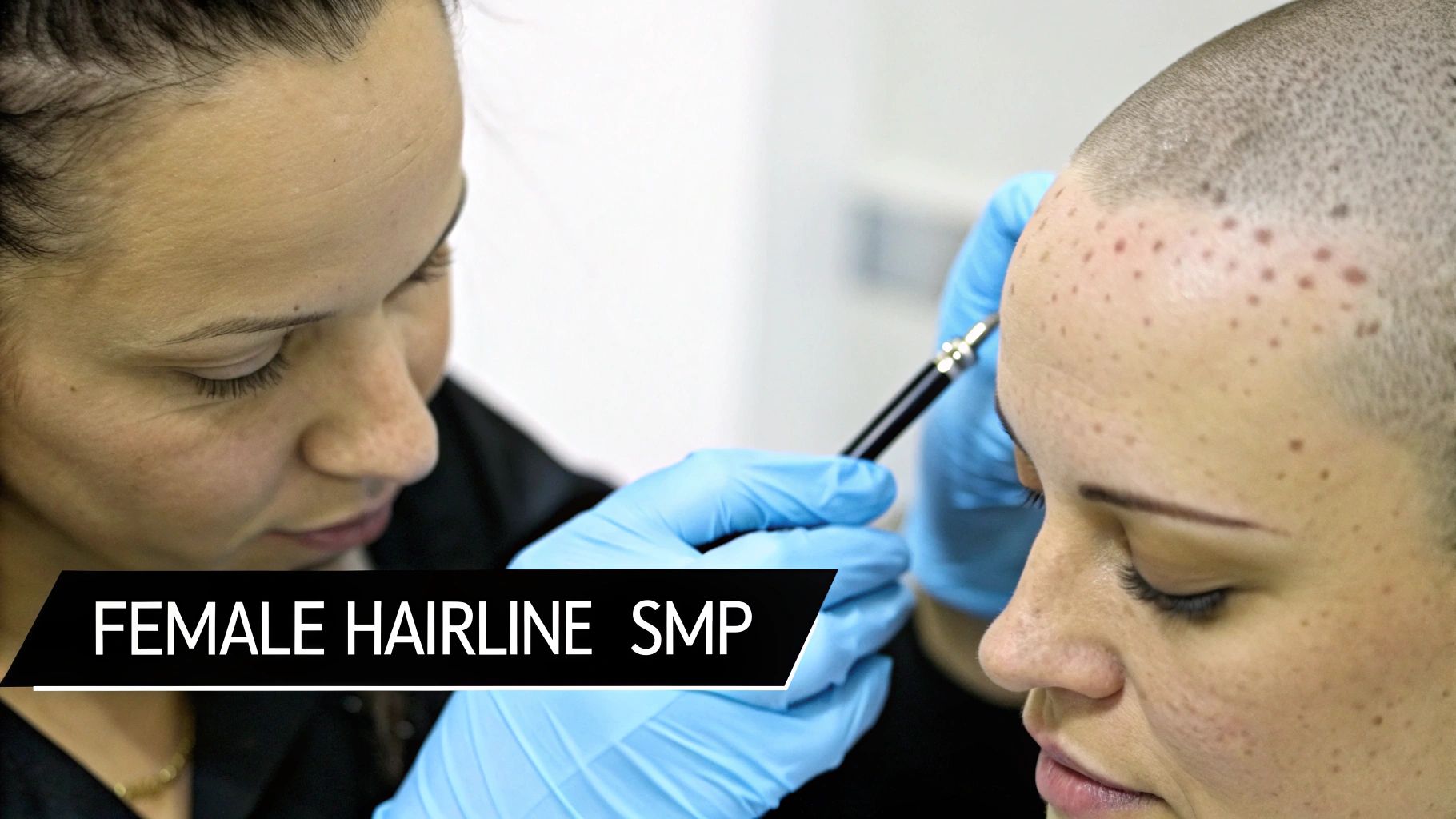
The Art of Creating Density
It’s a bit like using a root touch-up spray to hide regrowth, only this is a far more precise and long-lasting solution. A skilled technician carefully layers thousands of these tiny pigment dots between your hair strands, focusing on areas that need a little boost.
This technique works wonders for:
- Widening Part Lines: Adding pigment along your part instantly makes it look tighter and fuller.
- Thinning Crowns: By camouflaging the scalp at the crown, you get an incredible illusion of thicker hair coverage right where it counts.
- Receding Temples: We can softly fill in those sparse areas around the temples, framing your face and restoring a more youthful, rounded hairline.
The final look is subtle but makes a huge difference, giving your hair a much-needed boost of volume without actually changing your hair itself. To really get into the nitty-gritty of the process, you can learn more about what Scalp Micropigmentation is in our complete guide.
How Is SMP Different From a Regular Tattoo?
It’s a common question! While both use needles and pigment, that’s where the similarities stop. SMP is a whole different ball game, using specialised equipment, unique pigments, and a very specific technique. The needles are much, much finer, and the pigment is placed only in the upper layer of the skin—much shallower than a traditional tattoo.
This shallow placement is crucial. It stops the pigment from spreading or turning that dreaded blue-grey colour over time, ensuring the tiny "follicles" stay crisp and natural-looking for years. The pigments themselves are carbon-based and specially formulated to match natural hair tones, not the bold inks used in body art.
This careful, meticulous approach is what makes hairline SMP for women such a game-changer. If you find this fascinating, you might want to explore other cosmetic pigmentation techniques like microblading to see how different cosmetic tattoo arts compare. At the end of the day, SMP gives women a discreet and durable way to reclaim the appearance of a full head of hair and all the confidence that comes with it.
Why Australian Women Are Choosing SMP
For a long time, female hair loss has been a conversation held in hushed tones. It's a deeply personal battle many women have fought quietly, often feeling like they were cycling through one frustrating "solution" after another. Think messy topical foams, medications with a laundry list of side effects, or temporary fixes that demand constant upkeep. But that's all starting to change. Across Australia, women are discovering a truly reliable and empowering alternative.
This shift is all about taking back control. Unlike treatments that hinge on the hope of regrowth and often deliver mixed results, hairline SMP for women creates an immediate and undeniable visual improvement. It’s a proactive choice—a way to tackle the emotional weight of thinning hair head-on with a single, lasting solution.
Let’s be honest, the freedom from a tedious daily routine is a massive drawcard. So many women are just over spending their time and money on concealers, fibres, and styling products. These can be messy, unreliable in the rain or humidity, and put limits on activities like swimming or hitting the gym. SMP just gets rid of that daily burden, plain and simple.
A Growing Trend Down Under
This isn't some niche, underground trend; it’s a movement that’s gaining serious momentum. Since 2020, Australia has seen a pretty remarkable 15-20% annual increase in demand for scalp micropigmentation. We’re seeing this surge particularly in major cities like Sydney and Melbourne, where clinics are performing hundreds of these treatments every single month. It shows that female pattern hair loss is finally being recognised as a genuine medical concern that deserves a real, effective solution.
Interestingly, about 40% of all SMP clients in Australia have already been down other roads, like hair transplants. They're now coming to SMP to add that crucial visual density or to expertly camouflage scarring left behind from previous procedures. This really highlights a clear shift in what people want: permanent, hassle-free results that just work.
SMP is so much more than a cosmetic procedure; it's about restoring confidence. For countless Australian women, it marks the end of a long, often frustrating journey and the beginning of feeling completely like themselves again.
Taking Back Control with a Medication-Free Solution
One of the most compelling reasons women are embracing SMP is that it's non-invasive and completely free of medication. It works with your body, not on it. This means you get to sidestep the potential systemic side effects that can come with oral medications for hair loss.
The whole process also offers a welcome sense of certainty in a situation that usually feels anything but. Instead of anxiously waiting for months to see if a treatment is having any effect, the results of SMP are visible from the very first session and are just refined and perfected over the next few appointments.
For many, this is the most important part. It provides a definitive answer to a persistent problem, allowing them to finally move forward with their heads held high and leave the anxiety of hair loss in the past. The many benefits of getting a scalp tattoo extend far beyond the mirror, offering genuine peace of mind. Ultimately, choosing SMP is a powerful step towards reclaiming your self-image, entirely on your own terms.
Is Hairline SMP the Right Move for You?
Making the decision to go ahead with any cosmetic treatment is a big one. It's all about finding what works for you and your unique situation. So, let's get straight to it: is hairline SMP for women the answer you’ve been looking for?
This isn't a one-size-fits-all solution, and its real magic shines when it’s matched with the right person. I want to give you a clear, honest look at who stands to gain the most from this treatment and who might be better off exploring other avenues. This way, you can feel confident and well-informed long before you even think about booking a consultation.
The Ideal Candidate for Female SMP
At its heart, scalp micropigmentation is an art of illusion. It masterfully creates the look of thicker, fuller hair by cleverly reducing the colour contrast between your hair and your scalp. If any of the following scenarios sound familiar, you're likely a fantastic candidate.
You're a great match for female hairline SMP if you have:
- Diffuse Thinning: This is the classic type of female pattern hair loss, where you see thinning across the top of your head and crown, but your actual hairline is still there.
- A Widening Part: Have you noticed your part line becoming more obvious over the years? SMP is brilliant for adding subtle density right where you need it, making your part appear tighter and fuller.
- Traction Alopecia: Often caused by tight hairstyles like ponytails, weaves, or braids, this type of hair loss usually affects the temples and hairline. SMP can beautifully restore that soft, natural frame to your face.
- A General Lack of Fullness: Maybe your hair just doesn't have the volume it used to. If you find yourself constantly trying to cover up your scalp or feel hesitant to wear your hair up, SMP can add that visual density that makes all the difference.
For a more detailed look into how the treatment works for these specific concerns, our guide on how scalp micropigmentation can help female hair loss is a great resource.
Before we dive into the table, it's helpful to see how SMP stacks up against common types of female hair loss. The goal is to camouflage thinning and create a foundation of density that blends seamlessly with your existing hair.
SMP Suitability for Different Types of Female Hair Loss
| Hair Loss Condition | Is SMP a Good Solution? | How SMP Helps |
|---|---|---|
| Female Pattern Hair Loss | Excellent | Perfectly camouflages diffuse thinning by adding density to the scalp, making hair appear thicker. |
| Traction Alopecia | Excellent | Rebuilds and softens weakened hairlines and temples caused by tight hairstyles. |
| Alopecia Areata | Sometimes | Can be effective for stable, non-progressing patches, but not for active or unpredictable cases. |
| Thinning from Menopause | Very Good | Adds visual fullness to combat hormonal hair thinning, especially at the crown and part line. |
| Scar Camouflage | Excellent | Disguises scars from hair transplants (FUT/FUE), surgery, or injuries by blending them with the scalp. |
This table shows just how versatile SMP can be, but it also highlights that it’s not a universal fix. Honest conversations with a qualified practitioner are essential to determine if it's the right path for your specific situation.
Who Might Not Be a Good Candidate
Just as important as knowing who SMP is for is understanding who it isn't. I believe in complete transparency, and setting realistic expectations is a huge part of ensuring you're happy with the outcome.
It's crucial to remember that SMP is a cosmetic treatment designed to create the illusion of density—it doesn't actually grow hair.
You might need to consider other options if:
- You Have Certain Scalp Conditions: If you have active psoriasis, eczema, or folliculitis in the area you want treated, these need to be under control before we can start.
- You Are Prone to Keloid Scarring: SMP involves thousands of tiny pigment deposits into the skin. If you have a history of developing keloid scars, this could be a risk.
- Your Hair Loss Is Progressing Rapidly: If your hair loss is very active, it's usually best to wait until it settles down. This ensures the SMP results look natural and consistent for years to come.
- You Have Unrealistic Expectations: SMP is an amazing tool for adding density and confidence, but it won't change your hair's texture or physically make strands thicker. It’s all about the visual effect.
It's a little-known fact, but female pattern hair loss is incredibly common, affecting about one in three women in Australia. This has led to a huge increase in women seeking out SMP, and they now make up around 30% of all SMP clients in Australian clinics. You can read more about the rise of SMP for women in Australia on smpaus.com.au.
What's The SMP Process Like From Start to Finish?
Deciding to get Scalp Micropigmentation is a big step, and it’s completely normal to feel a mix of excitement and nerves. You’re probably wondering what really happens. Let's walk through the entire process, from your first chat with a practitioner to seeing the final result in the mirror. No jargon, no surprises—just a clear guide so you feel completely in the loop.
Everything kicks off with the initial consultation, which is arguably the most important part of your entire SMP experience. This isn't just a quick meet-and-greet; it’s a detailed design session. Your practitioner will sit down with you to genuinely understand your concerns, what you hope to achieve, and take a close look at your specific hair loss pattern. This is your time to ask anything and everything that's on your mind.
From there, we get into the artistic side of things. For women, the goal is almost always a soft, natural-looking hairline. We avoid the sharp, "lined-up" look you might see on men. Instead, the artist’s focus is on designing a hairline that beautifully frames your face and blends perfectly with your existing hair. The result should be subtle and completely undetectable. This first meeting is where the vision for your new look starts to come alive.
This simple chart shows how we go from that first conversation to confirming if SMP is the right path for you.
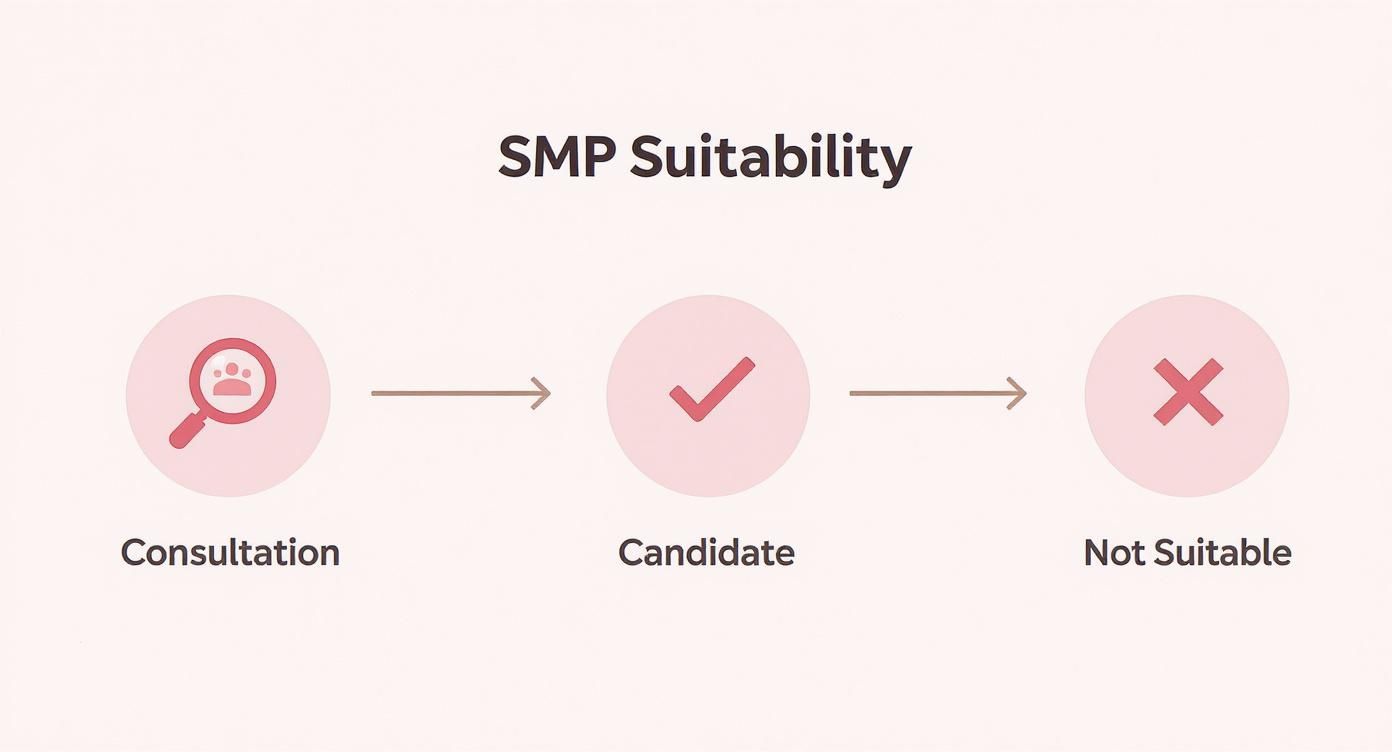
This process ensures every woman is thoroughly assessed and confirmed as a great candidate before any treatment begins.
Breaking Down The Treatment Sessions
Once you're happy with the plan, it’s time for the treatment itself. The final look is carefully built up over 2-4 separate sessions, with each one lasting about two to four hours.
Why so many sessions? Think of it like a painter adding layers of colour to a canvas to create real depth and richness. A rushed, one-and-done job just wouldn't look natural. This multi-session approach is the secret to achieving realistic, layered density.
Here’s what to expect from each appointment:
- Session One: The Foundation. The first appointment is all about laying down the groundwork. Your practitioner will use a lighter pigment shade to create the initial layer of tiny follicle impressions. This establishes the basic shape of your new hairline and provides the base for the next stages.
- Sessions Two and Three: Building Density. In the following sessions, the real artistry begins. Your practitioner will add more layers, often using slightly darker pigment shades, to create a stunning 3D effect. This is where the illusion of fullness truly takes shape as each tiny dot is placed to fill in thinning areas and blend seamlessly with your hair.
We schedule a healing period of one to two weeks between each session. This gives the pigment time to settle and allows your artist to see how the colour has healed, so they can make precise adjustments in the next appointment for a perfect result.
What About Pain and The Pigments Used?
One of the first questions everyone asks is, "Does it hurt?" Most women tell us the sensation feels more like a light, consistent tapping or a mild irritation rather than actual pain. While the scalp can be sensitive, it's generally much more comfortable than getting a traditional body tattoo. Your comfort is always the top priority.
The other crucial element is the pigment. We use specialised carbon-based pigments, not regular tattoo ink. These are formulated to match natural hair colours and, importantly, are designed to hold their true shade over time without turning blue or green.
During your consultation, your practitioner will mix a custom blend of pigments to get a perfect match for your hair colour and skin tone. For women with highlights or different tones in their hair, we can even use several shades to create an incredibly realistic, multi-dimensional effect that mimics your hair's natural variations.
The whole experience is designed to give you a result that looks and feels like your own. If you want to learn more, our detailed guide explains what’s involved in the process of getting a hair tattoo. From start to finish, the journey is all about providing a comfortable, empowering experience that brings back not just your hairline, but your confidence, too.
Understanding the Cost of SMP in Australia
Let's get straight to it and talk about the investment. When you're looking into a solution like hairline SMP, one of the biggest questions on your mind is undoubtedly the cost. Knowing what to expect financially is a huge part of the decision, and you deserve clear, straightforward answers.
The price for scalp micropigmentation isn't a simple, flat fee. It’s less like buying a product and more like commissioning a bespoke piece of art—one that’s tailored specifically for you. A few key things will shape the final cost to ensure the treatment perfectly matches your needs.
The main factors are the size of the area we’re treating and how much density you’re looking to create. A woman who just needs a bit of soft definition along her part line will have a very different price point than someone wanting to build comprehensive fullness across her entire crown.
What Determines the Final Price
The final quote you receive reflects the time, skill, and intricate detail needed to bring your vision to life. It’s a completely personalised service from the moment you walk in the door.
Here’s what goes into the pricing:
- Treatment Area Size: Are we working on just the hairline and temples, a widening part, the crown, or a combination? The more scalp we cover, the more time and pigment it requires.
- Required Density: The level of your hair thinning is a major factor. Creating a subtle shadow of density involves less work and layering than building up the look of full, thick hair.
- Artist's Skill and Experience: You're investing in expertise. Practitioners who are true specialists in the nuances of hairline SMP for women will command higher rates, and for good reason—their ability to deliver incredibly natural, undetectable results is proven.
Realistic Price Ranges in Australia
To give you a clearer picture, the cost for scalp micropigmentation here in Australia really depends on the extent of the hair loss. Prices can start from around $990 for very minor density work and go upwards of $6,000 for treatments covering the entire scalp.
For women dealing with receding hairlines or thinning that falls into the Norwood scale 2-3 range, you’re typically looking at a cost between $1,200 and $1,800 AUD. This is usually spread over two to three sessions. If you have more advanced thinning at the crown and hairline (around Norwood 4-5), expect to invest from $1,800 to $2,600 AUD to achieve that beautiful, full look.
It’s helpful to think of this not as a recurring expense, but as a one-time investment in your confidence. Think about the money spent on temporary fixes—hair fibres, special shampoos, pricey styling products. Over time, those costs really add up without ever offering a permanent solution.
Ultimately, SMP gives you a lasting result that frees you from that endless cycle of buying and applying temporary cover-ups.
For an even more detailed breakdown, have a look at our complete guide on scalp micropigmentation cost. Getting that financial clarity is the first step towards making a choice that feels truly right for you.
Got Questions About SMP? We've Got Answers
It’s completely natural to have a lot of questions when you’re thinking about a new cosmetic treatment. And when it comes to hairline SMP for women, you’ve probably got a few things on your mind. That's a good thing! Being informed is the best way to feel confident and excited about your decision.
We've pulled together the most common questions women ask about scalp micropigmentation and answered them head-on. Our goal here is to cut through the jargon and give you clear, honest information so you know exactly what to expect.
Let's get into the nitty-gritty, from how it feels and what to do afterwards to how long it lasts and how it fits into your lifestyle.
How Much Discomfort Should I Expect?
This is usually the first question on the list, and for good reason! The honest answer is that everyone's tolerance is a bit different, but most women describe the sensation as a light, persistent irritation rather than actual pain. Think of a repetitive tapping feeling, maybe similar to having your eyebrows tweezed.
It's definitely less intense than getting a traditional body tattoo. That's because the specialised needles for SMP are incredibly fine and only just break the surface of the skin, going into the upper dermis. A good practitioner will work at your pace and do everything they can to make sure you're comfortable from start to finish.
How Is SMP Different From A Standard Tattoo?
While they both use needles and pigment, scalp micropigmentation and tattooing are worlds apart. It's a highly specialised craft, and understanding what makes it unique is key to appreciating the incredible results it can produce.
Here’s a quick rundown of the main differences:
- Needle Depth: SMP needles are super-fine and only go about 2mm deep into the top layer of your skin. Traditional tattoos go much deeper, which is why the ink can sometimes bleed or look blurry over the years.
- Pigment Type: We use a carbon-based pigment, not regular tattoo ink. This is a big one. These pigments are made to match natural hair tones and are designed to hold their colour, so you won't ever see them turning blue or green.
- Technique: SMP is all about a 'stippling' method, where thousands of tiny dots are carefully placed to mimic individual hair follicles. Body art typically involves drawing lines and shading in larger areas.
At its heart, SMP is about creating a subtle illusion. The whole point is to build undetectable density that blends perfectly with your existing hair. That requires a completely different mindset, toolset, and skill level than traditional tattooing.
How Long Will My SMP Results Last?
Scalp micropigmentation is considered a permanent cosmetic treatment, but you can expect the look to soften and lighten a bit over a long period of time. Most people find their results look brilliant for 4 to 6 years—sometimes even longer—before they might think about a quick touch-up.
A few things can influence how long it lasts for you personally:
- Sun Exposure: UV rays are the number one enemy of any pigment. The best thing you can do to protect your investment is to wear a hat or use sunscreen on your scalp when you're out in the sun for long periods.
- Your Immune System: Everybody is different, and your immune system will break down the pigment at its own pace.
- Skin Type: If you have particularly oily skin, you might notice the pigment softening a little faster than someone with drier skin.
When you do feel it’s time for a refresh, it’s usually just a single, straightforward session to restore the depth and definition, making it look as good as new.
Can I Still Colour My Hair After SMP?
Yes, absolutely! This is one of the best things about SMP for women. You can carry on dyeing, colouring, or highlighting your hair just like you always have. The pigment is placed in the skin of your scalp, not the hair follicle, so any chemicals you use on your hair won't touch it.
We only have one simple rule: please wait at least one week after your very last SMP session before using any hair dye. This just gives the skin enough time to heal up properly and for the pigment to settle in perfectly. After that, you’re free to get back to your normal hair routine without a worry in sight.
While we've focused on female SMP here, looking through general Frequently Asked Questions from reputable clinics can also give you a broader understanding of cosmetic procedures.
What Does Aftercare Actually Involve?
The aftercare for SMP is surprisingly simple and won't throw your life into chaos. For the first four days after each session, the most important thing is to keep the area completely clean and dry.
This means you’ll need to avoid:
- Washing your hair or letting water run over your scalp.
- Getting a heavy sweat on at the gym.
- Using saunas, steam rooms, or going for a swim.
- Putting any creams, lotions, or styling products on your scalp.
Once you're past those first four days, you can gently wash your hair using a mild, sulphate-free shampoo. You'll also want to keep your scalp out of direct, strong sun for a couple of weeks to let the pigment settle. Long-term, the only real maintenance is a bit of sunscreen on sunny days. That's it! The sheer simplicity of the aftercare is a huge plus for busy women.
Ready to take the next step and see how scalp micropigmentation can restore your confidence? At My Transformation, Michael is dedicated to helping women achieve natural, beautiful results. Book your free consultation today to discuss your unique needs and create a personalised plan.