

Hair Plug Scars: hair plug scars - Causes, Treatments, Concealment
Hair plug scars are the ghosts of hair transplants past. They're the tell-tale signs—often small, circular marks or a long, thin line—left behind by surgical techniques that are now decades old. These permanent scars come from older methods that involved removing larger grafts or entire strips of scalp, leaving behind a pattern that modern procedures are specifically designed to avoid.
The Enduring Problem of Hair Plug Scars
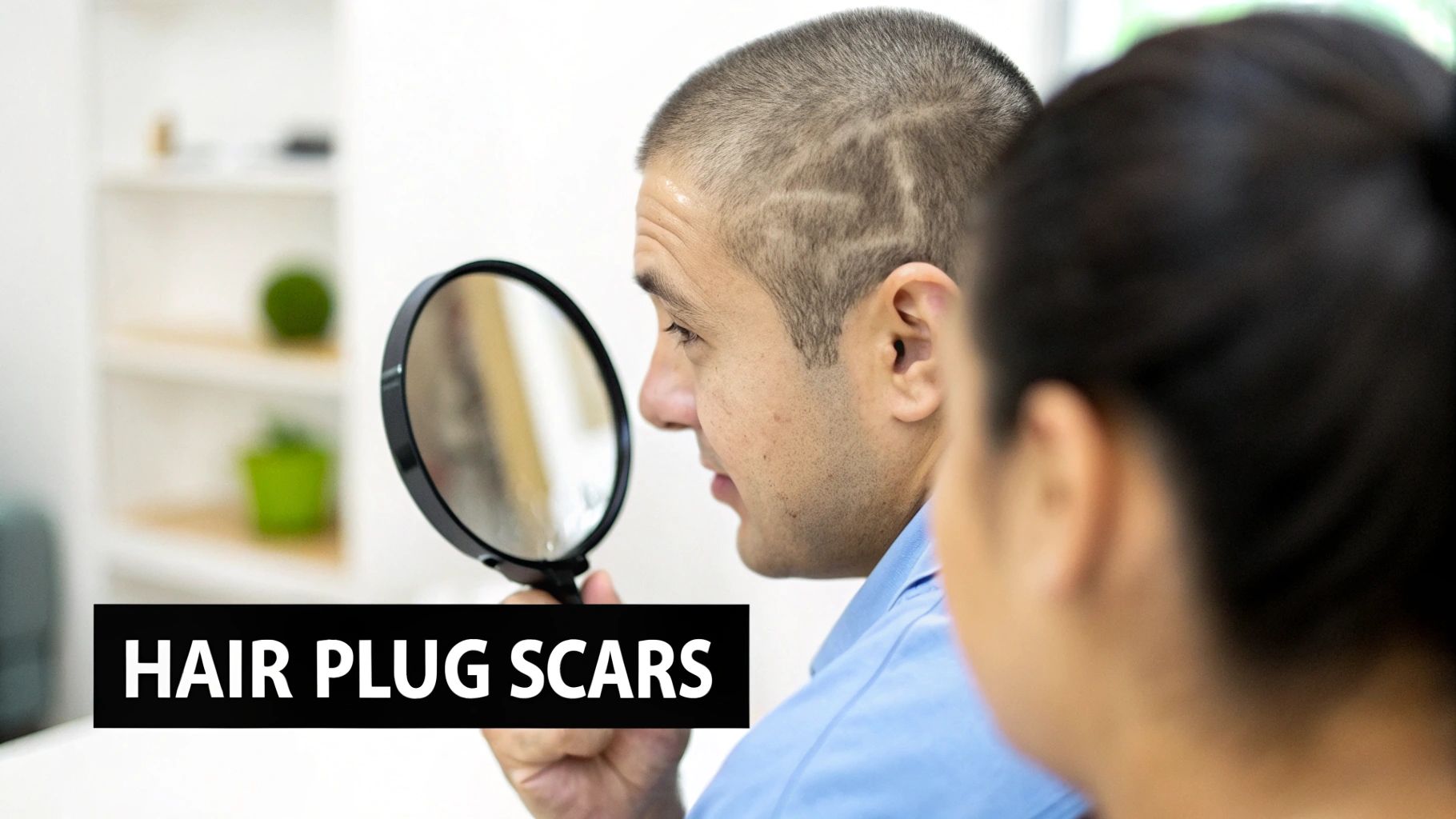
For a lot of men, these marks are more than just scars; they're a daily frustration. They’re a constant, visible reminder of a procedure that was supposed to restore confidence but left behind a different kind of self-consciousness. If you're living with this, you are far from alone.
The history of hair plug scars in Australia mirrors the evolution of hair restoration itself. The procedures that were common back in the 1980s and 1990s often used large 4–8 mm punch grafts. The result was often that unnatural "doll's hair" look, along with a collection of noticeable circular scars. Later on, Follicular Unit Transplantation (FUT), also known as strip surgery, became popular, but it could leave a long, linear scar across the back of the head, forcing many to look for ways to hide it years down the track.
Understanding Different Scar Types
The phrase "hair plug scars" actually covers a couple of distinct patterns, and knowing which one you have is the first step to finding the best way to deal with it.
- Circular "Plug" Scars: These are the classic calling card of old punch graft methods. They typically look like small, pale, and sometimes shiny dots scattered where the hair was taken from or implanted.
- Linear FUT Scars: This scar is a single, long line, usually found on the back or sides of the head. It's the result of the "strip" method, where a surgeon removed a whole piece of the scalp to harvest follicles for the transplant.
Either way, these scars can seriously limit your hairstyle choices and completely undermine the confidence you were trying to get back in the first place. The great news is you don't have to put up with them anymore.
Modern concealment techniques have come an incredibly long way, offering realistic and effective ways to camouflage old surgical marks. You are no longer defined by the limitations of a procedure from another era.
Modern Solutions Offer New Hope
Fortunately, there are fantastic solutions available now to tackle these old scars. One of the most popular and successful non-surgical options is Scalp Micropigmentation (SMP). This isn't a tattoo in the traditional sense; it's a highly specialised technique that uses cosmetic pigments to replicate the look of individual hair follicles. The artist carefully blends the scar tissue right into the surrounding hair, making it virtually disappear.
If you're interested in the nuts and bolts of how SMP works on different surgical marks, you can learn more about how to hide hair implant scars in our detailed guide.
SMP is brilliant because it masks the colour and uneven texture of hair plug scars, creating a seamless, natural-looking finish. It gives you back control over your appearance, finally freeing you from that constant reminder of an outdated surgery and letting you wear your hair short with confidence.
So, Why Do Hair Transplants Leave Scars?
Before we can talk about fixing hair plug scars, it’s good to know exactly why they show up in the first place. The bottom line is that every surgical procedure, no matter how minor, creates an incision that your body needs to heal. A hair transplant is really just thousands of tiny surgical procedures happening in one go, and each one is going to leave a mark.
The type of scar you end up with, and how visible it is, all boils down to the specific technique used to harvest the hair follicles from the donor area of your scalp.
Think of your scalp like a healthy patch of lawn. If you need to take some turf to fill a bare spot, the method you use will leave a very different pattern behind. This is the perfect way to understand the two main hair transplant methods: Follicular Unit Transplantation (FUT) and Follicular Unit Extraction (FUE).
FUT Scars: The Linear Mark of "Strip Surgery"
Follicular Unit Transplantation (FUT) gets its nickname, the "strip method," for a very straightforward reason. During this procedure, a surgeon removes a long, thin strip of scalp tissue from the donor area, which is usually at the back of your head.
This strip, which is full of healthy hair follicles, is then carefully dissected under a microscope into individual follicular units. These are the grafts that get implanted into the thinning or balding areas. Of course, after removing a whole piece of skin, the surgeon has to stitch the remaining scalp back together.
This process always leaves a long, linear scar. The exact length and width can change based on the surgeon's skill and how your own body heals, but a scar is guaranteed. This is our "strip of turf" analogy in action—taking a whole section of lawn leaves a clear, unavoidable line that will always be there if you cut the surrounding grass short.
FUE Scars: The Polka Dot Pattern
Follicular Unit Extraction (FUE) was really developed to solve the obvious scarring problem created by FUT. Instead of taking a whole strip of scalp, the FUE technique harvests individual hair follicles one by one directly from the donor area using a tiny, circular punch tool.
This is like carefully plucking single blades of grass from all over the lawn. Each time a follicle is removed, it leaves a very small, round wound, typically less than a millimetre across. While this gets rid of the big linear scar, it creates hundreds or even thousands of tiny, dot-like hair plug scars scattered all over the donor area.
A common myth is that FUE is a "scar-free" procedure. This simply isn't true. It avoids the long FUT scar, but it replaces it with a pattern of tiny circular scars. These can become quite noticeable, especially if you like to wear your hair short. Sometimes these little dots can also heal with hypopigmentation, meaning they appear as pale spots against your natural skin tone.
Understanding this difference is a big deal when you're choosing a procedure. Here in Australia, you can see how much the fear of scarring impacts patient decisions. Clinics often quote FUT graft survival rates of 90–98% but have to be upfront about the permanent linear scar. FUE, on the other hand, offers 85–95% graft survival but leaves lots of little dots.
Because of this, many people now opt for FUE, which makes up about 66% of hair transplants worldwide. They’re choosing the dot pattern to avoid the one big scar that limits their future hairstyle choices.
Knowing the difference between these surgical methods is the first step. You can dive deeper into this comparison in our guide that asks: what is a FUE hair transplant. Once you can identify whether your scars are linear (from FUT) or scattered dots (from FUE), you’ll be in a much better position to understand the powerful camouflage solutions we're about to explore.
Exploring Your Treatment Options for Hair Scars
Living with the daily reminder of old hair transplant scars can be frustrating, but the good news is you have more options than ever to deal with them. The best path forward really depends on the type of scar you're dealing with, what you want the end result to look like, and your lifestyle. Generally, the approaches fall into a few key categories, each tackling these marks in a different way.
Let’s dive into the most effective treatments available today. We’ll break down how they work, who they’re best suited for, and what you can realistically expect from each one.
This quick visual shows how the two main surgical methods lead to very different types of scars.
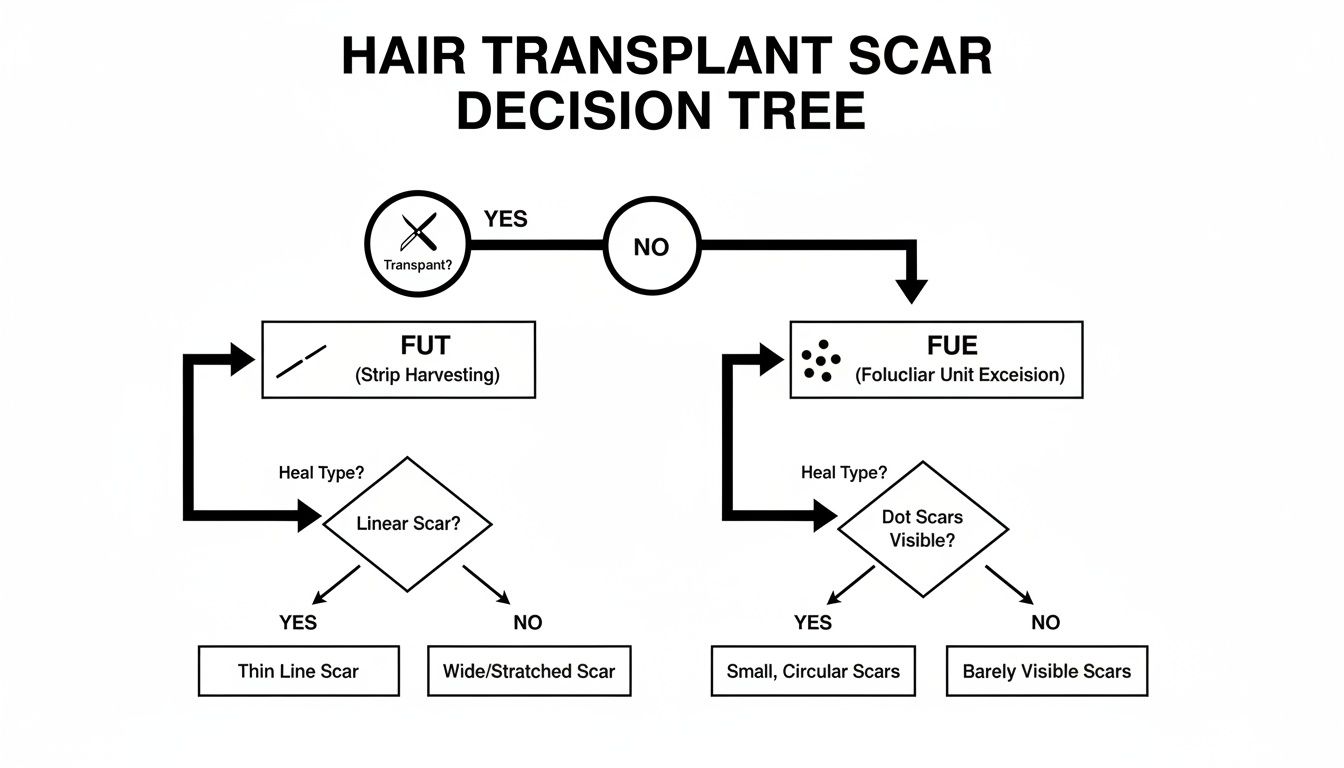
As you can see, FUT surgery typically leaves a long, linear scar, whereas FUE creates a pattern of small, scattered dots across the donor area.
Scalp Micropigmentation (SMP) for Camouflage
Scalp Micropigmentation, or SMP, is a highly specialised cosmetic technique that creates the illusion of thousands of tiny hair follicles. Think of it less as a tattoo and more like artistic pointillism for your scalp, where a trained practitioner deposits tiny impressions of pigment to mimic a full head of hair.
This method doesn't actually remove the scar; it masterfully hides it. By perfectly matching the pigment to your natural hair colour and skin tone, SMP makes the scar tissue blend seamlessly into the surrounding scalp. It’s a game-changer for both the long line of an FUT scar and the spread-out dots from FUE, creating a look of even density.
The biggest plus? SMP is a non-invasive camouflage solution. There's no surgery, minimal discomfort, and the result is permanent, giving you the freedom to wear your hair as short as you like without a second thought. To get a better idea of how this looks, check out our guide on using scalp micropigmentation for hair transplant concealment.
Surgical Scar Revision
If you have a wide or particularly noticeable linear scar from an old FUT procedure, surgical revision is an option that aims to physically improve the scar itself. The goal here isn't to hide the scar but to make it smaller and less obvious.
A surgeon will excise (cut out) the old, stretched scar tissue and then meticulously stitch the skin back together using advanced techniques. This is designed to create a much finer, cleaner line. It's crucial to remember that this procedure replaces one scar with another—the new one is just a whole lot better.
Surgical revision is an invasive procedure that requires healing time and doesn't guarantee a perfect result. However, for the right candidate, it can dramatically reduce the width and texture of a prominent scar, making it far easier to conceal.
For those wanting to directly tackle the scar itself, exploring dedicated scar revision surgery options can lead to a huge boost in confidence. It's also quite common for clients to get a scar revision first, then follow up with SMP to camouflage the new, finer scar for a truly undetectable result.
Laser Treatments
Laser therapy offers another path, improving the texture and colour of hair plug scars without needing more surgery. Treatments like fractional laser resurfacing work by creating thousands of microscopic injuries in the scar tissue. This kicks your body’s natural healing response into high gear, boosting collagen production to help smooth and soften the scar’s surface.
Laser treatments can be especially effective for:
- Fading redness or discolouration, particularly in newer scars.
- Softening and flattening raised or bumpy scar tissue.
- Improving the overall texture so it blends better with the surrounding skin.
This isn't a one-and-done solution; it usually takes multiple sessions to see the best results. It’s also more about improving the scar's quality than making it disappear completely.
Topical and Dermal Solutions
Finally, there are less invasive options like topical creams and dermal fillers. While their effects are often more subtle, they can be helpful in the right situation.
Topical solutions like silicone gels are best used during the initial healing phase of a new scar to help it heal better and minimise its final look. For old, settled hair plug scars, they won't do much. Dermal fillers, on the other hand, can be injected into indented or sunken scars to raise them, making them level with the skin around them. Just keep in mind this is a temporary fix, as the body eventually absorbs the filler.
Comparing Hair Plug Scar Treatment Options
With several distinct approaches available, choosing the right one can feel overwhelming. This table breaks down the key differences between the most common treatments to help you see how they stack up against each other.
| Treatment | How It Works | Best For | Invasiveness | Typical Cost (AU) |
|---|---|---|---|---|
| Scalp Micropigmentation | Deposits tiny pigment impressions into the skin to create the illusion of hair follicles, blending the scar. | Camouflaging both FUT and FUE scars; creating a 'shaved head' look. | Non-invasive | $1,200 - $3,500+ |
| Surgical Scar Revision | A surgeon removes the old scar tissue and re-stitches the skin to create a finer, less visible line. | Wide, stretched FUT linear scars. | Invasive | $3,000 - $7,000+ |
| Laser Therapy | Uses focused light to stimulate collagen, improving the scar's texture, colour, and smoothness. | Red, raised, or texturally uneven scars. | Minimally invasive | $300 - $800 per session |
| Dermal Fillers | Injected into sunken scars to raise them to the level of the surrounding skin, making them less noticeable. | Indented or atrophic scars. | Minimally invasive | $600 - $1,200+ per treatment |
Each method has its place, and sometimes the best outcome involves a combination of treatments—like a surgical revision followed by SMP. The right choice for you will come down to a conversation with a specialist who can assess your specific scar and goals.
How SMP Transforms Hair Transplant Scars
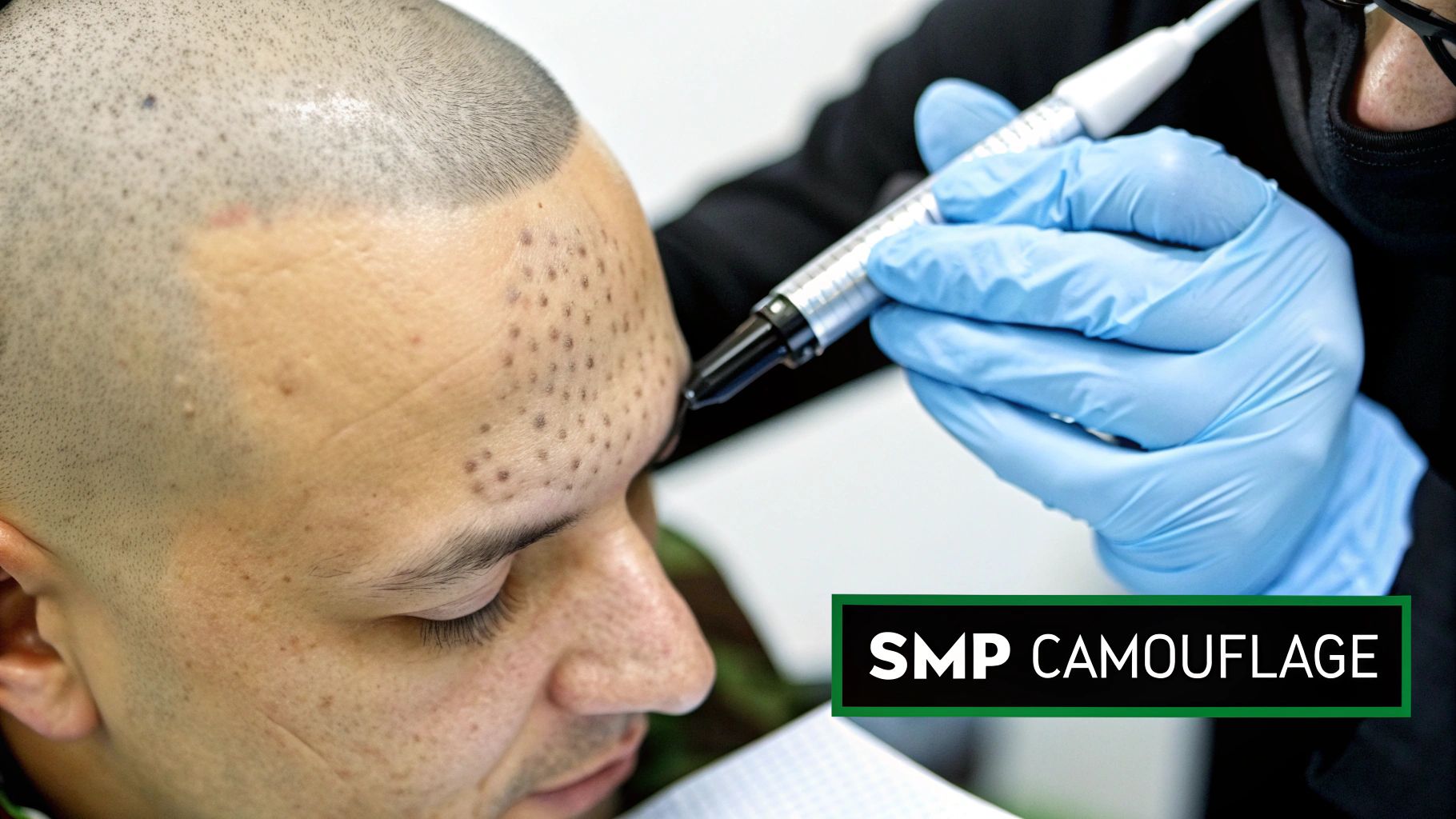
Scalp Micropigmentation, or SMP, has become the go-to solution for dealing with the visual reminders of old hair transplants. It doesn't actually remove the scar tissue. Instead, it uses incredible artistry and precision to make the scar blend seamlessly into the background, giving you back the look of a full, even scalp.
Imagine an artist creating a detailed image using a technique called stippling, where countless tiny dots come together to form a whole picture. SMP operates on a similar principle. A highly skilled practitioner uses specialised equipment to place thousands of tiny pigment dots into the upper layers of your skin, both on the scar and the surrounding area.
Each dot is a masterful imitation of a natural, closely-shaved hair follicle. Layered over several sessions, these dots build a powerful illusion of density that completely masks the different colour and texture of hair plug scars. The result is a flawless camouflage that lets you wear your hair as short as you like, with absolute confidence.
The Art and Science of Pigment Matching
Getting SMP to look completely natural all comes down to getting the colour just right. This is far from a one-size-fits-all job; it’s a careful blend of artistic skill and scientific understanding that starts the moment you walk in for a consultation.
A seasoned practitioner will carefully analyse your existing hair colour, your skin tone, and its undertones to mix a pigment blend that is uniquely yours. This is crucial—it ensures the treated area matches the specific shade of your natural hair, rather than just looking like a flat grey or black patch. The whole point is to make the SMP work totally indistinguishable from your real hair, even up close in the bright Aussie sun.
This painstaking colour-matching process is what separates a world-class result from an average one. It’s the secret to making the camouflage so convincing that even you might forget the scar is there.
How SMP Addresses Different Scar Types
One of the best things about SMP is how adaptable it is. It can be tailored to handle the different types of marks left behind by older hair transplant methods.
- For Linear FUT Scars: The practitioner’s first job is to break up that solid, pale line. They do this by depositing pigment directly into the scar tissue itself, then meticulously blending outwards into the healthy skin above and below. This essentially "colours in" the bare strip, making it disappear into the surrounding hair.
- For Scattered FUE Scars: With the small, dot-like scars from FUE, the strategy is to add more "dots." The artist strategically places pigment impressions among the existing pale scars, filling in the gaps to create a uniform look of density. This makes it impossible for the eye to single out the individual scar marks.
The real magic of SMP lies in its ability to build density gradually. Rather than applying a heavy, solid block of colour in one go, the practitioner layers the pigment over two to four sessions. This methodical approach ensures the most realistic and subtle transition, allowing the scar to simply fade into the background.
What to Expect During the Process
The journey to covering up your hair plug scars with SMP is surprisingly straightforward, and most people find the discomfort to be minimal. Clients often describe the sensation as a light, repetitive tapping or a very mild prickling—nowhere near as intense as getting a standard tattoo.
The whole process usually unfolds over a few weeks, which allows for proper healing between appointments. This layering technique is absolutely vital for building a natural-looking density that will last. It also gives the practitioner the chance to tweak the shade and density at each stage for a perfect final outcome.
Once your final session is done, the results are immediate. The scar is camouflaged, and after a short healing period, you’re good to go. The longevity of SMP is another huge plus, with results often lasting for many years before needing minor touch-ups to stay looking fresh.
For a deeper dive into the mechanics, have a read of our guide explaining in detail how SMP works for hair loss and density restoration. It gives a complete picture of the technique from start to finish.
Restoring Confidence Beyond Concealment
At the end of the day, the power of SMP goes so much deeper than just hiding a scar. It’s about getting your freedom back. For years, a hair plug scar might have dictated how you wear your hair, forcing you to keep it longer than you’d like just to keep it covered.
SMP puts an end to that. By expertly camouflaging the scar, it gives you back control. You can finally get that sharp, short haircut you've been thinking about without a second thought about a visible line or a pattern of dots. It’s a solution that not only perfects your look but also provides incredible peace of mind.
The SMP Journey for Scar Camouflage
Taking the plunge to get your hair plug scars camouflaged with Scalp Micropigmentation (SMP) isn't just a one-off appointment. It's a proper journey. Think of it as a genuine partnership between you and your artist, a step-by-step process designed to get you the exact result you’re after.
We can map out the whole experience by breaking it down into three main stages: what happens before, during, and after your sessions. Knowing what to expect at each turn helps you feel comfortable and in control, from that very first chat to the final, fantastic result.
Before Your First Session
It all kicks off with a detailed consultation. Honestly, this initial meeting is probably the most critical part of the entire process, as it sets the stage for everything that follows. Your SMP artist will sit down with you to get a real feel for your goals, take a close look at your hair plug scars, and map out a plan that’s tailored just for you.
During this chat, we'll carefully assess a few things:
- The Scar Type: Are we dealing with a long, thin FUT scar or the small, scattered dots from an FUE procedure?
- Scar Tissue Condition: We need to check its texture, colour, and how healed it is. This all influences how the pigment will settle into the skin.
- Your Desired Look: We'll talk about the final appearance you want, making sure the pigment blend will be a perfect match for your natural hair colour and skin tone.
This is where the real artistry comes in. We’ll design a strategy for layering and blending the pigment dots to create a camouflage so natural, it's virtually undetectable.
During Your Treatment Sessions
With a solid plan in place, it’s time to begin the treatment. Hiding hair plug scars with SMP isn’t a quick fix; it's a careful, gradual process. We build up the colour and density over several sessions to get that hyper-realistic look. You can generally expect 2 to 4 sessions, each scheduled a few weeks apart to give your scalp plenty of time to heal properly.
Each session involves the precise application of thousands of tiny pigment impressions. The artist works methodically, placing pigment not just on the scar tissue itself but also in the surrounding area. This technique breaks up the solid appearance of the scar and creates a seamless illusion of hair density. The artist's skill is absolutely paramount here. In many ways, the process mirrors the principles of choosing the right tattoo artist, where expertise and a keen eye make all the difference.
The layering technique is essential. It prevents the treatment from looking flat or unnatural and allows the artist to make subtle adjustments at each stage, building density gradually for a perfect finish that looks authentic from every angle.
After Your Final Session
Once your last session is done and dusted, the focus switches to healing and looking after your new look. The aftercare is straightforward but so important for making sure your results settle in perfectly and last for years to come. For the first few days, you'll need to stay out of the sun, avoid heavy sweating, and keep your scalp dry.
Sticking to these instructions is the key to good pigment retention and a sharp, clean result. For a full rundown of what to expect as you heal, our guide on scalp micropigmentation aftercare has all the details you’ll need. You'll see the final, settled-in look after a few weeks. The best part? Long-term, SMP is incredibly low-maintenance, usually just needing a small touch-up every few years to keep it looking fresh.
Your Hair Plug Scar Questions Answered
If you're looking into ways to deal with old hair transplant scars, you've probably got a lot of questions. It's completely normal. You want to feel certain you're making the right choice, and that means getting clear, honest answers.
This section is all about tackling the most common things people ask us about using SMP for hair plug scars. We've put together the essential questions to help you get the clarity you need.
Can SMP Actually Get Rid of My Hair Transplant Scar?
This is usually the very first question we hear, and it’s a big one. It’s important to be clear: SMP is an incredibly effective camouflage technique, not a scar removal procedure. The treatment doesn't physically remove the scar tissue itself.
So what does it do? An experienced artist deposits tiny dots of specialised pigment into the scar tissue and the surrounding area. These dots perfectly mimic your natural hair follicles, blending the scar into the scalp until it becomes practically invisible. For most people, the result is so good that the scar simply isn't a concern anymore.
Is SMP More Painful on Scar Tissue?
It’s a valid concern. The thought of having work done on an already sensitive area can be daunting. While it's true that scar tissue can feel a bit different from the rest of your scalp, the sensation of SMP is almost always described as minimal and easy to handle.
Most of our clients say it feels like a light, fast tapping, not real pain. We go to great lengths to make sure you're comfortable from start to finish. Any minor discomfort is short-lived and disappears as soon as the session is over.
An expert SMP artist's job isn't just about the final look; it's about making the whole process as relaxed and comfortable as possible. Your peace of mind is our priority.
How Many Sessions Will It Take to Cover My Scar?
There’s no magic number here, as every scar is unique. The final count really depends on the scar itself—its size, texture, age, and even how your skin takes to the pigment.
As a general guide, you can expect between 2 and 4 sessions for scar camouflage. We always space these appointments a few weeks apart, and there are two key reasons for this:
- Healing: This gives your skin the time it needs to heal properly and allows the pigment to settle in.
- Building Density: We build up the colour and density layer by layer. This gradual approach is the secret to creating a truly natural, seamless blend that looks real.
When you come in for a consultation, we’ll take a close look at your scar and map out a personalised plan that includes the estimated number of sessions you'll need.
Will My SMP Look Fake in the Sun?
Definitely not. A hallmark of professional SMP is that it looks completely natural in any light, and that includes the harsh Aussie sun. A huge part of our job is skilfully mixing pigments to get a perfect match for your hair colour and skin tone.
We only use premium, stable pigments that are made to stand up to UV exposure without fading. Of course, we always recommend you protect your scalp (and the treatment) with a good high-SPF sunscreen, but you can be confident your SMP will look authentic whether you’re inside or enjoying a day at the beach.
Ready to finally stop worrying about old hair plug scars? At My Transformation, we're experts in creating undetectable SMP camouflage that gives you your confidence back. Book your free consultation today and let's talk about how we can achieve the clean, sharp look you've been wanting.